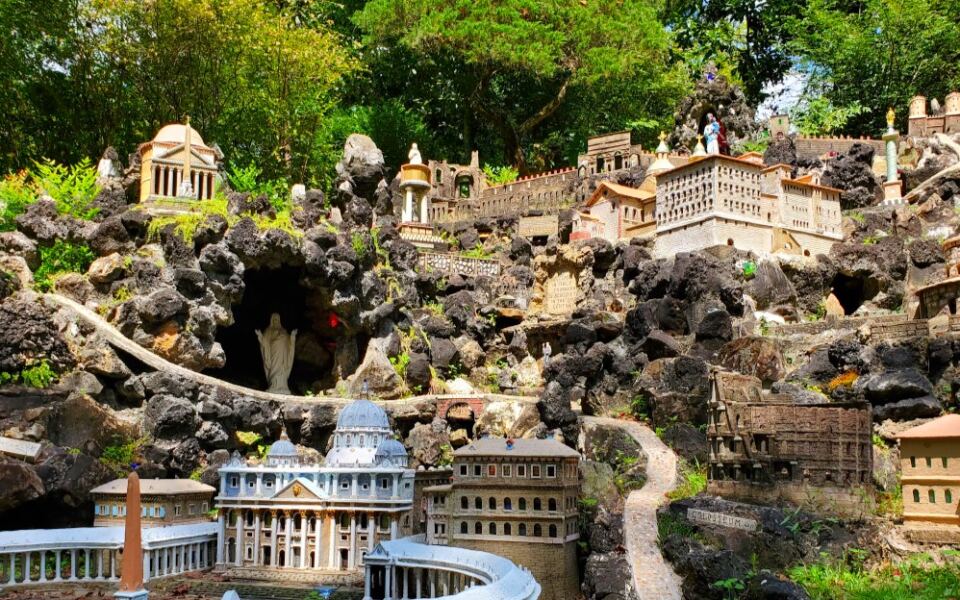
Most people leave behind a few photographs or a well-worn armchair. A rare few leave behind entire kingdoms built from broken plates, concrete, scrap metal, and sheer stubbornness.
Across backyards, hillsides, forests, and ordinary homes, determined creators have spent decades covering walls with mosaics, carving armies from stone, and turning discarded objects into environments unlike anything around them. Some of these places took 40 years to build.
Some were created in secret. Some were nearly destroyed before the world realized what it had almost lost.
What they all share is an almost impossible level of personal commitment, the kind where a single human being decides, quietly and without much fanfare, to construct a world from scratch. The 14 places on this list are proof that a lifetime of focused creativity can produce something no architect or city planner could ever blueprint.
Read on, because every single one of these is worth knowing about.
1. Owl House, Nieu-Bethesda, South Africa
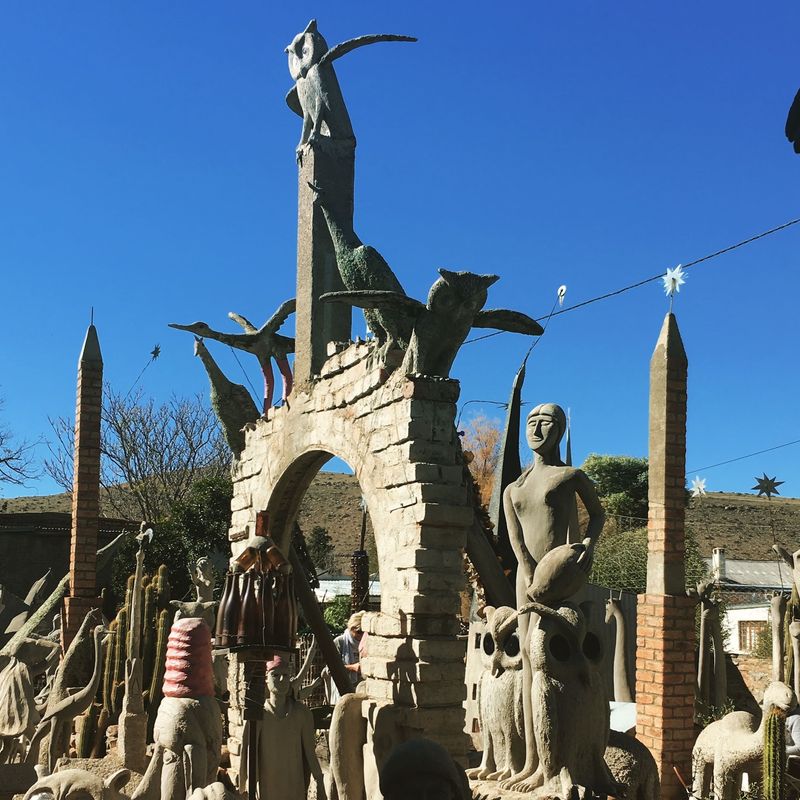
A small, remote village in the Karoo desert of South Africa is home to one of the most personal handmade environments ever created, built by a woman who rarely left her property.
Helen Martins began transforming her modest home in Nieu-Bethesda from around the mid-20th century onward, working with local craftsman Koos Malgas, who learned to shape cement and wire specifically to help her realize her vision.
The interior walls and ceilings are covered in crushed glass and mirrors. Outside in the Camel Yard, hundreds of concrete sculptures of owls, camels, mermaids, and human figures populate the space.
Most of the figures face eastward, reflecting Martins’ symbolic search for light.
After her passing in 1976, the Friends of The Owl House Trust preserved the property as a museum. Guided tours are available, and an entrance fee applies.
2. Little Chapel, Les Vauxbelets, Guernsey
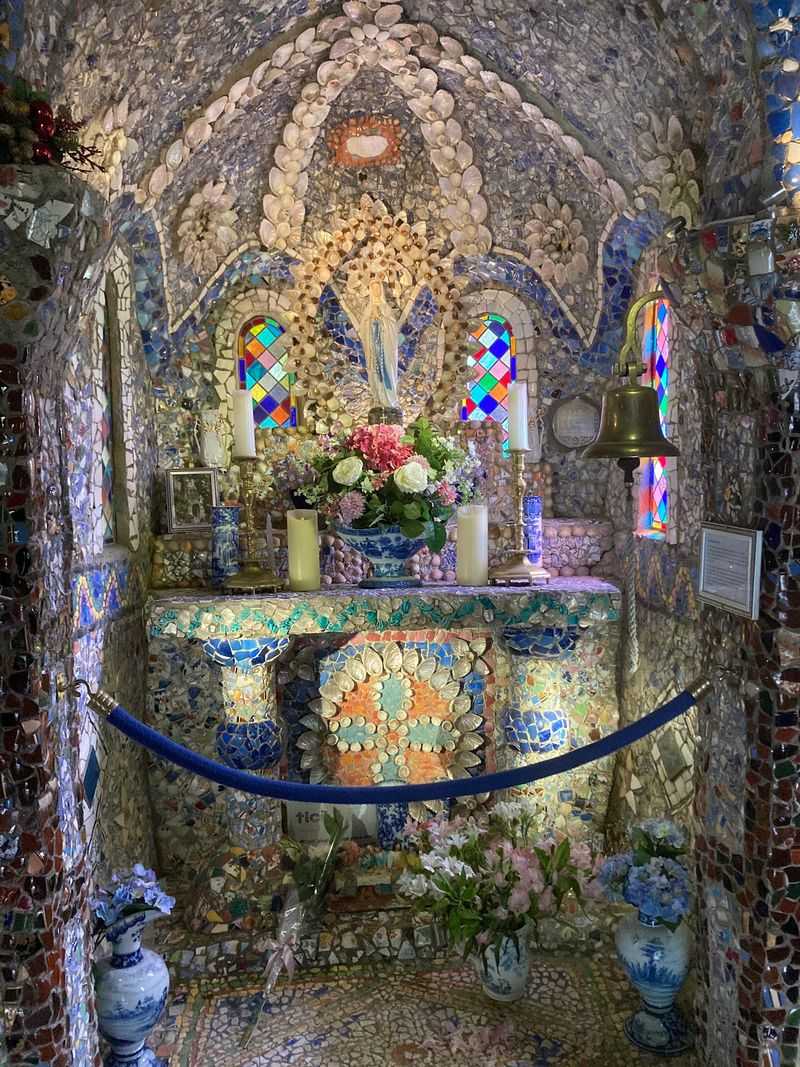
Brother Deodat did not get it right on the first try, or the second. His superiors demolished his first attempt for being too small, and a bishop’s visit ended the second version shortly after.
The chapel visitors see today in Les Vauxbelets Valley is the third iteration, begun in 1923 and worked on until Deodat’s health declined in 1939. It measures approximately 16 by 9 feet, making it one of the smallest churches in the world.
Every surface is covered in a mosaic of broken china, shells, and pebbles. The materials include fragments of plates, teacups, and saucers, many donated by island residents and visitors who wanted to contribute something permanent to the project.
The chapel has three interconnecting domes, each containing a small altar. Entry is generally free, donations are welcomed, and a gift shop is available nearby.
3. Ave Maria Grotto, Cullman, Alabama
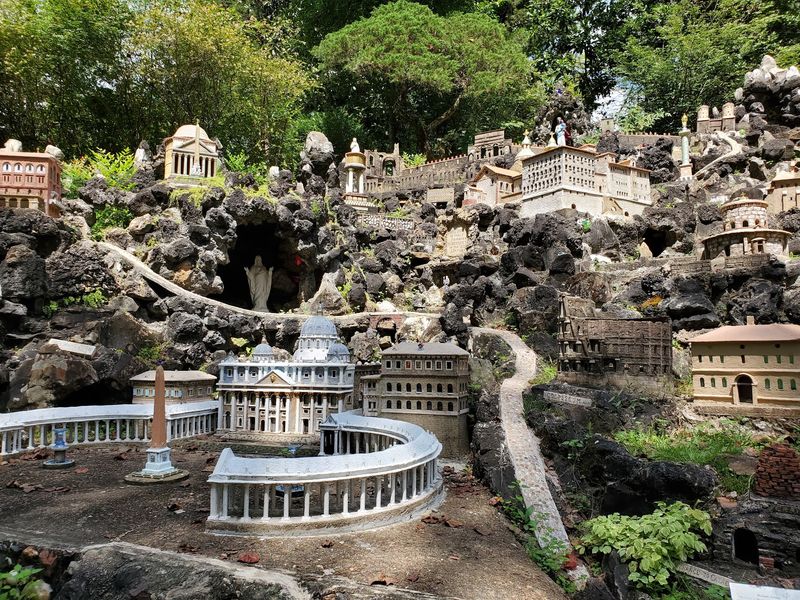
Brother Joseph Zoettl never visited Rome, Jerusalem, or Bethlehem, yet he built remarkably detailed miniature versions of landmarks from all three cities on a hillside in Alabama.
The Benedictine monk began his project in 1912, using concrete, stone, shells, broken glass, cold cream jars, old tires, marbles, and even crutches and bedpans as construction materials. He worked from photographs and postcards, recreating more than 125 structures including St. Peter’s Basilica, the Leaning Tower of Pisa, and various biblical scenes.
Zoettl continued working until his passing in 1961 at the age of 80, leaving behind a landscaped hillside with pathways guiding visitors through his handmade miniature world.
The Ave Maria Grotto at St. Bernard Abbey is open year-round with an admission fee. A gift shop and restrooms are on site, and the grounds are accessible for visitors with varying mobility.
4. Grotto of the Redemption, West Bend, Iowa
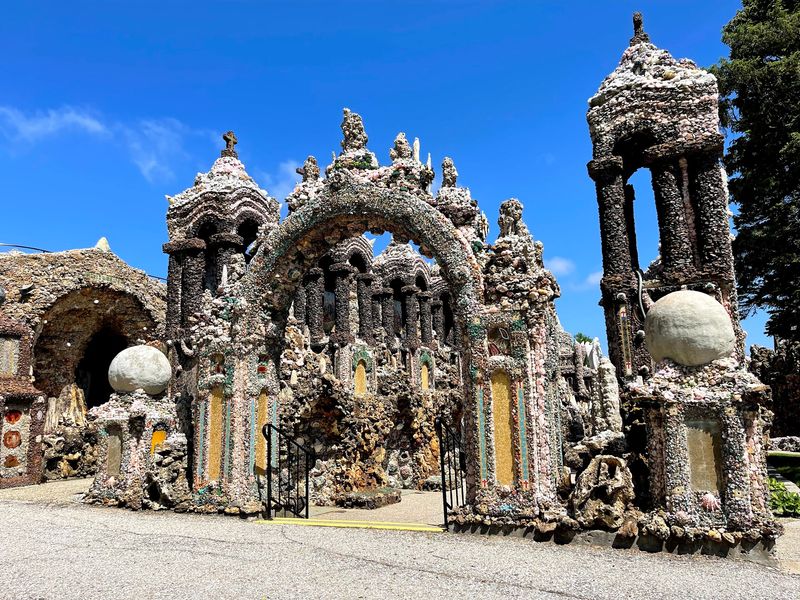
Father Paul Dobberstein made a promise during a serious illness, and he spent the next 42 years of his life keeping it, one carefully placed rock at a time.
Construction began in 1912 in West Bend, Iowa. Rather than using ordinary building stone, Dobberstein incorporated minerals, fossils, shells, crystals, petrified wood, and geological specimens collected during extensive travels, often transported in a Ford Model T.
The estimated value of the materials embedded in the Grotto exceeds four million dollars.
The complex contains nine distinct grottos, each depicting a different scene from the life of Christ, from the Nativity to the Resurrection. Arches, towers, and chambers form a dense, layered environment that rewards close inspection of individual rocks and specimens.
The Grotto of the Redemption is considered one of the largest man-made grottoes in the world. Admission is free, though donations are accepted, and a gift shop and museum are on site.
5. Petersen Rock Garden, Redmond, Oregon
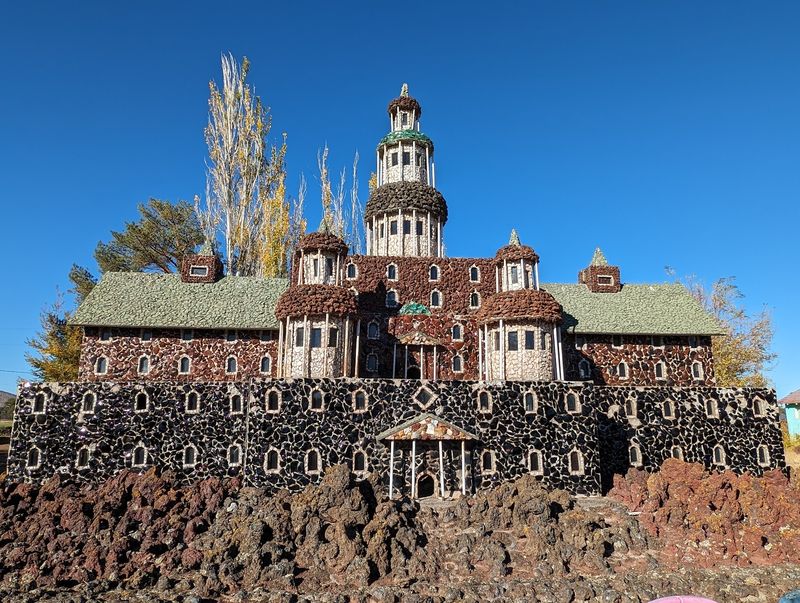
Rasmus Petersen arrived in Oregon from Denmark, bought a sheep ranch, and then spent nearly two decades turning it into something a sheep would find very confusing.
Beginning in 1935, Petersen constructed miniature castles, bridges, churches, towers, and ponds across his 4-acre property near Redmond. Materials came from his farm, nearby fields, and the surrounding Central Oregon landscape, including petrified wood, lava rock, geodes, shells, concrete, and pieces of glass.
The garden includes miniature reproductions of notable landmarks such as the Statue of Liberty and Smith Rock. Pathways guide visitors through its various sections, and the contrast between the small-scale architecture and the wide-open Central Oregon scenery gives the place a charmingly out-of-proportion quality.
Petersen worked on the garden until his passing in 1952. His family preserved the property, which is now a public park open daily from dawn to dusk.
Admission is free, and donations are accepted.
6. Hartman Rock Garden, Springfield, Ohio
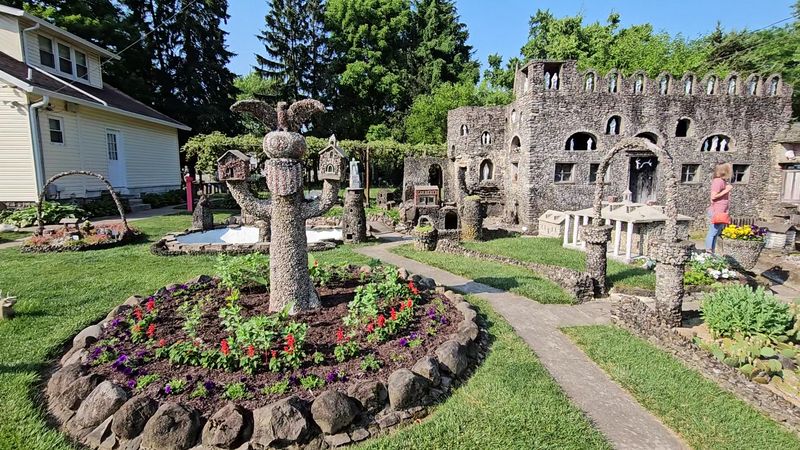
Ben Hartman lost his job during the Great Depression and responded the way most of us do not: by building a miniature civilization in his backyard.
Starting in 1932, Hartman used concrete, stone, metal, glass, and other found materials to construct over 250 individual structures at his Springfield, Ohio home. The garden includes castles, a Wedding Chapel tableau, a Last Supper scene, representations of George Washington and Abraham Lincoln, animals, and interpretations of famous landmarks.
The themes running through the work cover local history, American patriotism, and religious narratives, all compressed into what is, at its core, an ordinary residential lot. That contrast between the scale of the project and the modesty of the setting is part of what makes it so memorable.
After Hartman’s passing in 1944, the Kohler Foundation and the Friends of the Hartman Rock Garden preserved the site. Entry is free, and the garden is open from dawn to dusk, seven days a week.
7. Fred Smith’s Wisconsin Concrete Park, Phillips, Wisconsin
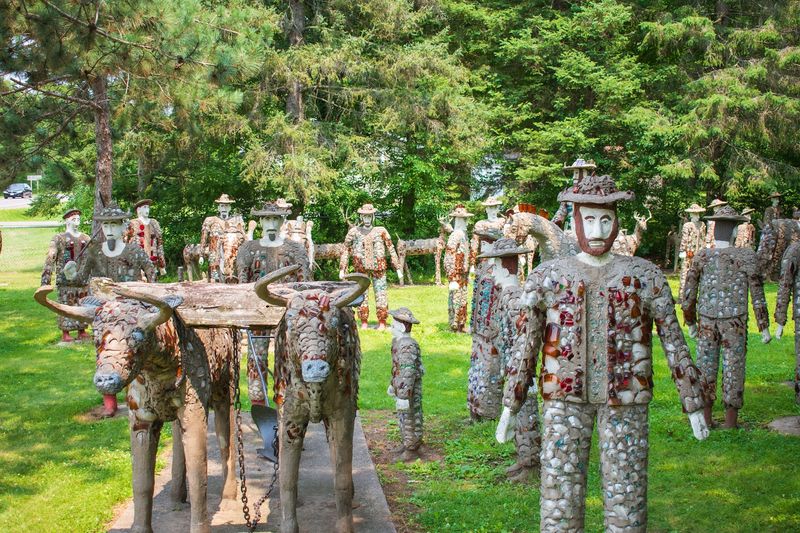
Fred Smith was 64 years old and freshly retired from lumberjack work when he decided he was not quite done yet, and spent the next 16 years proving it.
Beginning in 1948, Smith populated his roadside property in Phillips, Wisconsin with concrete figures built over armatures of wood and wire. The cast includes horses, deer, Paul Bunyan, local people, musicians, and various animals, many of them standing up to 10 feet tall.
Pieces of glass, broken mirrors, and stones embedded in the surfaces catch light from various angles.
Smith completed more than 200 sculptures before his passing in 1964. The Kohler Foundation stepped in during the 1970s and 1980s to stabilize and restore the park after weather and neglect took a toll.
Price County and the Friends of Fred Smith now manage the Wisconsin Concrete Park. The park is open year-round from dawn to dusk with no admission fee, and a visitor center provides background on Smith’s life and work.
8. Chauvin Sculpture Garden, Chauvin, Louisiana
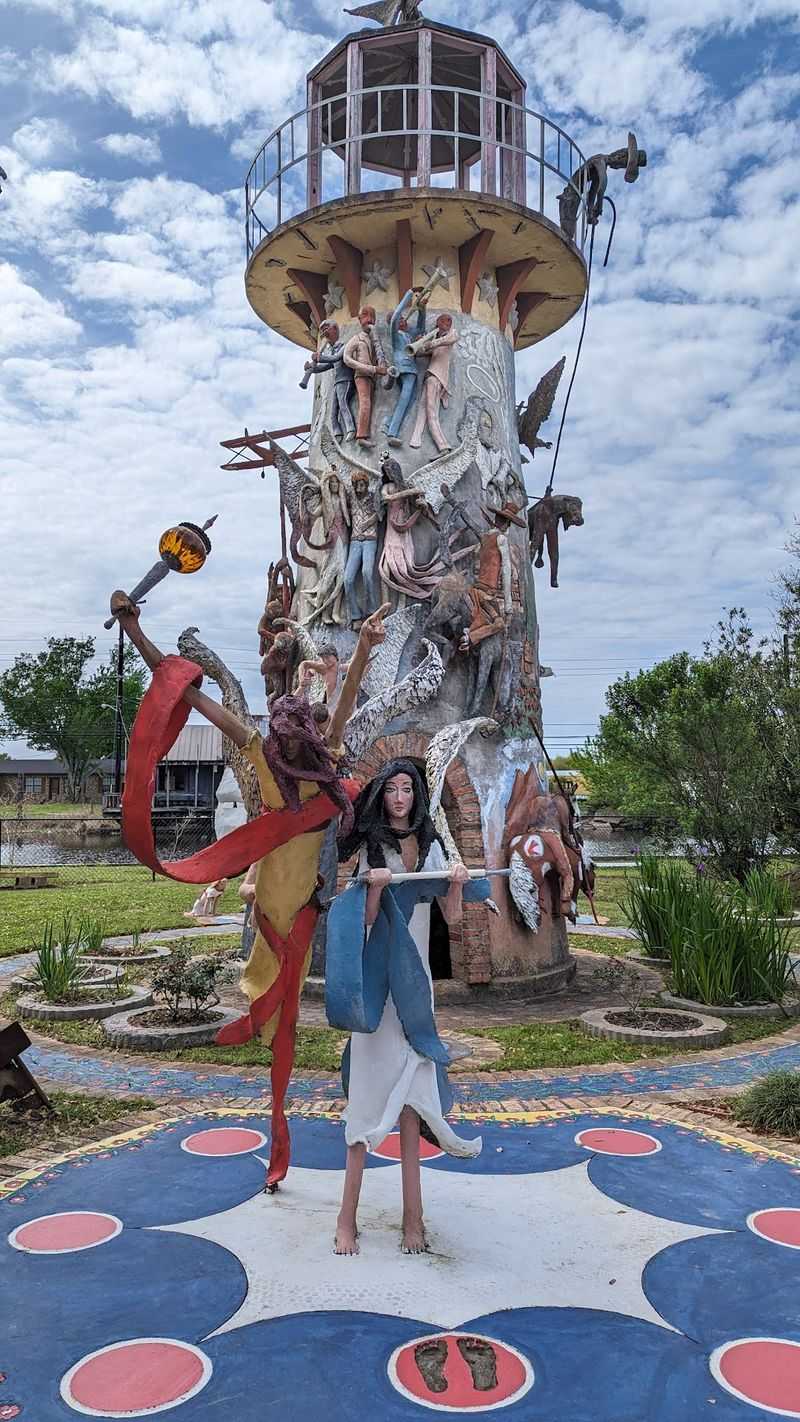
Kenny Hill chose a narrow strip of land beside a quiet Louisiana bayou and proceeded to fill it with an entire concrete congregation of angels, cowboys, soldiers, and himself.
A self-taught artist, Hill began transforming the property beside Bayou Petit Caillou in 1988. Over roughly 12 years, he built scores of concrete and rebar sculptures, incorporating personal messages and symbolic elements throughout.
At the center stands a towering brick structure known as The Lighthouse, topped by a winged horse and an angel.
Hill left the property in 2000, but the sculptures remained. Nicholls State University later acquired and preserved the site, establishing a visitor center and opening the garden to the public.
Monumental figures appear unexpectedly among trees and ordinary neighboring homes along the waterway.
The Chauvin Sculpture Garden is open during daylight hours with no admission fee. A self-guided tour map and an on-site interpretive center are available for visitors.
9. Luna Parc, Sandyston, New Jersey
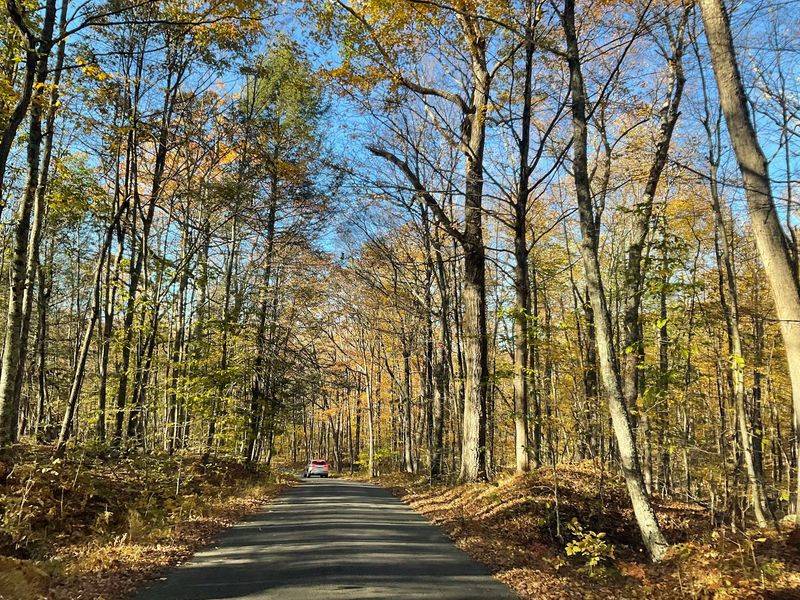
Most artists hang their work on walls. Ricky Boscarino decided to make the walls themselves the artwork, and then kept going until there was not a plain surface left in sight.
Luna Parc in Sandyston, New Jersey is Boscarino’s home and his ongoing creative project. Mosaic-covered walls, handmade towers, colorful tiles, ceramics, stained glass, and architectural fragments cover nearly every visible surface, inside and out.
Found objects and recycled materials are integrated throughout the property’s fantastical structures.
Unlike most art environments that become museums after their creators finish working, Luna Parc is still actively evolving. Boscarino continues to add to it, making the property a living artwork rather than a preserved relic.
Public access is limited to designated open-house events or by appointment, so a visit has the feel of being invited into someone’s private creative universe. Upcoming dates are typically posted on the Luna Parc website, and an admission fee usually applies.
10. Vollis Simpson Whirligig Park, Wilson, North Carolina
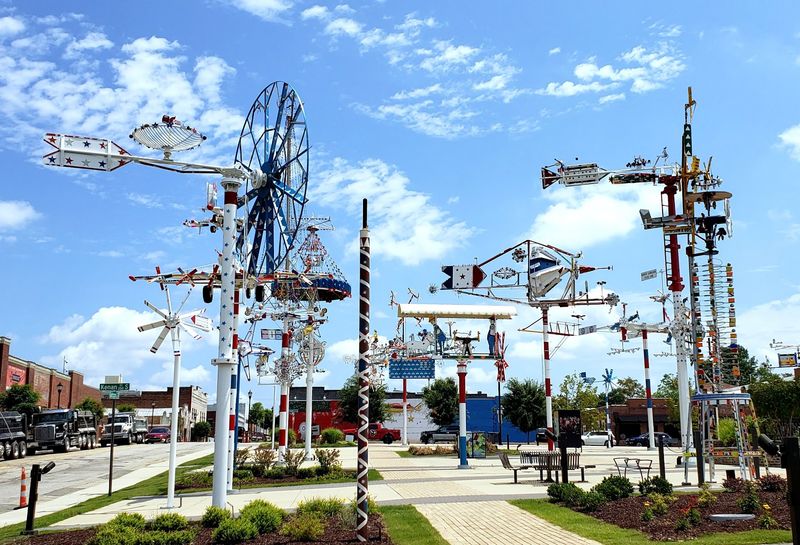
Vollis Simpson built machines that do absolutely nothing useful, and that is precisely what makes them extraordinary.
A retired machinery repairman and farmer, Simpson began constructing large-scale kinetic sculptures in the 1980s on his property in Lucama, North Carolina. He built them from salvaged machinery parts, road signs, reflectors, bicycles, metal scraps, and other industrial materials.
Each whirligig incorporates wheels, fans, and paddles that spring into motion when wind arrives. Some of his creations reach heights of 50 feet.
Simpson created more than 30 large-scale pieces. After his health declined, a restoration project relocated his work to a dedicated park in downtown Wilson, which opened in 2013.
Seeing dozens of the sculptures moving together is a completely different experience from viewing a single piece, and the park occasionally holds special night-lighting events where reflective elements transform the machines further.
The park is open daily year-round with no admission fee, and includes pathways, seating, and interpretive signage.
11. Musée Robert Tatin, Cossé-le-Vivien, France
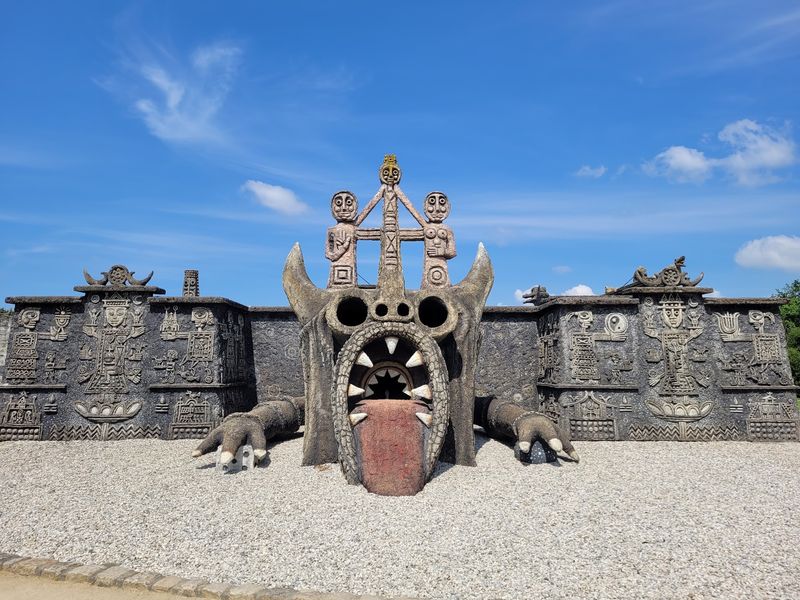
Robert Tatin returned to his hometown in the Mayenne region of France in the early 1960s and immediately set about making it much stranger than he had left it.
Over two decades, Tatin transformed his home and surrounding property into an enormous personal artwork drawing on cultural traditions he had encountered during travels through South America and Asia. The layout includes a Dragon Gateway at the entrance, an Avenue of Giants lined with imposing sculptures, and the House of Fields where Tatin lived and worked.
An alchemy garden and a structure called the House of the Devil are also part of the complex.
Materials throughout include concrete, stone, and metal, combined with vibrantly painted surfaces. The site functions as a three-dimensional autobiography rather than a conventional museum, reflecting Tatin’s life philosophy through its spatial arrangement.
Operating hours vary by season, an admission fee applies, and guided tours are available to help visitors navigate the layered symbolism built into every section.
12. Giardino dei Tarocchi, Capalbio, Tuscany, Italy
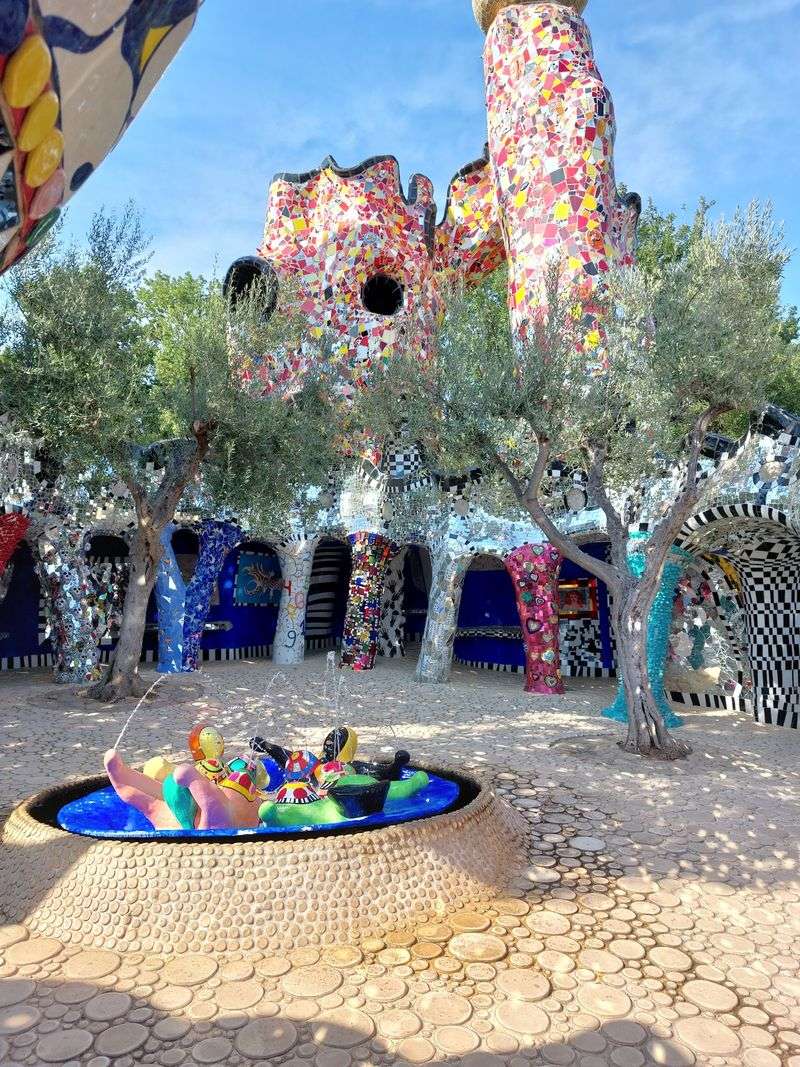
Niki de Saint Phalle did not just build a sculpture garden in Tuscany. She moved into one of her own sculptures while constructing it, living inside the Empress, a sphinx-like mosaic structure, for years during the project.
Saint Phalle began work on the Giardino dei Tarocchi in 1979, drawing inspiration from the 22 Major Arcana cards of the Tarot. She spent roughly two decades on the project before officially opening it to the public in 1998.
The garden sits on Garavicchio hill and offers views of the Tuscan coastline. Visitors can walk around, beneath, and sometimes inside the monumental figures, which include the Magician, depicted as a green face, and Justice, shown as a woman tied to a scale.
The garden is typically open from April through October, and advance booking is recommended during busy months.
13. Las Pozas de Edward James, Xilitla, San Luis Potosí, Mexico
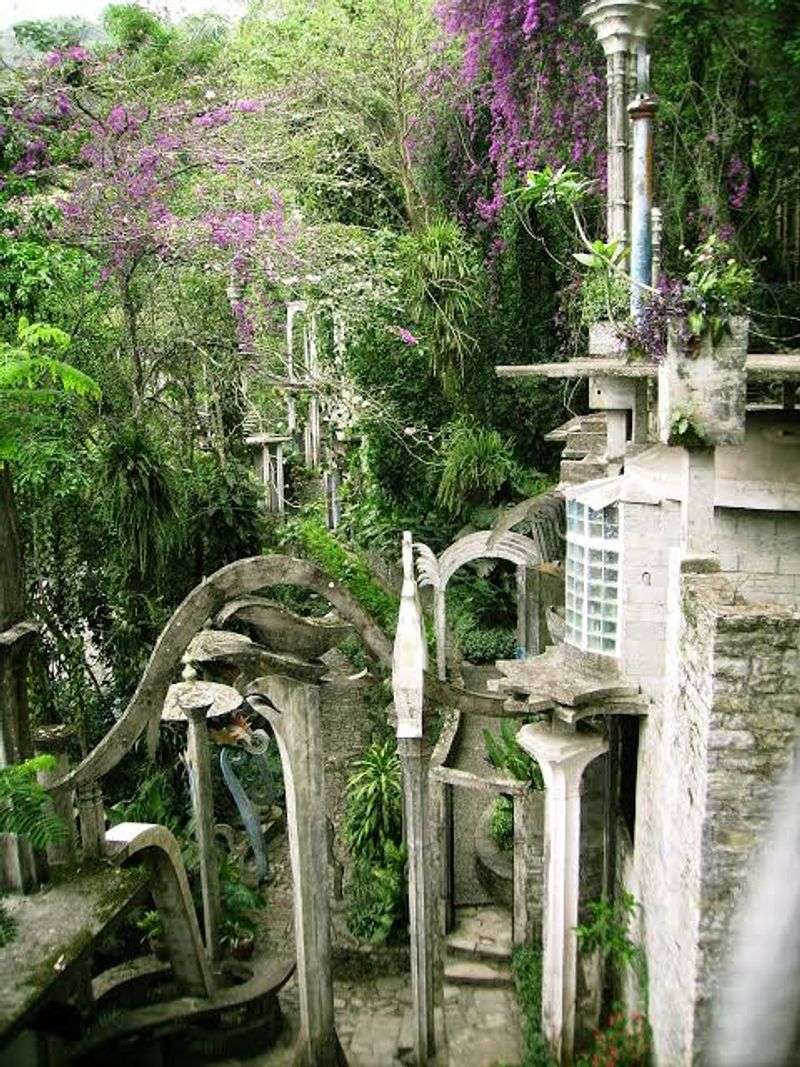
Somewhere in the mountains of central Mexico, a British eccentric built staircases that lead nowhere, concrete flowers taller than houses, and a structure with a roof shaped like a whale, and called the whole thing a personal utopia.
Edward James, a prominent supporter of the Surrealist movement, began developing Las Pozas in the 1960s alongside local builders, particularly foreman Plutarco Gastelum, whose construction skills were essential to realizing James’s vision. The site covers over 80 acres and contains more than 30 concrete structures integrated with waterfalls and tropical vegetation.
Specific structures include the Staircase to Heaven, the Temple of the Ducks, and the House with a Roof Like a Whale. Construction continued for decades until James’s passing in 1984.
Las Pozas is now managed by Fondo Xilitla and is open to the public with an entrance fee. Guided tours are available, and visitors are advised to wear sturdy shoes given the uneven terrain throughout the site.
14. Nek Chand’s Rock Garden, Chandigarh, India
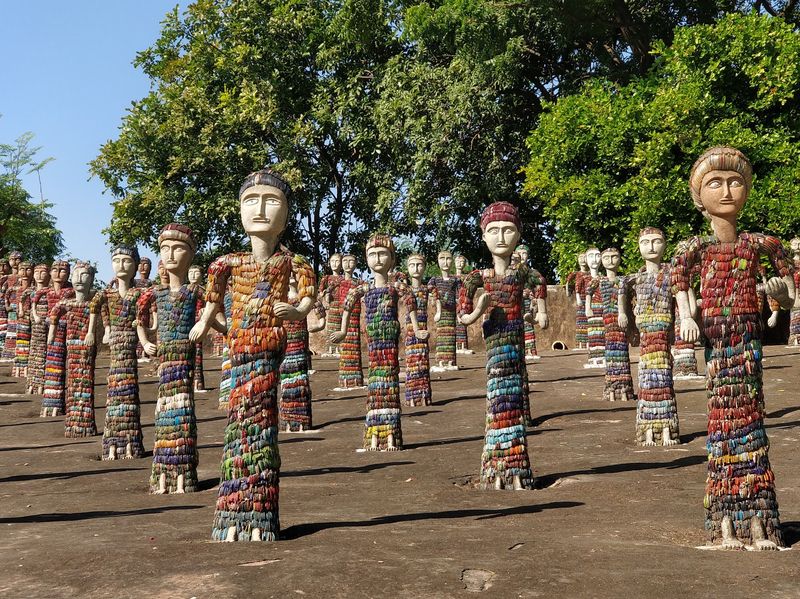
For 18 years, a government road inspector quietly built a secret kingdom in a forbidden forest clearing near Sukhna Lake, and nobody knew a thing about it.
Nek Chand Saini began his hidden project in 1957, collecting broken ceramics, bangles, electrical waste, tiles, glass, and scrap metal from demolition sites across Chandigarh.
When authorities finally discovered the unauthorized garden in 1975, public support was so strong that instead of ordering its removal, the city gave Chand a salary and 50 workers to keep going.
The Rock Garden was formally opened to the public on January 24, 1976, and now spans roughly 40 acres. It is organized into three phases, featuring interconnected courtyards, winding walkways, an amphitheater, and thousands of sculptures of birds, animals, and humans.
Some figures in Phase II were even decorated with human hair collected from local barber shops.
Share this story