Africa is home to some of the oldest and most fascinating history on the planet. From ancient fortresses built along coastlines to grand palaces decorated with stunning tilework, the continent holds stories that stretch back thousands of years.
Whether you are a history enthusiast, a curious traveler, or simply someone who loves discovering new places, African cities offer a remarkable journey through time. This list covers 12 cities across the continent, each one packed with landmarks that have shaped cultures, empires, and entire civilizations.
Get ready to see Africa in a whole new way.
Cairo Citadel, Cairo, Egypt
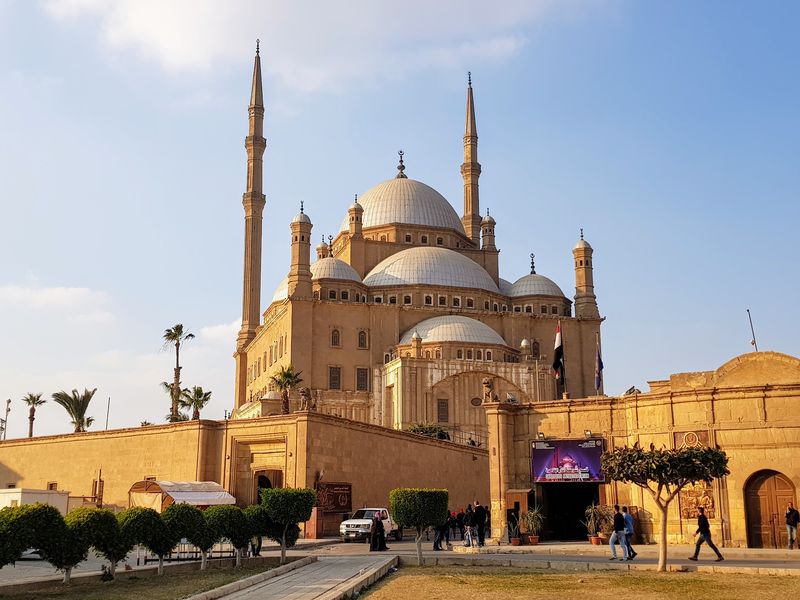
Perched high on Mokattam Hill, the Cairo Citadel has watched over Egypt’s capital for nearly 900 years. Saladin, the famous Muslim military leader, ordered its construction in 1176 to defend the city against Crusader forces.
The massive stone walls and towers still stand strong today, making it one of the most impressive medieval fortifications in the entire Middle East.
Inside the Citadel complex, visitors will find several mosques, including the stunning Mohamed Ali Mosque, which features a large central dome and twin minarets that are visible from many parts of Cairo. The mosque’s interior is decorated with alabaster stone, giving it a clean, elegant appearance that draws thousands of visitors each week.
The Citadel also houses several museums covering Egyptian military history and police history. Views from the hilltop stretch across the city and toward the famous Giza pyramids on clear days.
Admission fees are reasonable and guided tours are widely available.
Qaitbay Citadel, Alexandria, Egypt
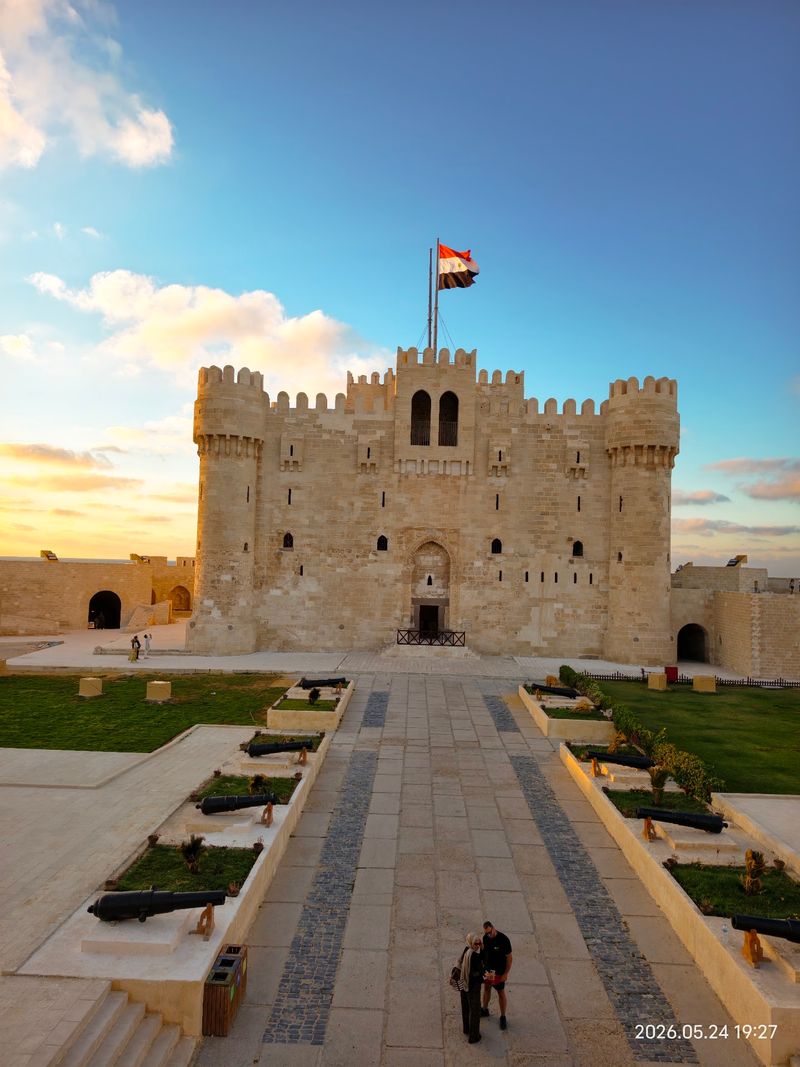
Built directly on the site where the ancient Lighthouse of Alexandria once stood, the Qaitbay Citadel carries a history that stretches back to one of the Seven Wonders of the Ancient World. Sultan Qaitbay ordered the fortress constructed in 1477, and builders reportedly used stones from the collapsed lighthouse to form parts of the structure.
That layered history makes every stone here feel like a piece of a much larger story.
The citadel sits right at the edge of the Mediterranean Sea, giving it a dramatic setting that few historic forts anywhere in the world can match. Waves crash against the base of the walls, and the sea breeze keeps the site comfortable even on warm afternoons.
Inside, a small museum displays artifacts recovered from the surrounding waters, including ancient anchors and ceramics. The surrounding harbor area is lively with fishing boats and cafes, making this stop easy to pair with an afternoon in Alexandria.
Bahia Palace, Marrakech, Morocco
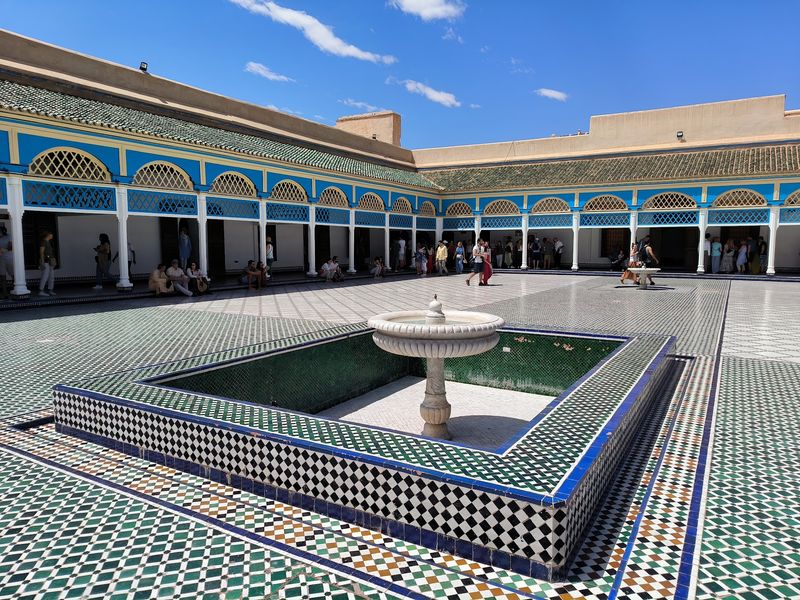
The name Bahia means “brilliance” in Arabic, and this palace absolutely earns that title. Built in the late 19th century by Si Moussa, a former enslaved person who rose to become grand vizier of Morocco, the Bahia Palace is a story of ambition written in marble, carved wood, and hand-painted tiles.
The palace took years to complete and covers more than eight hectares of land in the heart of Marrakech’s old medina.
Walking through its rooms feels like moving through a living museum of Moroccan craftsmanship. Ceilings made from intricately carved cedarwood sit above floors covered in colorful zellij tilework.
Courtyards are filled with orange and lemon trees, and sunlight filters through ornate stucco screens along the walls.
The palace was home to the grand vizier’s wives and concubines, and the layout reflects the social structure of the era. Guided tours help explain the history behind each room.
Entry fees are low and the palace is open most days of the week.
Bou Inania Madrasa, Fez, Morocco
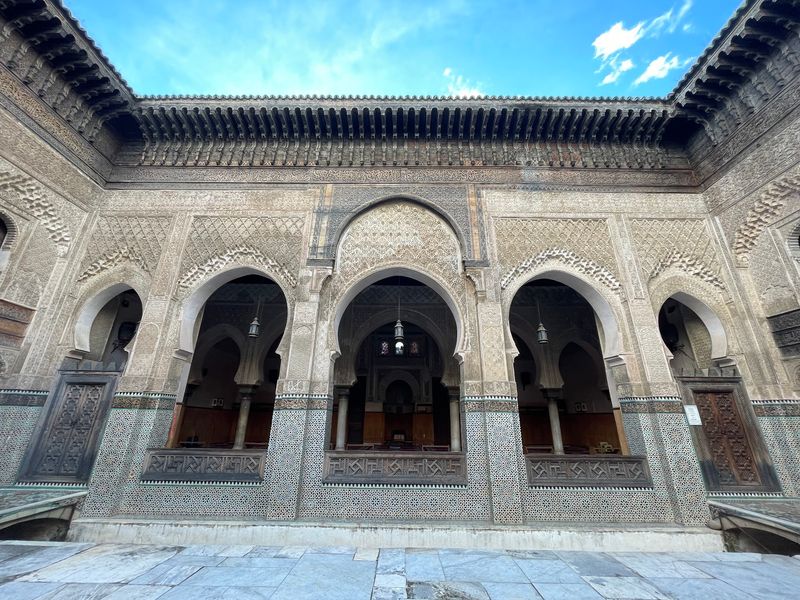
Fez is considered one of the best-preserved medieval cities in the world, and the Bou Inania Madrasa sits right at its center. Built between 1350 and 1357 during the Marinid dynasty, this religious school and mosque complex is widely considered the finest example of Marinid architecture still standing in Morocco.
It is one of the few religious sites in Fez’s medina that welcomes non-Muslim visitors, which makes it an especially valuable stop on any itinerary.
Every surface inside seems to compete for attention. The lower walls are covered in geometric zellij tilework.
Above that, carved stucco panels feature intricate floral and geometric patterns. Higher still, carved cedarwood screens frame the upper galleries where students once studied Islamic law and theology.
A central courtyard with a marble fountain anchors the space, and the sound of water adds a calm contrast to the busy streets just outside. The madrasa is open daily, though hours can shift during religious holidays, so checking ahead is a good idea.
Hassan Tower, Rabat, Morocco
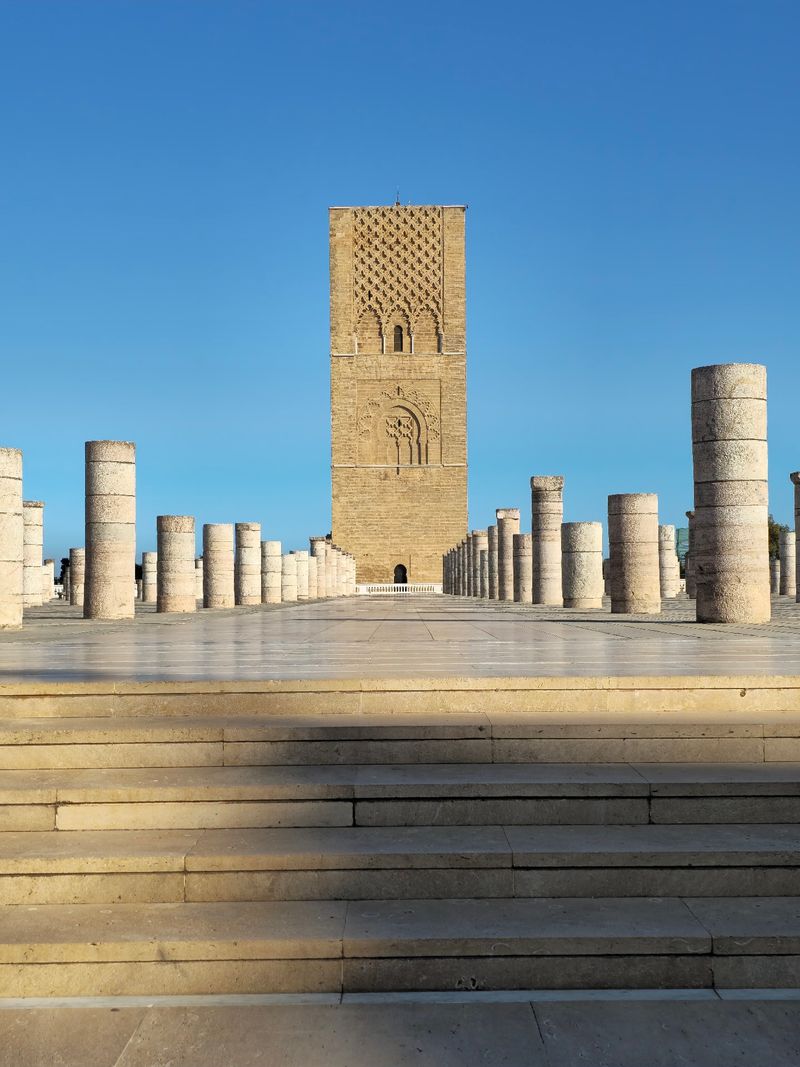
What makes Hassan Tower so compelling is not just what it is, but what it was supposed to be. Construction began in 1195 under the Almohad Sultan Yacoub al-Mansour, with plans to build the largest mosque in the world.
The sultan passed away in 1199, and construction stopped immediately. The minaret, now known as Hassan Tower, was left standing at about 44 meters tall, roughly half its intended height.
Surrounding the unfinished tower are hundreds of stone columns arranged in neat rows across a wide platform. These columns are all that remain of what would have been the mosque’s prayer hall.
The combination of the tall tower and the silent columns creates a scene that feels both grand and quietly haunting.
Across from the tower stands the Mausoleum of Mohammed V, a beautifully decorated royal tomb that visitors are welcome to view. The entire site is free to enter, well maintained, and located in Rabat’s city center, making it an easy and worthwhile stop.
Bardo National Museum, Tunis, Tunisia
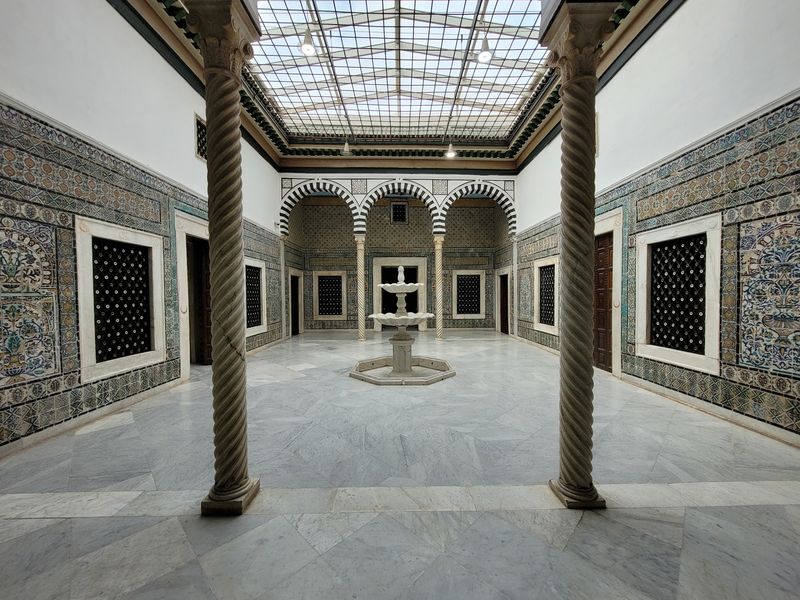
If Roman mosaics are your thing, the Bardo National Museum in Tunis will genuinely surprise you. Housed inside a former 13th-century Hafsid palace that was later expanded by Ottoman rulers, the museum holds one of the largest and most important collections of Roman mosaics in the entire world.
Many of these mosaics were recovered from ancient sites across Tunisia, including the famous ruins of Carthage.
The building itself is worth visiting on its own merits. Ornate painted ceilings, carved plasterwork, and decorative tilework from different eras cover the palace’s halls, creating a layered visual experience that reflects centuries of Tunisian history under different rulers.
Beyond the mosaics, the museum displays prehistoric artifacts, ancient Greek ceramics, early Christian objects, and Islamic art spanning several centuries. The collection is vast and well organized, with labels in both Arabic and French.
English-language audio guides are available for rent. The museum is located just outside the medina of Tunis and is accessible by public transport.
Ribat of Sousse, Sousse, Tunisia
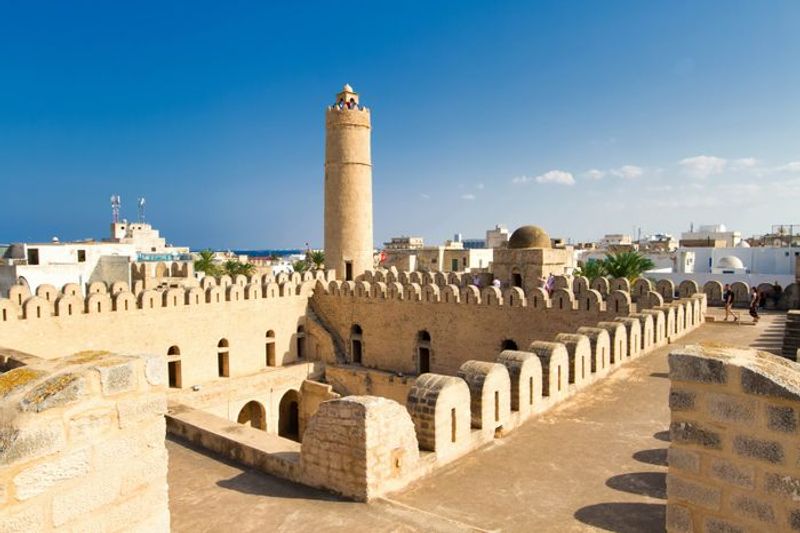
The Ribat of Sousse is one of the oldest surviving Islamic military monuments in North Africa, and it has been standing since around 821 CE. A ribat was a fortified monastery used by Muslim warriors who combined religious devotion with coastal defense.
This one was built to protect the city of Sousse from sea-based attacks, and its thick walls and tall watchtower made it one of the most effective defensive structures along the North African coast.
Climbing to the top of the watchtower rewards visitors with a panoramic view over Sousse’s medina, the surrounding city, and the Mediterranean Sea stretching to the horizon. The view alone is worth the modest admission fee.
The ribat is located inside Sousse’s UNESCO-listed medina, which means a visit here can easily be combined with a walk through the old city’s markets and the nearby Great Mosque of Sousse. The site is well preserved and open to visitors most days throughout the year.
Kasbah of Algiers, Algiers, Algeria
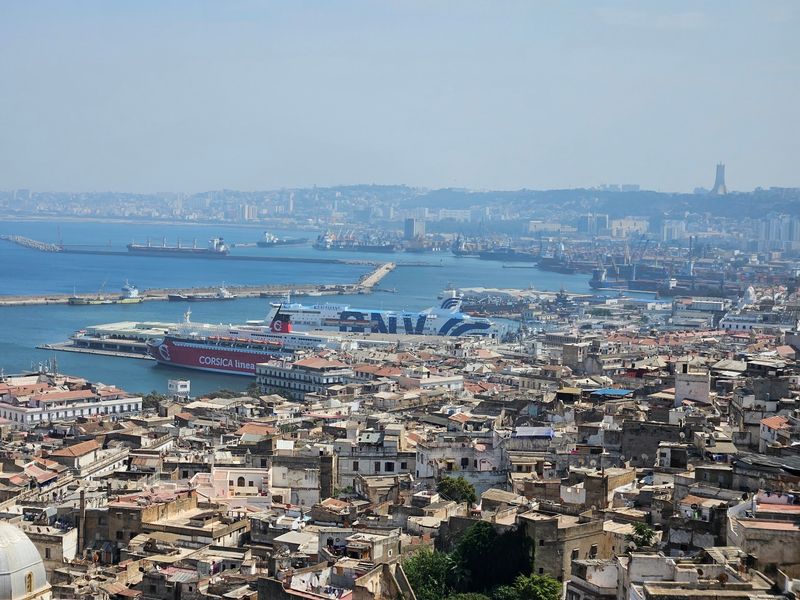
Recognized as a UNESCO World Heritage Site since 1992, the Kasbah of Algiers is one of the most historically layered urban neighborhoods in North Africa. Built on a steep hillside overlooking the Bay of Algiers, the kasbah is a dense maze of narrow alleys, whitewashed houses, Ottoman palaces, mosques, and ancient hammams.
Some of its structures date back to the 16th century, when the Ottoman Empire made Algiers one of its most important Mediterranean ports.
The neighborhood played a central role in Algeria’s fight for independence during the 20th century, and that history is woven into the identity of the place. Walking through the kasbah, you pass through layers of time with each turn.
Several restored Ottoman palaces within the kasbah now function as museums, including the Dar Aziza and the Dar Khdaoudj el Amia, which display traditional Algerian costumes, jewelry, and decorative arts. The kasbah is a living neighborhood as well as a historic site, so respectful and curious visitors are always welcome.
Castle of Good Hope, Cape Town, South Africa
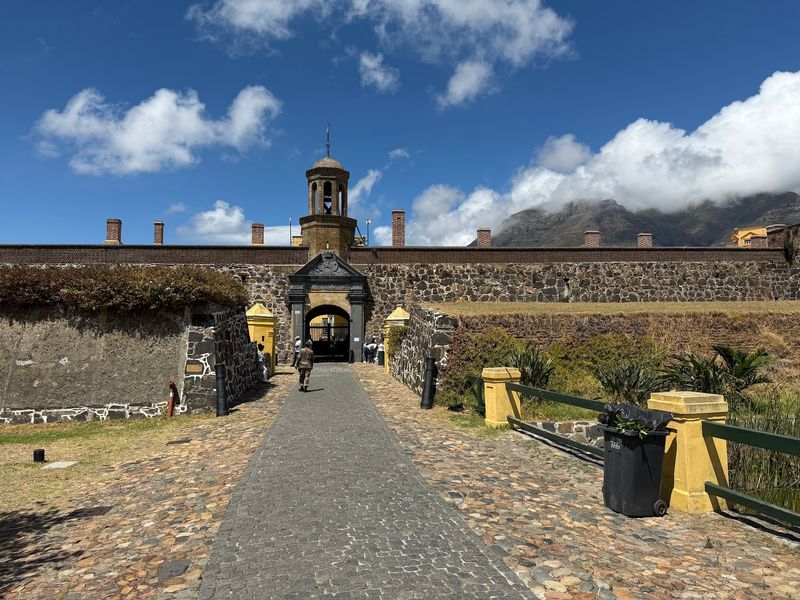
The Castle of Good Hope holds the distinction of being the oldest surviving colonial building in South Africa. The Dutch East India Company began construction in 1666, and the fortress was completed in 1679.
Built in a distinctive five-pointed star shape, the design was a standard European military architecture style of the era, intended to eliminate blind spots and give defenders clear sightlines in every direction.
For much of its history, the castle served as the headquarters of the Dutch and later British colonial administration at the Cape. Today it functions as a museum and heritage site managed by the South African National Defence Force.
The William Fehr Collection, housed inside the castle, displays a significant collection of paintings and decorative arts depicting early Cape colonial history.
The castle sits in central Cape Town, close to the Grand Parade and the Company’s Garden, making it an easy stop to combine with other city landmarks. Guided tours run regularly and are genuinely informative for visitors of all ages.
Cape Coast Castle, Cape Coast, Ghana
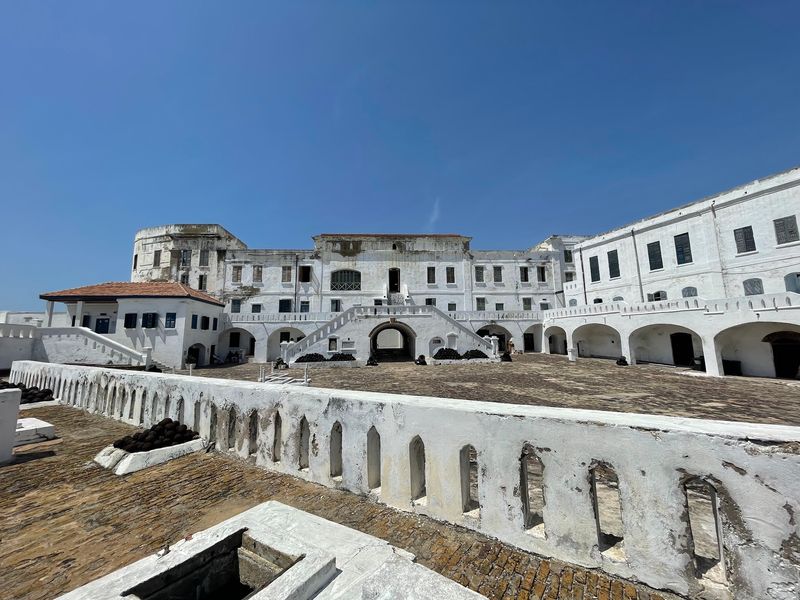
Cape Coast Castle is one of the most significant and sobering historic sites on the African continent. Built by Swedish traders in the 1650s and later controlled by the British, the castle served as a major hub in the transatlantic slave trade for over 200 years.
Millions of enslaved Africans passed through its underground dungeons before being loaded onto ships and taken across the Atlantic. The “Door of No Return” at the castle’s edge has become a powerful symbol recognized around the world.
Today, the castle is a UNESCO World Heritage Site and a museum that documents both the history of the slave trade and the broader story of Ghana’s colonial era. The dungeons are preserved and open for guided tours, which are led by knowledgeable local guides who explain the history in careful and respectful detail.
Visiting Cape Coast Castle is a heavy but important experience. Many visitors from the African diaspora travel specifically to this site as part of a personal journey of connection and remembrance.
The museum’s exhibits are well organized and worth taking time to fully explore.
Fort Jesus, Mombasa, Kenya
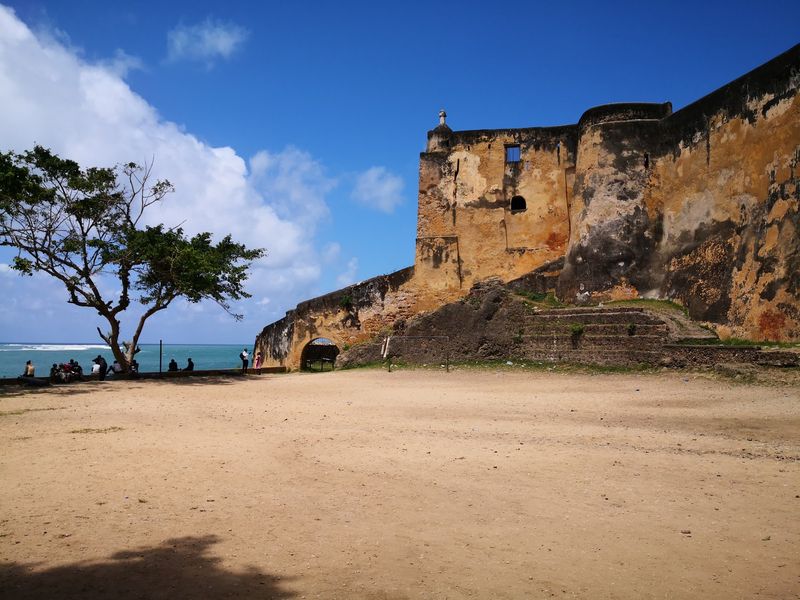
Fort Jesus was built by the Portuguese in 1593 to protect their trading route along the East African coast, and its shape was designed in the form of a human figure, a rare and deliberate architectural choice. The fort sits on a coral ridge overlooking the Old Port of Mombasa, giving it a commanding view of the sea that made it both a strategic military asset and a symbol of colonial power in the region.
Over the centuries, Fort Jesus changed hands multiple times between the Portuguese, Omani Arabs, and the British, and each transition brought new conflict and new layers of history to the site. The fort’s walls still show damage from past sieges, and those marks feel like a physical record of everything the structure has survived.
Declared a UNESCO World Heritage Site in 2011, the fort now operates as a museum featuring artifacts from the Portuguese period, Omani occupation, and earlier Swahili coastal civilization. The collection includes ceramics, coins, and navigational instruments.
The site is open daily and located within easy reach of Mombasa’s Old Town.
Kigali Genocide Memorial, Kigali, Rwanda
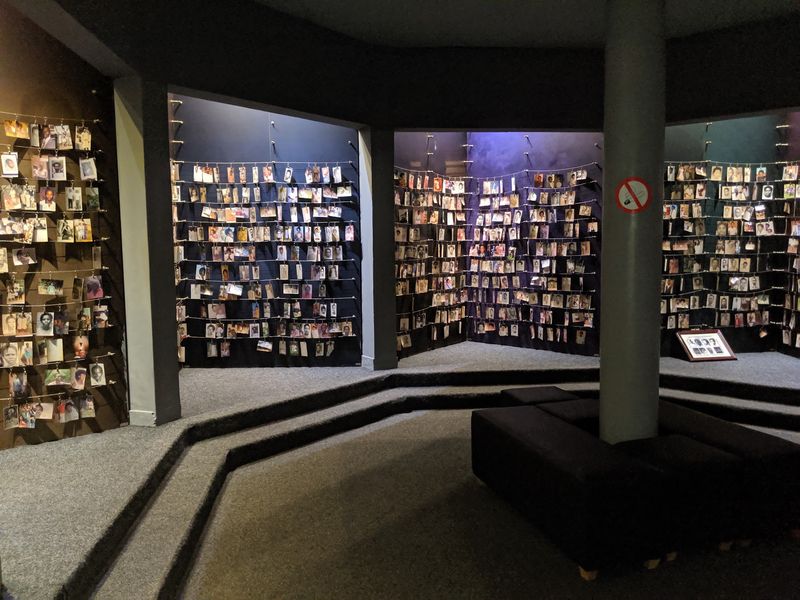
The Kigali Genocide Memorial is unlike any other site on this list, and it deserves a place here precisely because of that difference. Opened in 2004, the memorial stands on a site where more than 250,000 people are buried, making it the largest burial site related to the 1994 Rwandan genocide.
It serves simultaneously as a place of mourning, a center of education, and a symbol of Rwanda’s determination to remember, rebuild, and move forward.
The memorial’s permanent exhibition walks visitors through the history leading up to the genocide, the events of 1994, and the long process of recovery and reconciliation that followed. The exhibits are carefully designed to be informative without being gratuitously graphic, and they are appropriate for older students and adult visitors.
A children’s memorial section pays tribute specifically to young lives lost, with photographs and personal details that make the history deeply personal. The memorial gardens surrounding the site are quiet and well maintained, offering a space for reflection.
Entry is free, and the memorial is open Tuesday through Sunday.
Share this story