Bigger armies usually win. That simple rule shaped how medieval kings planned their wars, raised taxes, and hired soldiers for centuries.
Yet between the 1170s and the 1410s, smaller forces kept breaking that rule in surprising ways. Some used a narrow bridge or a muddy field.
Others relied on longbows, ditches, careful timing, or a leader who refused to back down. The results reached far past the battlefield.
A few of these clashes helped create whole countries, while others pushed a king toward signing Magna Carta or sent a monarch home in borrowed clothes. Numbers on paper meant very little once the ground, the weather, and the plan came into play.
In the pages ahead, you will travel from the Holy Land to the Scottish hills, from Swiss mountain paths to the plains of France and Portugal. Each stop explains who fought, how the smaller side pulled off its win, and what changed afterward.
You will also see how ideas from one battle traveled to the next, turning old habits of warfare upside down. By the end, you will understand why medieval generals learned to fear a well-chosen hill more than a long list of enemy soldiers.
1. Battle of Montgisard, 1177
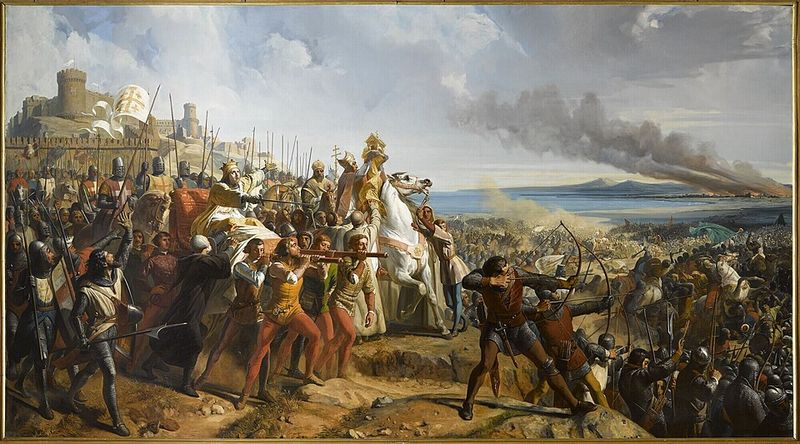
Most 16-year-olds worry about school. King Baldwin IV of Jerusalem worried about Saladin, and he did it while living with leprosy.
In November 1177, Saladin marched north from Egypt with an army that modern historians place at roughly 12,000 to 20,000 men. Baldwin had only about 3,000 to 4,500 soldiers, including around 375 knights and 80 Templars.
Saladin first trapped the young king inside the coastal town of Ascalon. Thinking the threat was over, he let his troops spread out to raid the countryside.
That was a big mistake. Baldwin slipped out and launched a surprise attack near Ramla on November 25, and his heavy cavalry charge broke Saladin’s scattered army.
Saladin escaped, reportedly on a racing camel. Only part of his force made it back to Cairo.
The win protected the Kingdom of Jerusalem for about a decade. Baldwin even founded a monastery on the site honoring St. Catherine.
Saladin bounced back and captured Jerusalem in 1187. Still, Montgisard proved that courage can outrank both age and illness.
2. Battle of Stirling Bridge, 1297
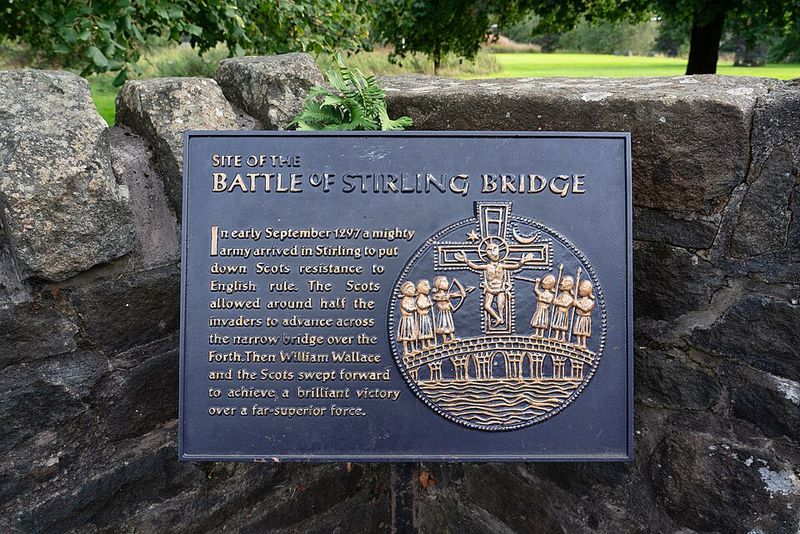
A bridge only wide enough for two or three riders side by side turned out to be the most important piece of real estate in Scotland.
On September 11, 1297, William Wallace and Andrew Moray faced an English army led by John de Warenne, Earl of Surrey. The English had roughly 8,000 to 12,000 men, while the Scots had about 5,000 to 6,500, mostly spearmen.
The Scottish leaders waited patiently on the high ground. They let part of the English army cross the narrow wooden bridge over the River Forth.
Then they charged and blocked the crossing. The English troops on the north bank were cut off from help.
The win pushed English control out of much of Scotland for a time. Wallace was knighted and named Guardian of Scotland.
Moray was badly wounded and did not recover. The English beat Wallace at Falkirk a year later.
Even so, Stirling Bridge showed that organized resistance could work. Today the National Wallace Monument stands nearby, and the real story is richer than the movie Braveheart.
3. Battle of Loudoun Hill, 1307
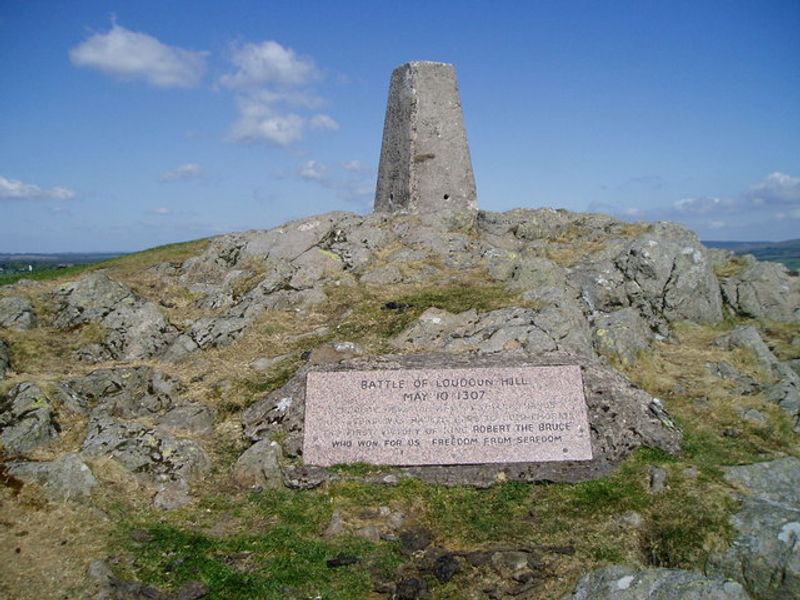
Some comeback stories start with a shovel. Robert the Bruce’s began with three ditches.
Bruce was crowned King of Scots in 1306, but things went badly fast. He lost at Methven to Aymer de Valence and spent months hiding like an outlaw.
By May 10, 1307, he was ready to try again. Traditional accounts give him about 600 men against roughly 3,000 under the same Valence.
Bruce picked his spot carefully near Loudoun Hill. Soggy marsh lined both sides of a narrow old Roman road, so his men dug three ditches across it.
The English riders were forced onto a slim front. Scottish spearmen in tight groups called schiltrons stopped the charge cold.
Valence retreated to Bothwell Castle. It was Bruce’s first big win as king, and supporters began joining his cause.
Timing helped too. King Edward I of England died just weeks later, giving Bruce breathing room.
Seven years on, the lessons from this hillside would pay off in a much bigger way.
4. Battle of Bannockburn, 1314
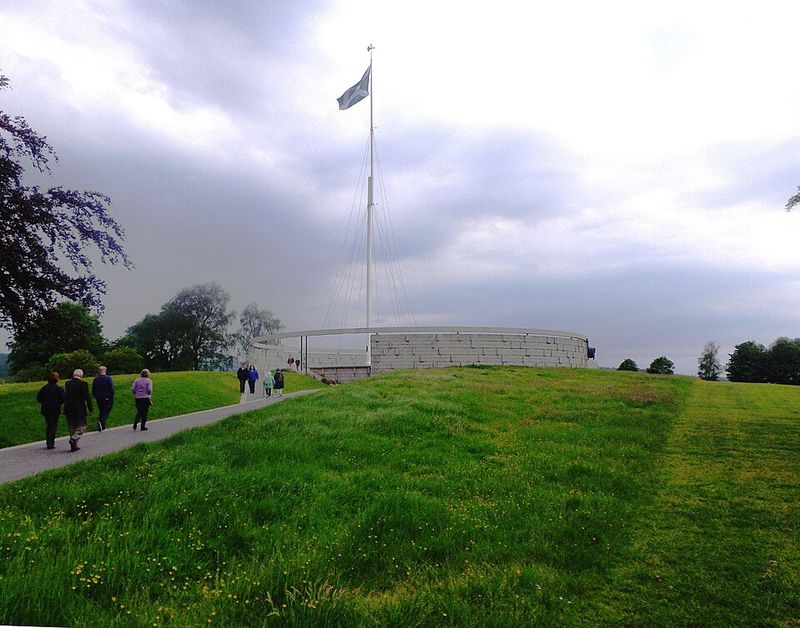
A deadline started it all. Stirling Castle’s English defenders had agreed to surrender unless help arrived by midsummer 1314.
King Edward II responded by bringing one of the largest armies ever to enter Scotland. Estimates suggest 2,000 to 3,000 armored cavalry plus 10,000 to 13,000 infantry.
Robert the Bruce had about 6,000 to 7,000 men. He chose ground near the Bannock Burn, a small stream surrounded by soft, marshy land.
His soldiers also dug hidden pits and scattered caltrops, which are small spiked devices. On day one, Bruce famously beat the English knight Henry de Bohun in single combat using an axe.
On June 24, the English launched a full attack. Squeezed by the terrain, their cavalry could not move well, and the Scottish schiltrons held firm.
Edward II fled the field. Bruce became the clear King of Scots.
Official English recognition came later, through the Treaty of Edinburgh-Northampton in 1328. Visitors can explore the battlefield and its heritage center near Stirling today.
5. Battle of Bouvines, 1214
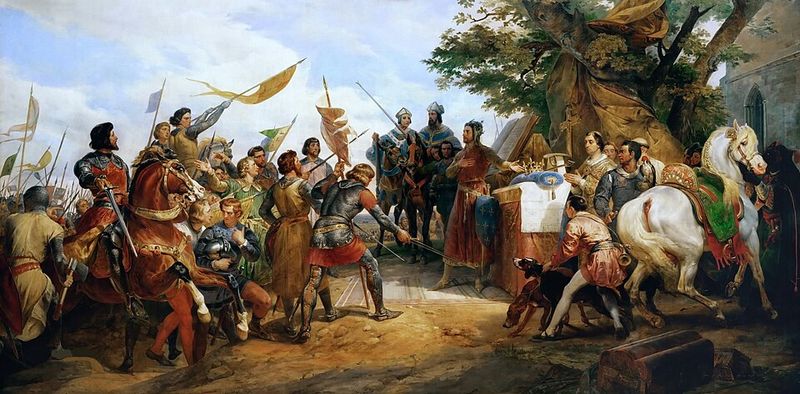
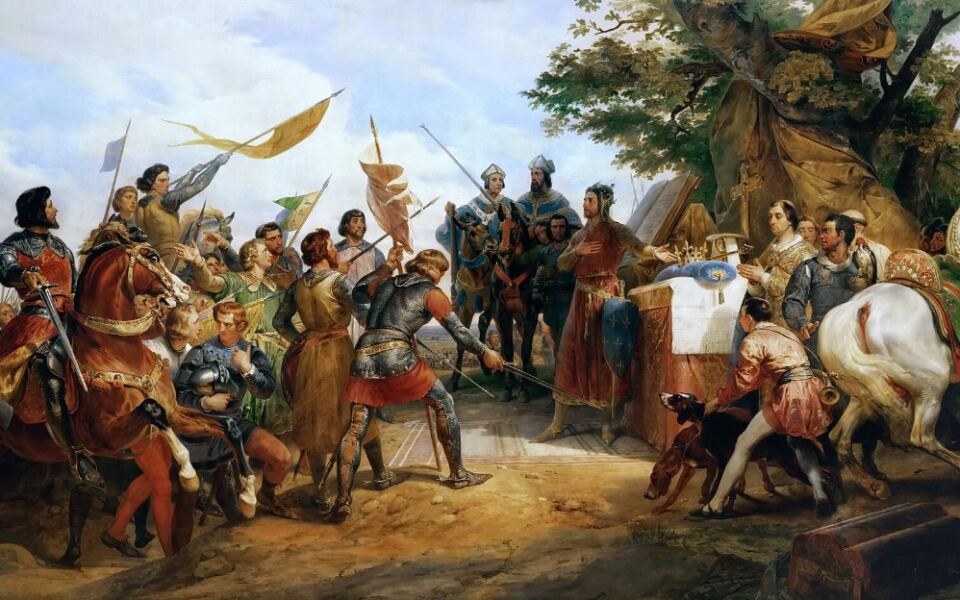
Here is a fun twist: an English king lost a battle he never even attended, and it helped give the world Magna Carta.
In 1214, King John of England built a coalition to win back lands taken by King Philip II of France. His partners included Holy Roman Emperor Otto IV and Count Ferdinand of Flanders.
The plan called for a two-sided attack. John came from the southwest, but he was pushed back at La Roche-aux-Moines.
That freed Philip to face the northern army on July 27 near Bouvines. Modern estimates give him 6,000 to 8,000 soldiers against roughly 9,000.
At one point, Philip was knocked off his horse and nearly captured. His household knights rescued him, and French cavalry kept attacking in steady waves.
Ferdinand and other leaders were taken prisoner. Otto fled, leaving his imperial standard behind, and he soon lost his throne.
Back in England, angry barons pressed a weakened John. In 1215, he agreed to Magna Carta, a document still studied in classrooms today.
6. Battle of Morgarten, 1315
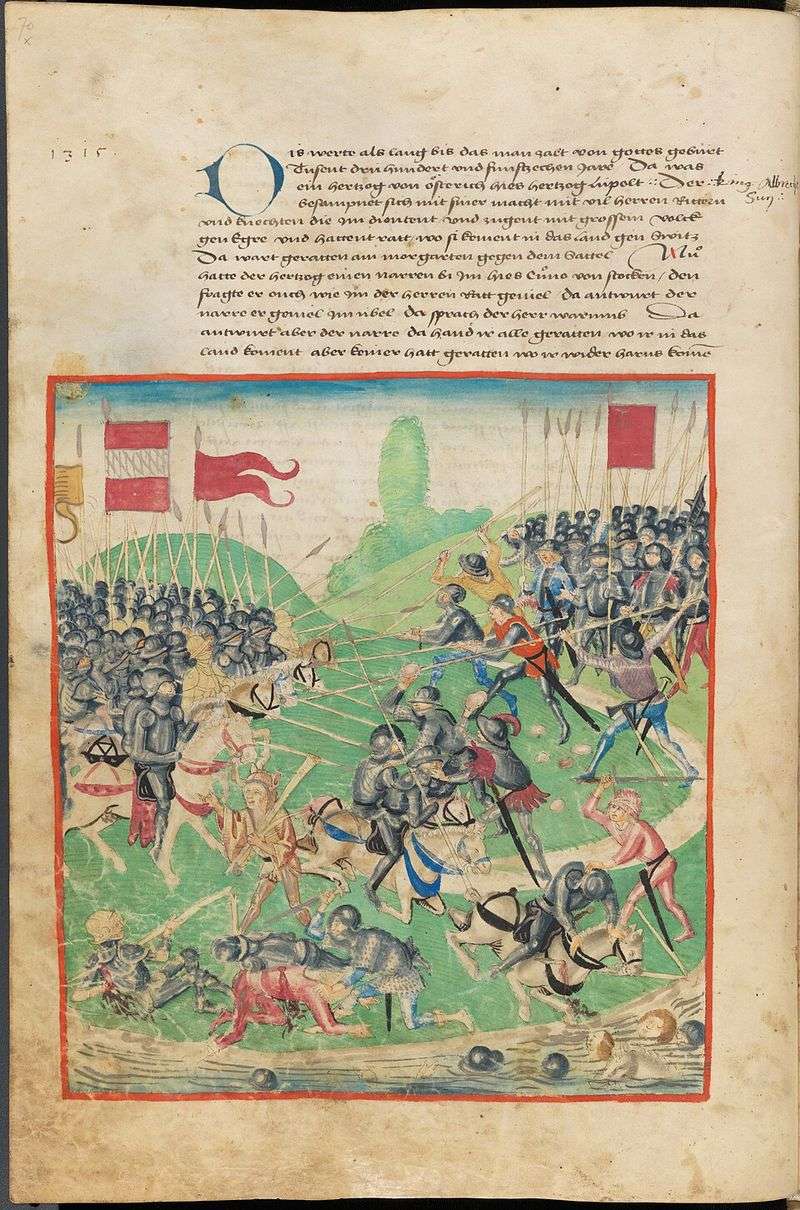
Farmers and herdsmen against one of Europe’s mightiest royal families sounds like a bad bet. Switzerland’s history says otherwise.
The trouble began when men from Schwyz raided Einsiedeln Abbey in 1314, a place protected by the Habsburgs. Duke Leopold I of Austria marched in to punish them.
One chronicle claimed 20,000 Habsburg troops, which historians call an exaggeration. Modern guesses range from 2,000 to 9,000, against a Swiss force of about 1,500 to 4,000.
On November 15, 1315, the Swiss waited along a tight path near Lake Ägeri. A steep slope sat on one side and swampy ground on the other.
Once the long Habsburg column stretched out, the Swiss attacked from above with rocks, logs, and halberds. Armored knights had no room to turn.
Leopold barely escaped. In December, Uri, Schwyz, and Unterwalden renewed their alliance.
Records from the time are thin, and later storytellers added details. Still, Morgarten became a cornerstone of Swiss identity and boosted the reputation of Swiss foot soldiers.
7. Battle of Posada, 1330
King Charles I of Hungary reportedly bragged he would drag Basarab I out of his mountains by the beard. That boast aged poorly.
Basarab ruled Wallachia, in today’s Romania, and he had stopped accepting Hungarian control. In 1330, Charles invaded with an army often estimated at around 30,000.
Basarab’s force was likely under 10,000, made up of cavalry, archers, and local peasants. Charles marched deep into Wallachia and found the capital, Curtea de Argeș, empty.
After talk of a truce, the Hungarians headed home through the Carpathian Mountains. Between November 9 and 12, Basarab’s men struck inside a narrow gorge.
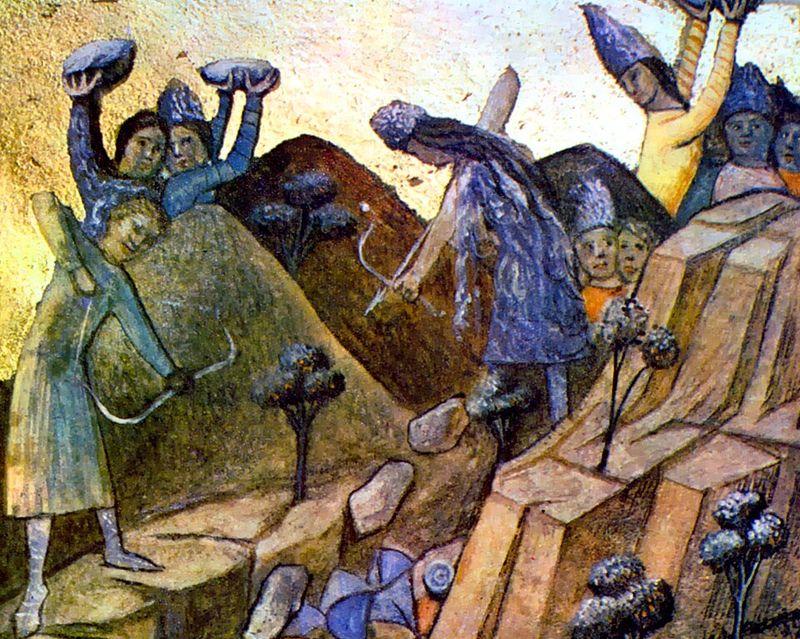
They attacked from the heights with arrows, stones, and fallen trees. Ditches blocked the path, and heavy cavalry was useless in such tight space.
Charles escaped by swapping his royal clothes with a loyal follower. Historians still argue over exactly where the fight happened.
The Hungarian Illuminated Chronicle later pictured the clash. Basarab is remembered as Wallachia’s founder and its first independent ruler.
8. Battle of Halidon Hill, 1333
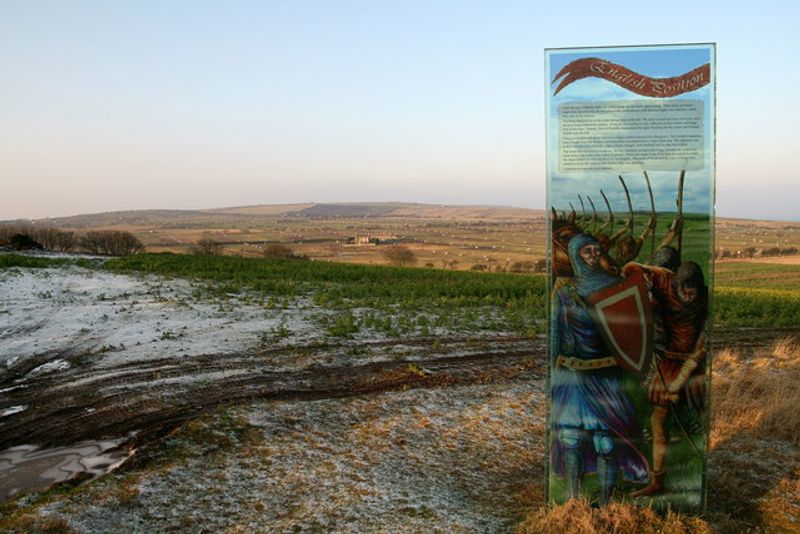
Think of it as a rehearsal. Before England’s famous wins in France, a young Edward III tested his favorite tactics on a hill near the Scottish border.
In 1333, the English were surrounding Berwick-upon-Tweed. Edward was backing Edward Balliol, who wanted the Scottish throne.
Sir Archibald Douglas, Guardian of Scotland, came to rescue the town. Modern estimates put the Scots near 15,000, while Edward had fewer than 10,000, possibly about 8,000.
On July 19, Edward held Halidon Hill. He placed dismounted soldiers in three groups with masses of longbowmen on the sides.
To reach them, the Scots crossed marshy ground and then climbed uphill. Arrows broke up their formations long before they arrived, and the close fighting ended quickly.
Berwick surrendered the very next day. Balliol’s position grew stronger, though he was pushed off the throne and restored several times afterward.
David II later returned from exile. The bigger legacy was the battle plan itself, which Edward carried into the Hundred Years’ War.
9. Battle of Crécy, 1346
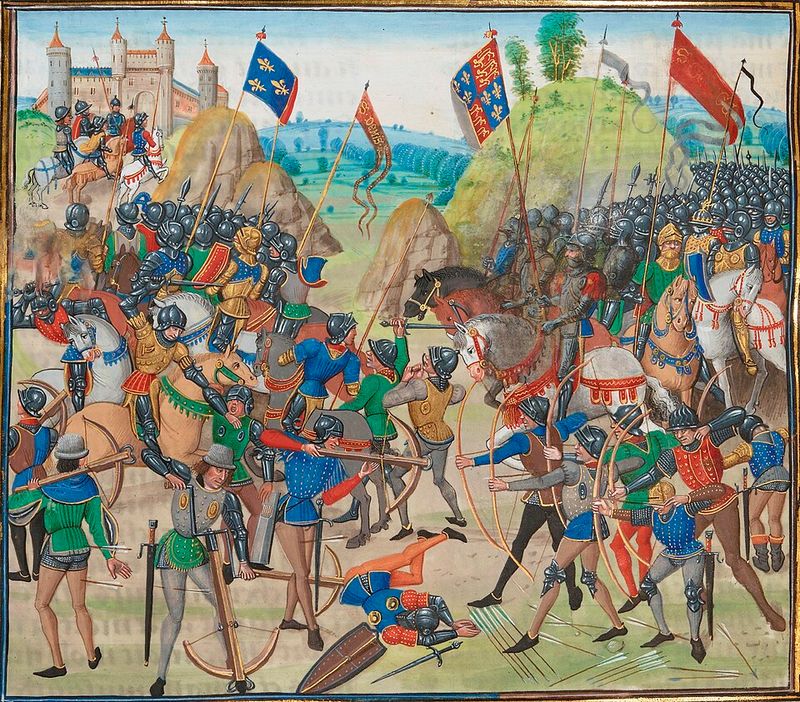
Rain played a sneaky role at Crécy. A storm soaked the bowstrings of the Genoese crossbowmen fighting for France, and their big shields were left behind with the baggage.
On August 26, 1346, King Edward III set up on a hillside in northern France. He had about 14,000 men, including around 10,000 English and Welsh longbowmen.
King Philip VI brought far more, with estimates running from 12,000 up to 30,000. His force included about 8,000 mounted knights.
Edward’s knights fought on foot in the center. Archers stood on the flanks behind sharpened stakes.
The crossbowmen were outshot and fell back into their own advancing cavalry. Charge after charge by French knights failed against the steady English line.
Edward’s son, 16-year-old Edward of Woodstock, led the right wing. Later called the Black Prince, he earned his spurs that day.
The win let Edward capture Calais in 1347. It also shook the old belief that armored knights on horseback ruled every battlefield.
10. Battle of Poitiers, 1356
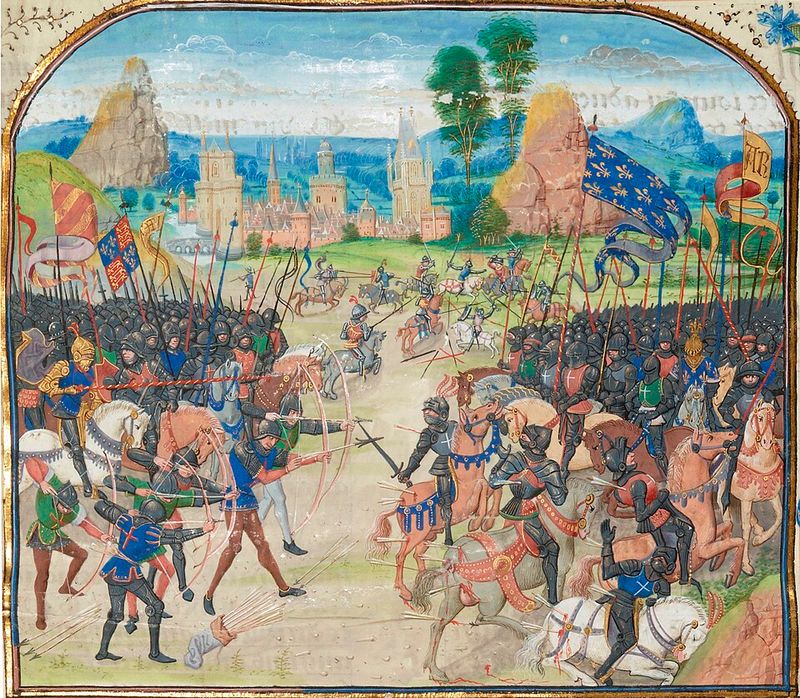
Capturing a king in battle is rare. Capturing a king and his son together, then charging a ransom of three million gold crowns, is almost unheard of.
That is what happened on September 19, 1356, near Poitiers in western France. Edward the Black Prince led about 6,000 to 7,000 English and Gascon troops.
King John II of France had an army estimated at 14,000 to 35,000. The prince took a ridge protected by thick hedges and wet ground.
John had studied Crécy, so he ordered most of his knights to fight on foot. It did not help much, because the narrow approaches and steady arrows still slowed them down.
The turning point came from a Gascon noble, Jean de Grailly. His small mounted group swung around and hit the French from behind.
John and his son Philip were taken prisoner. France faced money troubles and unrest at home.
The Treaty of Brétigny in 1360 handed Edward III huge lands in France. Many were lost again within decades.
11. Battle of Aljubarrota, 1385
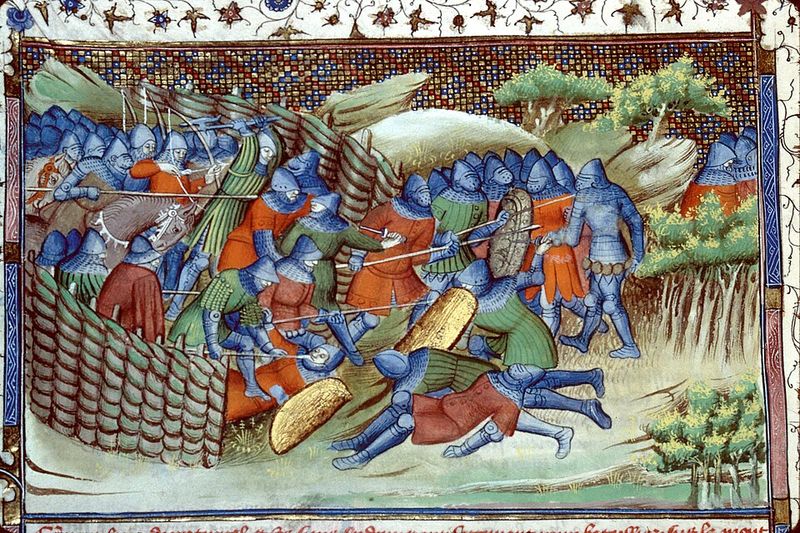
Portugal nearly vanished from the map in 1385, and a famous monastery stands today because it did not.
King Ferdinand I died in 1383 without a son. John I of Castile, married to Ferdinand’s daughter Beatrice, claimed the Portuguese crown and invaded.
Sources place the Castilian army anywhere from 20,000 to 44,000, including French knights. Portugal’s John I and his commander Nuno Álvares Pereira had about 6,600 men.
That small group included roughly 200 English longbowmen. Pereira chose a plateau near Porto de Mós and borrowed English-style tactics.
Troops fought on foot in a tight line, with archers on the sides. Ditches and hidden holes called wolf pits broke up the cavalry charges.
On August 14, the Castilian standard fell, and the Castilian king left the field. Portugal kept its own crown under the new House of Aviz.
John I built the Batalha Monastery to give thanks, now a UNESCO World Heritage Site. The 1386 Treaty of Windsor with England remains one of history’s longest-lasting alliances.
12. Battle of Agincourt, 1415
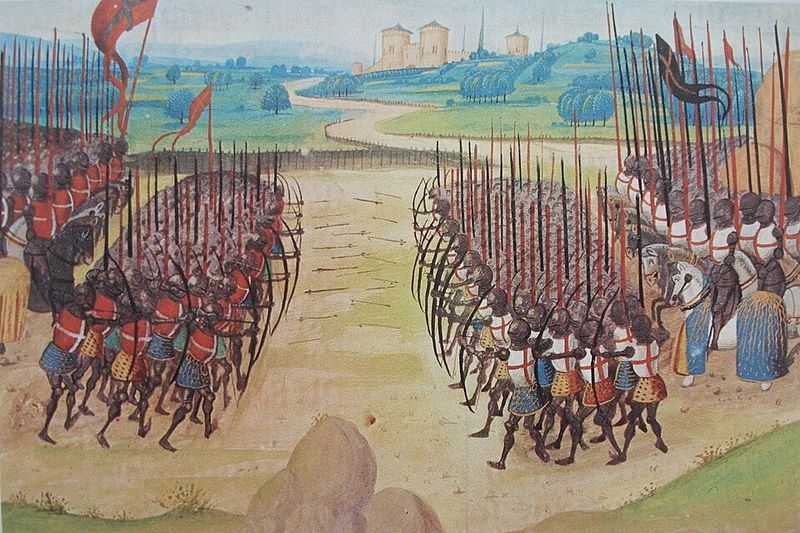
Mud may deserve a share of the credit for England’s most famous medieval win.
King Henry V’s army was worn out by October 1415. The siege of Harfleur and widespread sickness had shrunk his force to roughly 6,000 to 9,000 men, most of them archers.
The French side had about 14,000 to 25,000, possibly more. Their king, Charles VI, was ill, so Constable Charles d’Albret and other nobles took charge.
On October 25, the armies met on a freshly ploughed field near Azincourt. Thick woods squeezed both sides, leaving little room to spread out.
French knights struggled through deep mud while English longbowmen fired from behind sharpened stakes. Crowded together, the French could barely swing their weapons.
Many French nobles were captured, including the dukes of Orléans and Bourbon. Henry himself guarded his injured brother Humphrey.
The Treaty of Troyes in 1420 named Henry heir to France. He died in 1422 before inheriting it, yet Shakespeare’s play Henry V keeps Agincourt famous.
Share this story