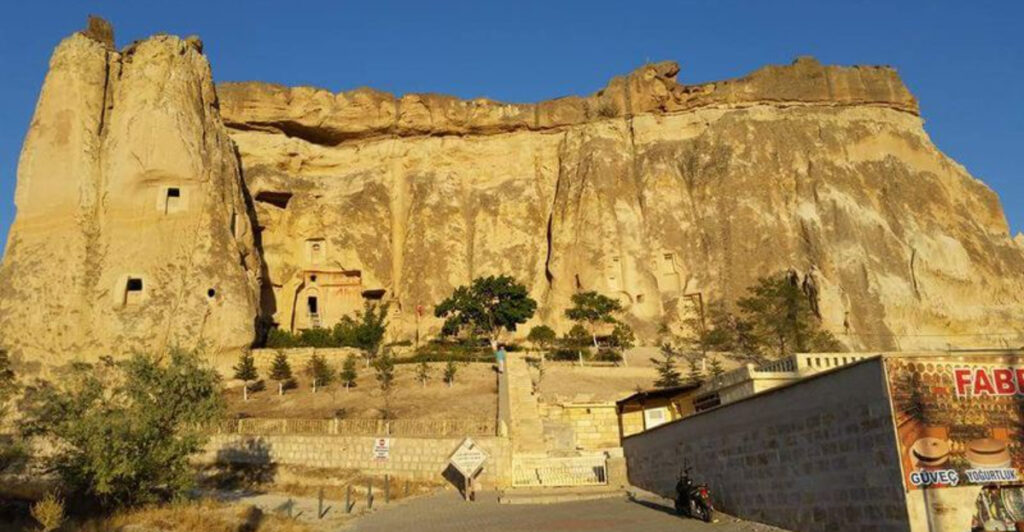
Some of the world’s most breathtaking religious art is not hanging in a gallery or displayed inside a grand cathedral. It is painted on the walls and ceilings of churches carved directly into rock, hidden for centuries inside mountains, cliffs, and canyon walls.
These cave churches stretch from the volcanic valleys of central Türkiye to the highlands of Ethiopia, and each one holds frescoes that have outlasted empires, earthquakes, and centuries of change. Whether you are a history enthusiast, a curious traveler, or someone who simply loves discovering places most people have never heard of, this list covers 11 cave churches where ancient art still covers every surface, waiting to be seen.
Dark Church, Göreme, Türkiye
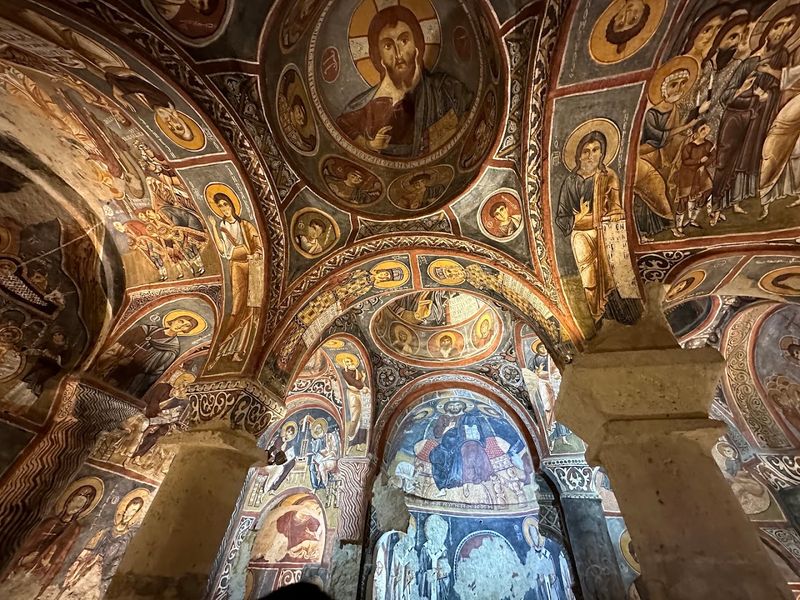
The name sounds mysterious, and the reason behind it is genuinely fascinating. The Dark Church earned its title because almost no natural light enters the interior, which turned out to be one of the best things that could have happened to its medieval paintings.
Without sustained exposure to sunlight, the frescoes retained colors that many comparable churches lost long ago. Reds, deep blues, and warm ochres still cover the domes, vaults, and walls, illustrating scenes from the life of Christ with striking clarity.
Subjects include the Nativity, the Last Supper, the Betrayal, and the Crucifixion, arranged across the rock-cut surfaces in careful Byzantine style.
The Dark Church sits inside Göreme Open-Air Museum, but it requires a separate admission ticket beyond the standard museum entry. Türkiye’s Ministry of Culture lists it as open daily.
For anyone visiting Cappadocia, this is one stop worth budgeting extra time and money for.
Tokalı Church, Göreme, Türkiye
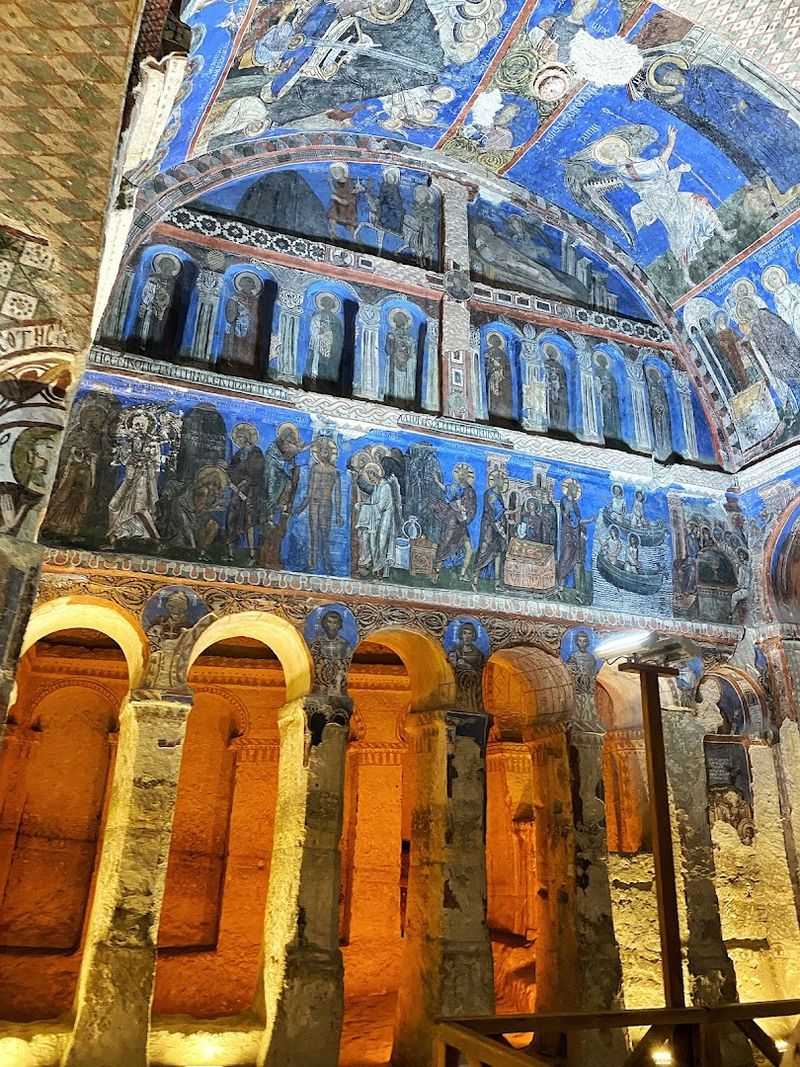
Known in English as the Buckle Church, Tokalı is not a single room but a connected complex of carved spaces, each built and decorated across different periods of the 10th and early 11th centuries. Standing just outside the main visitor circuit of Göreme Open-Air Museum, it tends to reward visitors who take a moment to explore beyond the obvious path.
The walls and barrel vault present one of the most extensive narrative programs in all of Cappadocia, moving through the Nativity, Christ’s miracles, the Passion, and the Resurrection in sequential scenes. The newer section of the church is particularly striking for its rich blue background, a pigment that was expensive and uncommon in medieval religious painting.
Tokalı Church is included with standard admission to the Göreme archaeological site, making it an accessible highlight. The visual storytelling packed into these rock-cut spaces rivals much larger and better-funded medieval churches found anywhere in Europe.
Çavuşin Church, Çavuşin, Türkiye
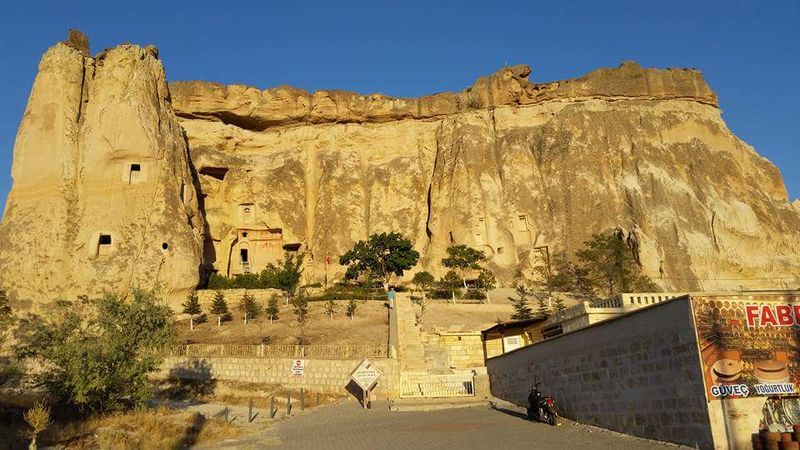
Most medieval churches were decorated with saints and scripture. Çavuşin Church went a step further by including portraits of a reigning Byzantine emperor and his family, which makes it one of the more historically specific painted sanctuaries in Cappadocia.
The church was constructed around 964 or 965, following Emperor Nikephoros II Phokas’ visit to the region. Surviving frescoes include images connected to the emperor, his wife Theophano, and members of their court, alongside the standard biblical scenes painted across the rock-cut interior.
Several sections remain well preserved despite centuries of erosion and exposure.
The church is part of the Çavuşin archaeological area near the village of the same name and remains listed by Türkiye’s Ministry of Culture as an active visitor site. For anyone interested in the crossover between Byzantine political history and religious art, Çavuşin offers a direct visual connection that most other cave churches simply cannot match.
Ağaçaltı Church, Ihlara Valley, Türkiye
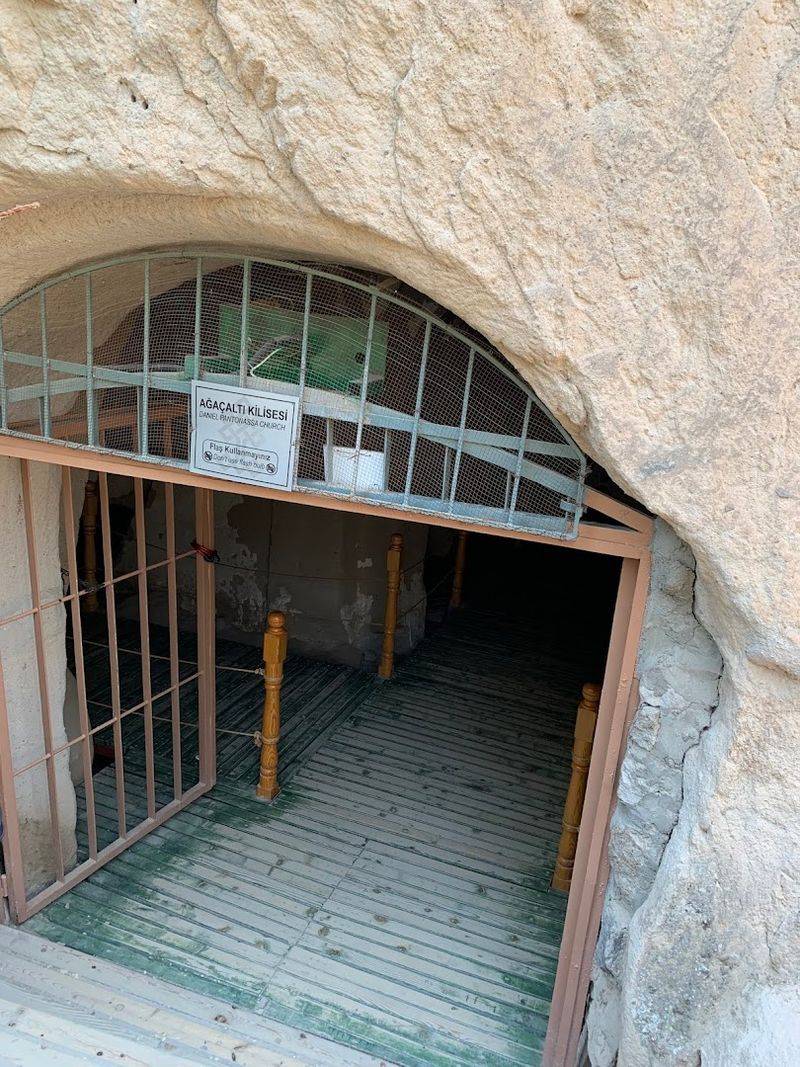
Ihlara Valley is a dramatic canyon carved by a river in central Cappadocia, and its walls are lined with dozens of rock-cut churches. Ağaçaltı Church sits near one of the main stairways descending into the valley, making it one of the more accessible painted churches along the route.
The frescoes are generally dated between the ninth and 11th centuries. Surviving scenes include the Annunciation, the Baptism of Christ, the Ascension, the Dormition of the Virgin, Daniel among the lions, and groups of apostles and prophets arranged across the walls and ceiling.
Painted figures curve around the dome in a way that creates an immersive effect inside the compact chamber.
Ihlara Valley operates as an official archaeological site with a formal entrance fee and visitor facilities. Ağaçaltı rewards close attention, especially on the ceiling, where the arrangement of figures and color still communicates the original composition with enough clarity to follow the full program.
Santa Lucia alle Malve, Matera, Italy
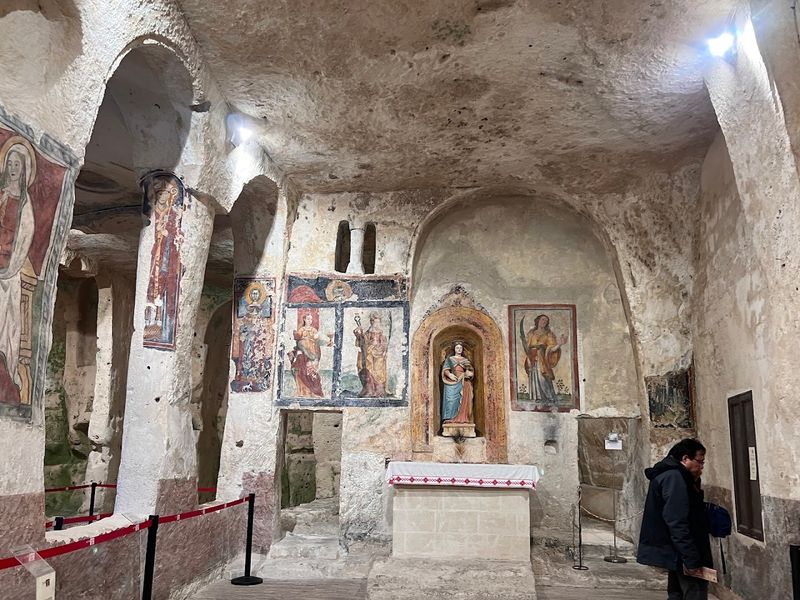
Matera is one of the oldest continuously inhabited cities in the world, and its cave neighborhoods hold dozens of rock-cut sanctuaries. Santa Lucia alle Malve, located in the Sasso Caveoso district, is among the best preserved and most visited of them.
The church is connected to a Benedictine community of nuns that occupied the surrounding caves during the medieval period. Its interior is divided into three aisles by rock-cut pillars and arches, giving it the structural feel of a proper basilica despite being carved entirely from limestone.
Frescoes dating primarily from the 13th and 14th centuries line the walls, depicting the Archangel Michael, various saints, and several representations of the Virgin Mary.
Part of the church is still associated with religious observance on Saint Lucia’s feast day. The current operator lists it as open to visitors daily, apart from specified holidays.
Seeing medieval paintings inside a room carved from living rock gives Santa Lucia a layered quality that photographs rarely capture fully.
Santa Maria de Idris and San Giovanni in Monterrone, Matera, Italy
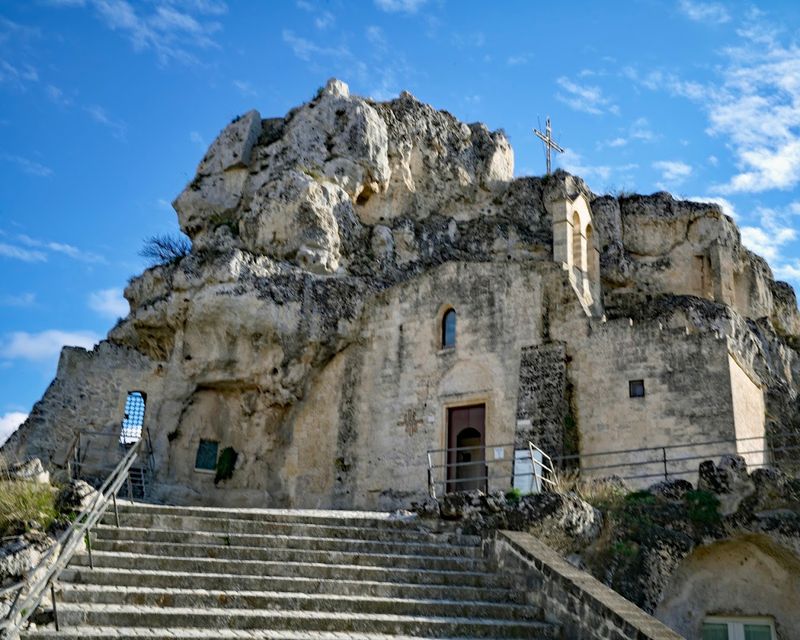
Rising above the Sasso Caveoso neighborhood, the rocky outcrop that holds these two connected churches is one of Matera’s most photographed landmarks from the outside. What is inside is equally worth the visit.
A narrow passage connects Santa Maria de Idris to the older San Giovanni in Monterrone chamber. San Giovanni preserves frescoes generally dated from the 12th through the 14th centuries, while Santa Maria de Idris contains later paintings, including a depiction of the conversion of Saint Eustace, Matera’s patron saint.
Portions of the artwork have been damaged or removed over centuries, but enough survives to reveal several distinct phases of decoration completed by different hands at different times.
Both churches are included in Matera’s managed rock-church circuit and are listed as open daily. Visiting the two together offers a compressed view of how cave sanctuaries in this region were expanded, redecorated, and repurposed across multiple generations of religious communities.
Rock-Hewn Churches of Ivanovo, Ivanovo, Bulgaria
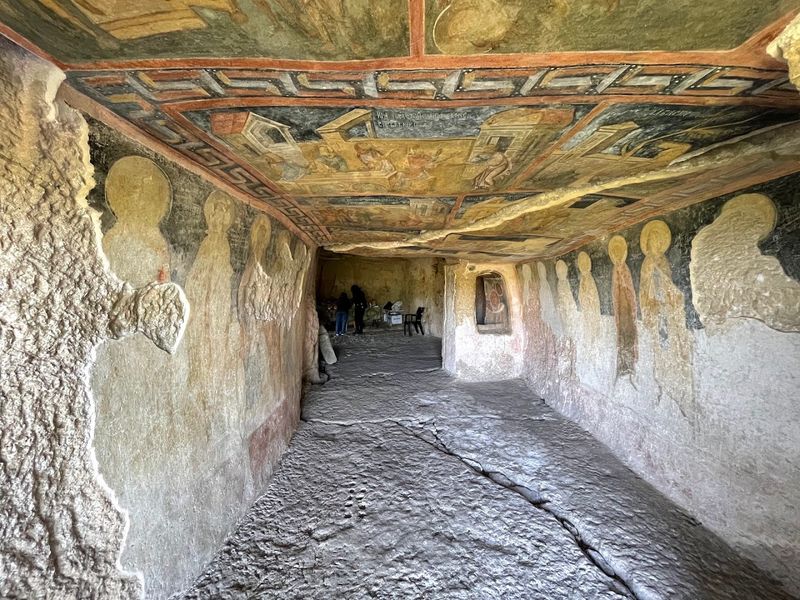
Carved into cliffs above the Rusenski Lom River in northern Bulgaria, the Rock-Hewn Churches of Ivanovo represent one of medieval Eastern Europe’s most ambitious monastic projects. Monks began developing the complex during the Bulgarian Empire, building churches, chapels, cells, and communal spaces between the 12th and 14th centuries.
The Church of the Holy Virgin holds the site’s most celebrated murals. Its 14th-century paintings show expressive figures with flowing garments, detailed architectural backgrounds, and complex biblical scenes rendered in a style that feels noticeably more naturalistic than the rigid conventions of earlier medieval art.
Art historians have pointed to these murals as examples of a transitional moment in Balkan religious painting.
The complex is designated a UNESCO World Heritage Site, and the Regional History Museum in Ruse currently manages daily visitor access. Getting there requires a short walk through pleasant river valley scenery, which makes the arrival at the cliff-face churches feel appropriately earned.
Church of the Dormition at Vardzia, Georgia
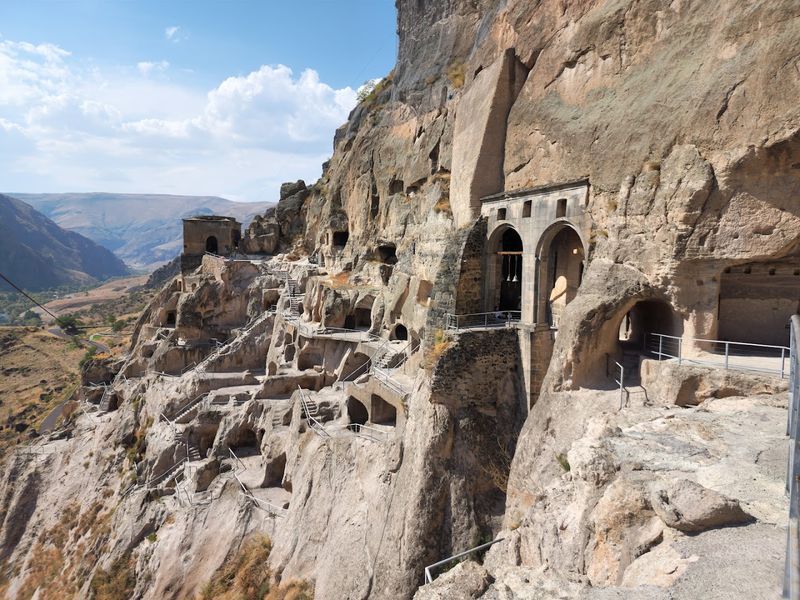
Vardzia is carved into a mountainside in southern Georgia, and the scale of it is hard to prepare for. Hundreds of rooms, tunnels, and storage chambers spread across the cliff face, but the Church of the Dormition at the center of the complex is where the most important artwork survives.
The frescoes date to approximately 1184 to 1186, placing them in Georgia’s medieval Golden Age. Among the most significant are portrait images of King Giorgi III and Queen Tamar, one of Georgia’s most celebrated rulers.
Religious scenes surround these royal figures on the walls and vaulted surfaces, creating a rare combination of sacred imagery and documented historical record within a single painted interior.
Vardzia functions today as both an active monastery and a major visitor attraction. Access to the church is included in tours of the cave complex.
The journey through the carved corridors leading to the church builds a sense of arrival that makes the frescoes feel all the more significant.
Enkleistra of Saint Neophytos, Tala, Cyprus
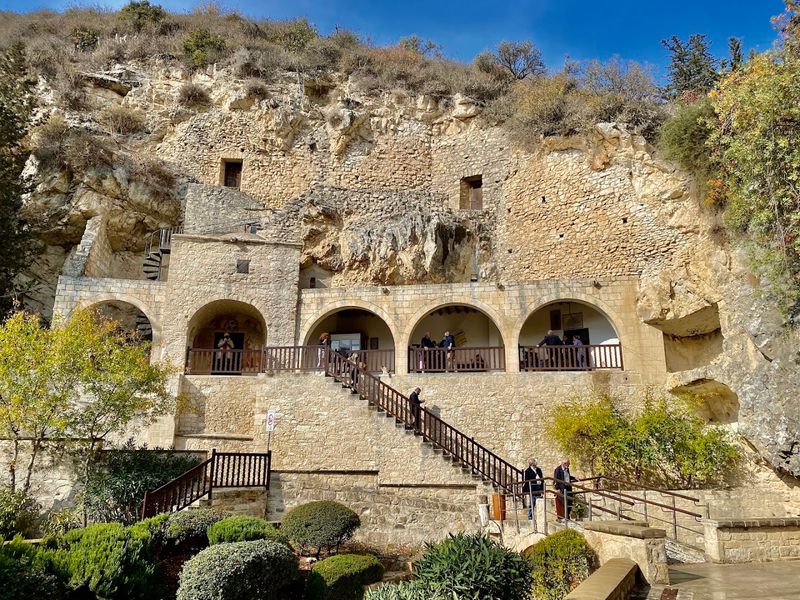
Not many historic sanctuaries were built by one person carving directly into a hillside with their own hands. That is essentially how the Enkleistra began.
In the 12th century, a hermit named Neophytos excavated a small group of rooms near what is now Paphos, creating a private retreat that eventually became part of the Monastery of Agios Neophytos.
The interconnected caves are covered with Byzantine frescoes created between the 12th and 15th centuries. Some paintings depict standard biblical events, while others incorporate Neophytos himself into carefully composed religious scenes, placing the hermit alongside saints and sacred figures in a way that is unusual for Byzantine art of this period.
The combination of personal imagery, theological content, and rock-cut architecture gives the Enkleistra an artistic identity unlike that of larger, more institutional Byzantine churches. The monastery and its small museum remain open to visitors, with the cave sanctuary serving as the main historical draw for anyone making the trip to this part of Cyprus.
Biete Maryam, Lalibela, Ethiopia
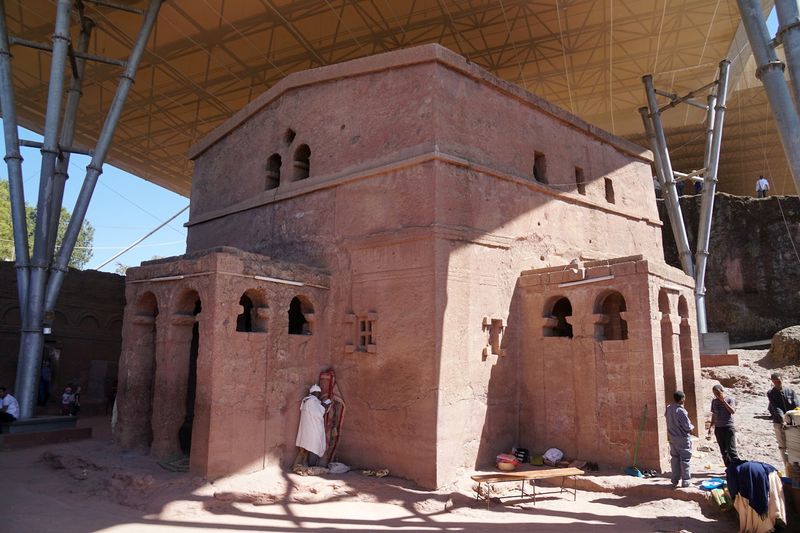
Lalibela’s rock-hewn churches are among the most remarkable architectural achievements in African history, and Biete Maryam, or the House of Mary, stands out even within that extraordinary group. Developed around the 12th and 13th centuries, it remains one of Ethiopian Christianity’s most important pilgrimage sites.
Where several neighboring churches are valued primarily for their sculpted stone architecture, Biete Maryam retains a full program of painted decoration. Brightly colored geometric patterns and biblical scenes cover portions of the walls, ceilings, columns, and arches, turning the interior into a combination of carved structure and sacred illustration that operates on multiple visual levels simultaneously.
The church remains active within the Ethiopian Orthodox tradition and continues to welcome both worshippers and ticketed visitors as part of the UNESCO-protected Lalibela complex. Visiting during a religious festival gives the painted interior an entirely different energy, with candlelight and liturgical chanting filling the carved stone space in ways that connect past and present directly.
Abuna Yemata Guh, Gheralta Mountains, Ethiopia
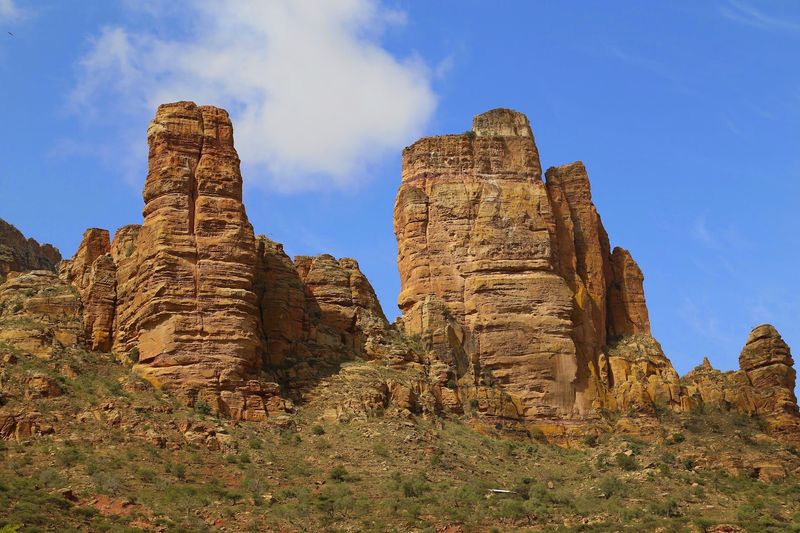
Getting to Abuna Yemata Guh is part of what makes it unforgettable. The church is carved into a sandstone cliff high in the Gheralta Mountains of northern Ethiopia, and reaching it requires a steep hike, sections of exposed rock climbing, and the crossing of narrow ledges, typically with assistance from local guides.
The approach is serious and the views are extraordinary.
Once inside, the atmosphere shifts completely. Paintings traditionally associated with the Nine Saints, apostles, the Virgin Mary, Christ, and Old Testament figures cover the walls and domed ceiling in compositions researchers generally date to the 15th century.
The scale of the interior is intimate, which makes the density of the painted surfaces feel immediate and personal rather than monumental.
Abuna Yemata Guh remains an active church, and local guides continue to facilitate visits for travelers who are comfortable with heights and physically demanding terrain. The combination of remote location, physical challenge, and centuries-old sacred art makes this one of the most singular church visits anywhere on earth.
Share this story