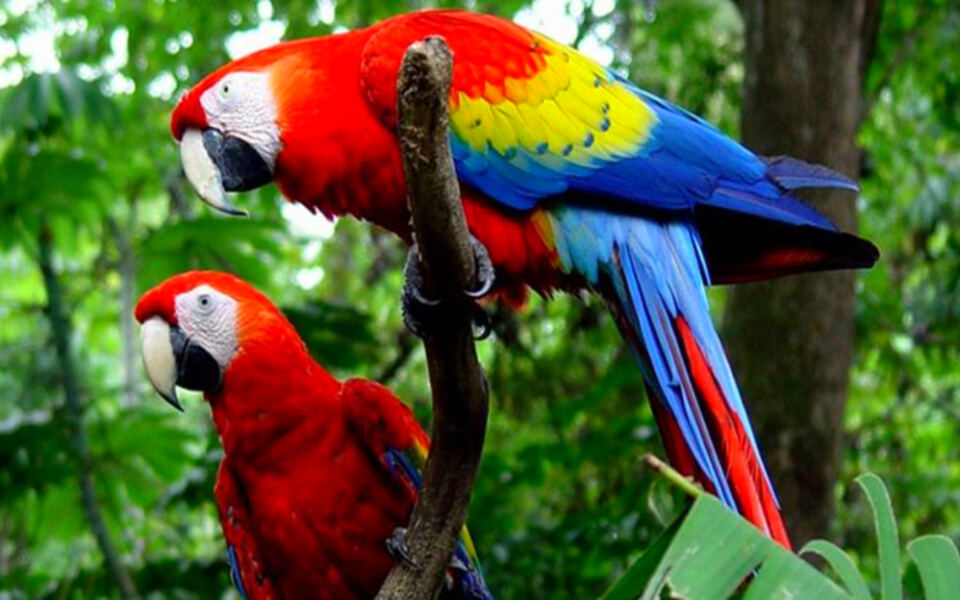
Macaws have been captivating travelers, naturalists, and scientists for centuries. Their bold plumage and social behavior have made them symbols of tropical biodiversity across South America, Central America, and beyond.
Some species are thriving, while others depend on carefully managed reserves and community-led conservation programs to survive. From a massive Bolivian sinkhole where hundreds of birds nest in the walls to remote Peruvian clay licks where five macaw species gather at once, each location has a documented, ongoing connection to macaws.
Conservation history, visitor infrastructure, and species diversity vary widely, so understanding what each place offers helps you plan a visit that matches your interests and expectations.
1. Tambopata Research Center, Tambopata National Reserve, Peru
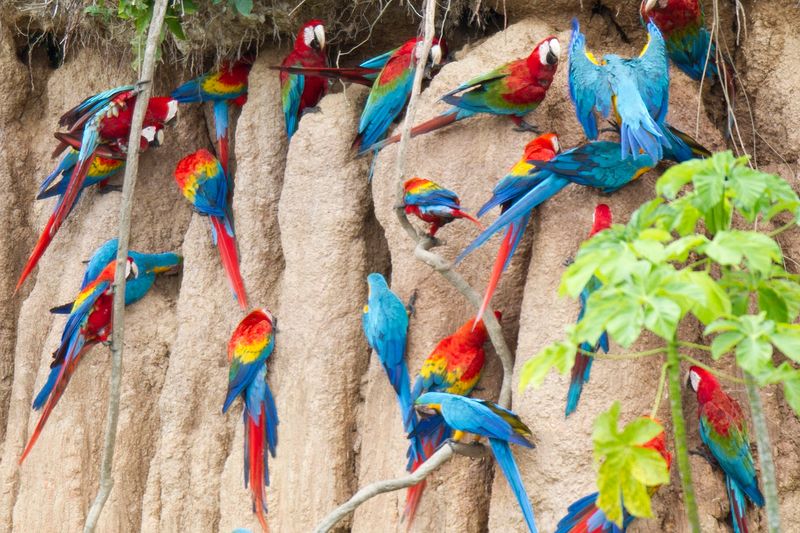
Few places on the planet can match what happens at the Colorado clay lick near Tambopata Research Center on a clear morning. Multiple macaw species, including scarlet, red-and-green, blue-and-yellow, chestnut-fronted, and red-bellied macaws, converge on the exposed mineral-rich riverbank in numbers that can reach into the hundreds.
The clay lick itself has been studied by researchers for decades, making it one of the most scientifically documented macaw gathering sites in the world. Scientists believe the birds consume the clay to neutralize compounds found in the seeds and fruits they eat, though research into the exact mechanism is ongoing.
Tambopata Research Center sits deep in southeastern Peru’s Madre de Dios region, requiring a multi-hour boat journey from Puerto Maldonado. That distance keeps crowds manageable and the surrounding forest largely intact, which directly benefits the bird populations that depend on it year-round.
2. Buraco das Araras, Jardim, Mato Grosso do Sul, Brazil
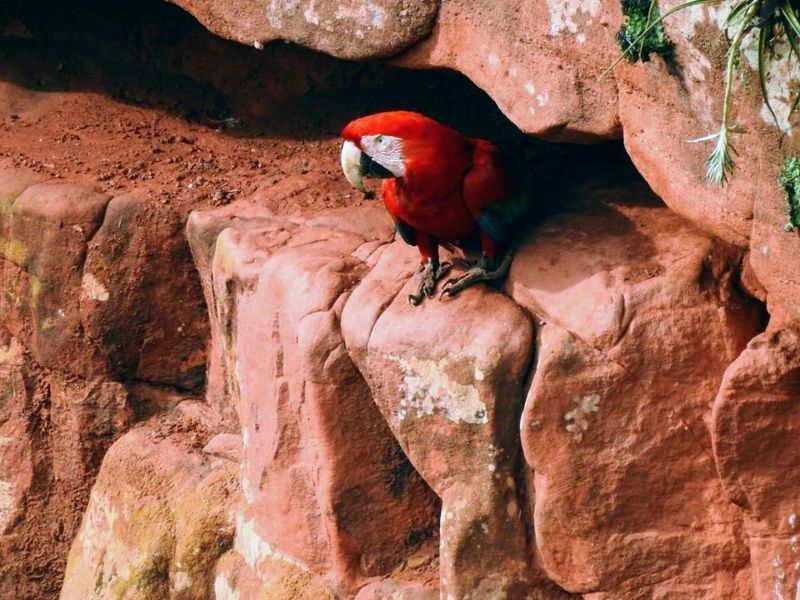
A collapsed geological formation roughly 100 meters deep and 500 meters in circumference, Buraco das Araras translates directly to Sinkhole of the Macaws, and the name is entirely earned. Red-and-green macaws have adopted its steep walls as a permanent nesting ground, with documented counts reaching around 120 individuals during the reproductive season.
The site holds status as a Private Reserve of Natural Heritage, which limits development and protects the habitat that the macaws depend on for nesting cavities and foraging. Visitors follow a walkway around the rim, watching the birds wheel in and out of the vertical rock faces below.
Formed millions of years ago through the dissolution of limestone bedrock, the sinkhole now supports a microhabitat distinct from the surrounding Cerrado landscape. Wildlife photographers regularly visit because the open-air setting and predictable bird behavior create reliable conditions for observation throughout much of the year.
3. Parque das Aves, Foz do Iguaçu, Paraná, Brazil
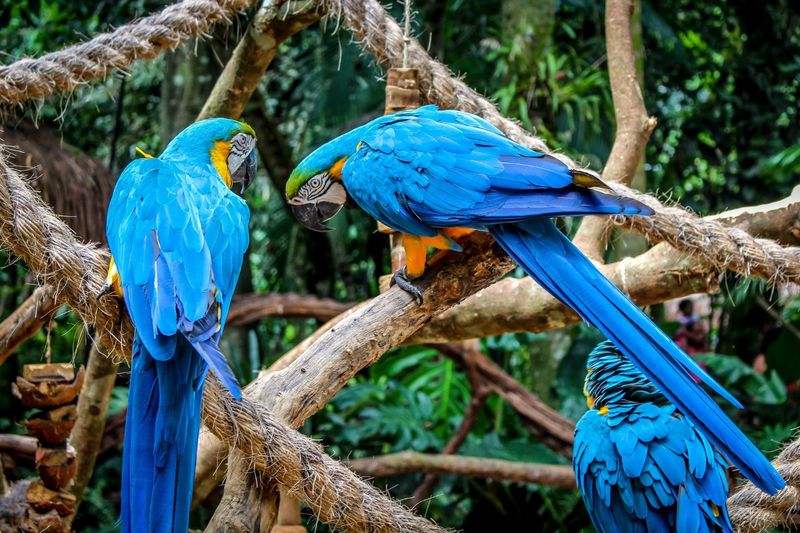
Latin America’s largest bird park, Parque das Aves houses over 1,000 birds representing approximately 140 species, with macaws occupying a central role in both its collection and its conservation mission. The park’s Macaw Aviary allows visitors to walk through a forested enclosure where blue-and-yellow, red-and-green, and hyacinth macaws move freely overhead and at eye level.
Many of the birds at Parque das Aves arrived after being confiscated from illegal wildlife trafficking operations, which means they cannot safely be returned to wild populations. The park channels that situation into active reintroduction programs, working to re-establish blue-and-gold and red-and-green macaws in areas of Brazil where both species had been locally absent since 1987.
The park’s location near Iguacu National Park makes it a practical addition to any visit to the falls area. Environmental education programs run throughout the year, giving the facility a role beyond tourism in shaping how Brazilians understand native bird conservation.
4. Macaw Recovery Network, Punta Islita, Guanacaste Province, Costa Rica
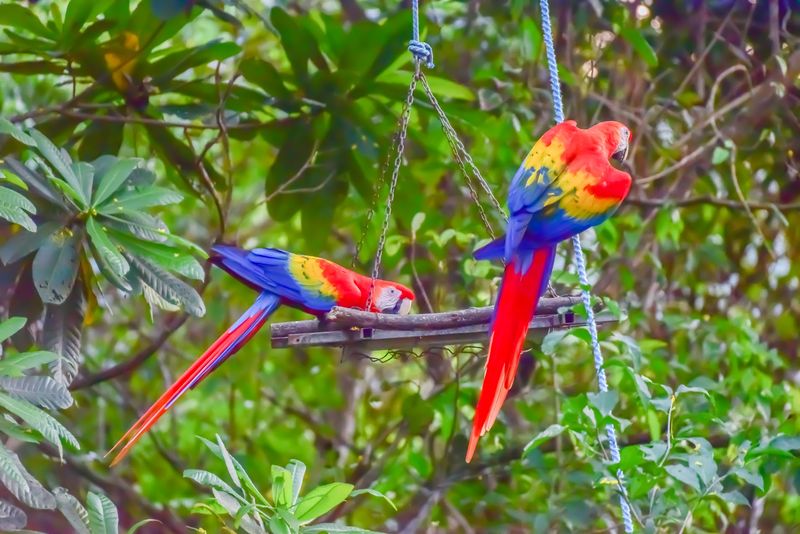
The Macaw Recovery Network turned Punta Islita into one of the more meaningful scarlet macaw stories in Central American conservation. The organization runs a breeding center and a Wild Macaw Reserve here, working to re-establish a self-sustaining population of scarlet macaws across the Nicoya Peninsula, where the species had largely disappeared from the landscape.
Birds bred and conditioned at the facility are gradually introduced into wild habitat, monitored closely in the months following release. The program tracks individual birds and adjusts its approach based on survival rates, breeding success, and territorial behavior, making it an adaptive conservation model rather than a fixed protocol.
Visitors to the Punta Islita area can now regularly see free-flying scarlet macaws that would not exist there without the program’s work. The project has also built relationships with local communities, framing macaw recovery as an economic and cultural benefit rather than a restriction on land use in the region.
5. Napo Wildlife Center Ecolodge, Yasuní Region, Ecuador
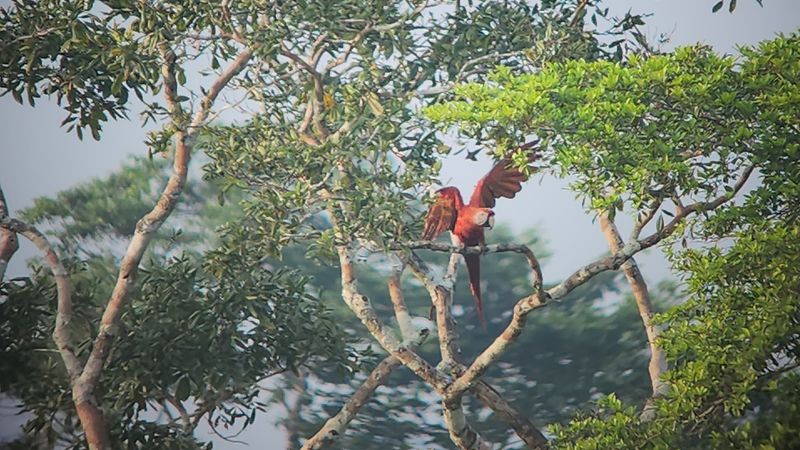
Yasuní National Park is consistently ranked among the most biodiverse places on Earth, and Napo Wildlife Center Ecolodge sits within a community-managed concession inside the park. The bird list for the surrounding area includes blue-and-yellow, scarlet, red-and-green, chestnut-fronted, and red-bellied macaws, representing a cross-section of Amazonian macaw diversity within a single accessible location.
The lodge is owned and operated by the Anangu Kichwa community, meaning tourism revenue flows directly to the people managing the forest rather than to outside operators. That structure creates a direct financial incentive for habitat protection, which benefits the macaw populations and the broader forest ecosystem simultaneously.
Canoe-based travel through the park’s network of rivers and oxbow lakes provides the primary mode of movement for guests. Clay lick visits, guided forest walks, and canopy observation all form part of the standard itinerary, giving travelers multiple opportunities to encounter the macaw species recorded in this part of the Ecuadorian Amazon.
6. Carara National Park, Tárcoles, Puntarenas Province, Costa Rica
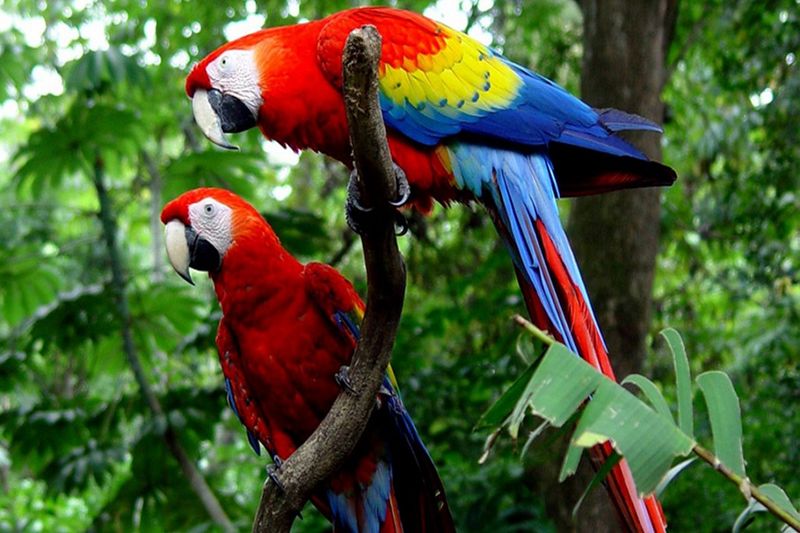
Established in 1979, Carara National Park sits at a biological crossroads where Costa Rica’s tropical dry forest transitions into wetter lowland rainforest, creating a layered habitat that scarlet macaws use extensively for feeding and nesting. The park was specifically created to protect this fragile transition zone and the species that depend on it.
Scarlet macaws here are notably active at dawn and dusk, when pairs and small groups move between the Tarcoles River corridor, coastal mangroves, and interior forest. Their red, yellow, and blue plumage is easy to track against the canopy during these movement periods, making early morning visits particularly productive.
Conservation programs implemented since the park’s founding have contributed to a measurable recovery of the local scarlet macaw population. Visitor numbers are managed carefully, and guided walks along the park’s trail system give travelers a structured way to observe the birds without disrupting their daily routines.
7. Barba Azul Nature Reserve, Beni, Bolivia
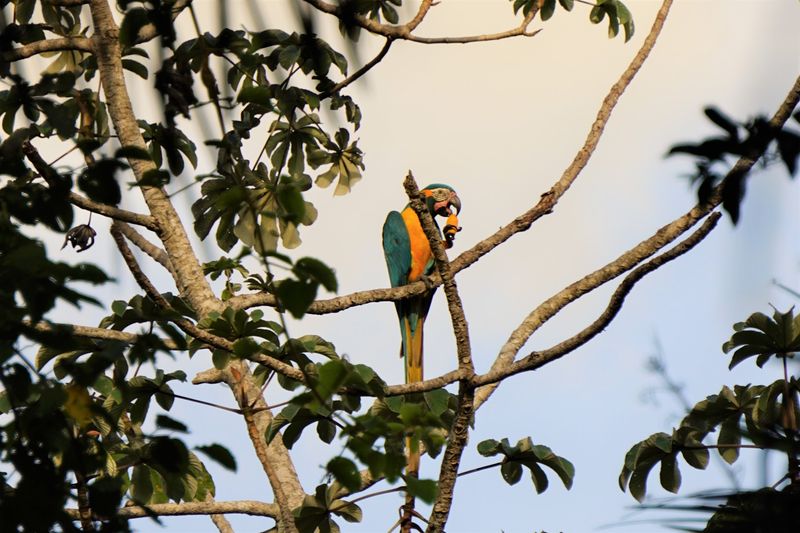
With fewer than 450 individuals estimated in the wild, the blue-throated macaw is one of the most critically endangered parrots in the world, and Barba Azul Nature Reserve in Bolivia’s Beni Savanna protects the western subpopulation’s most important foraging and roosting habitat. The reserve’s name, meaning Blue Beard, directly references the bird’s distinctive blue facial patch.
Asociacion Armonia manages the reserve using a combination of habitat restoration, fire prevention, and sustainable cattle ranching models that reduce pressure on the forest islands the macaws depend on for survival. The birds are most reliably present from March through October, outside their breeding season, when seasonal flooding concentrates them on higher ground within the reserve.
Eco-tourism at Barba Azul is structured to fund conservation directly, with lodge fees contributing to the macaw program’s operating costs. Visitors can observe groups of blue-throated macaws foraging and roosting, an experience that carries particular weight given how few of these birds remain in existence.
8. Red-Fronted Macaw Lodge, Cochabamba Department, Bolivia
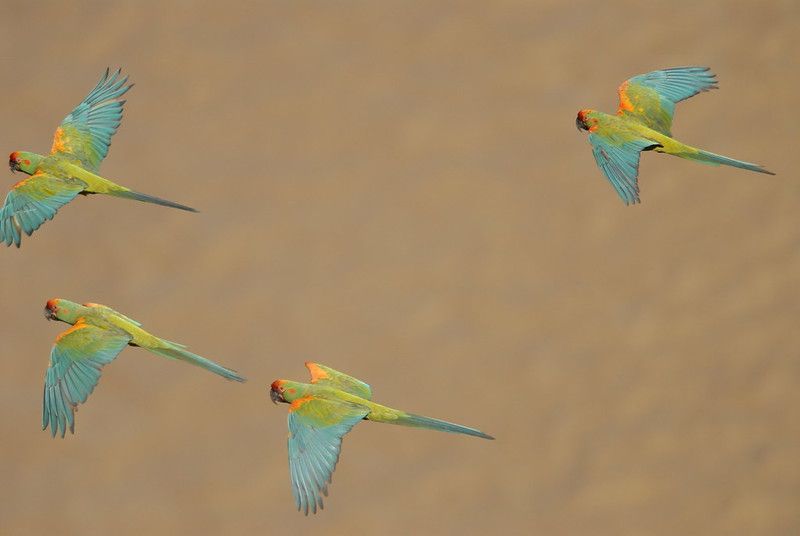
Central Bolivia’s dry Andean valleys look nothing like the humid Amazon, and the red-fronted macaw is equally unlike its lowland relatives. Endemic to a small mountainous region of central Bolivia, the species has a wild population estimated at roughly 1,000 individuals, making every sighting at this lodge a meaningful one from a conservation standpoint.
The Red-Fronted Macaw Lodge sits beside one of the most significant known breeding cliffs for the species, where pairs and family groups are visible throughout the breeding season from November to early May. Native vegetation and supplemental feeders around the property bring the birds close enough for extended observation without requiring long treks into the surrounding terrain.
The lodge is managed by local Quechua communities, giving the facility a direct community-conservation connection similar to other successful ecotourism models in South America. Staying here contributes financially to both the conservation program protecting the cliffs and the livelihoods of the families who run the operation.
9. Red Bank Scarlet Macaw Viewing Area, Red Bank, Stann Creek District, Belize
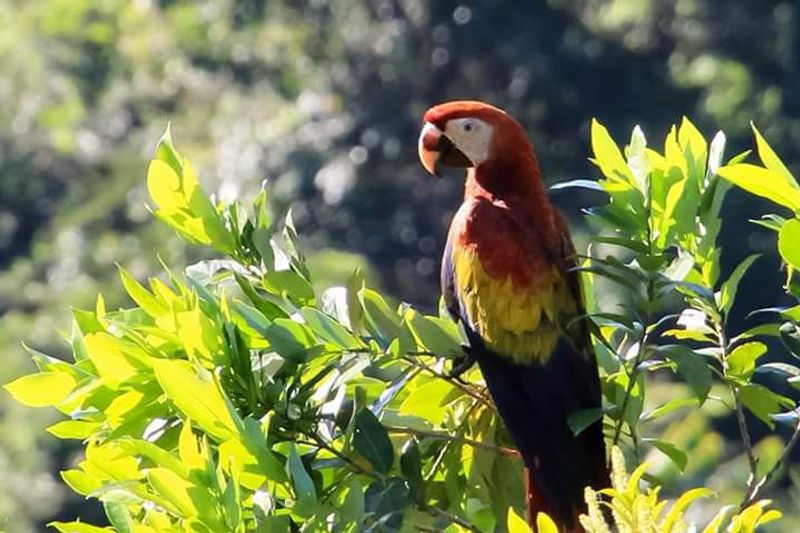
Each year between December and March, the small Maya village of Red Bank in southern Belize becomes one of Central America’s most concentrated seasonal scarlet macaw viewing locations. The birds migrate from breeding areas including Chiquibul National Park to feed on annatto and pole wood fruits that ripen in the lower elevations around the village during these months.
At peak season, observers can track pairs and groups crossing the valley and moving through the canopy, often heard before they are seen. Local community guides are available and actively recommended, as they know the birds’ daily movement patterns and can position visitors for the best observation windows in the morning hours.
The Red Bank community’s involvement in macaw tourism has given residents a direct economic reason to support the birds’ presence rather than view them as a neutral or inconvenient element of the landscape. That community ownership model has been noted as a factor in the site’s sustained success as a birding destination in Belize.
10. Refúgio Ecológico Caiman, Miranda, Mato Grosso do Sul, Brazil
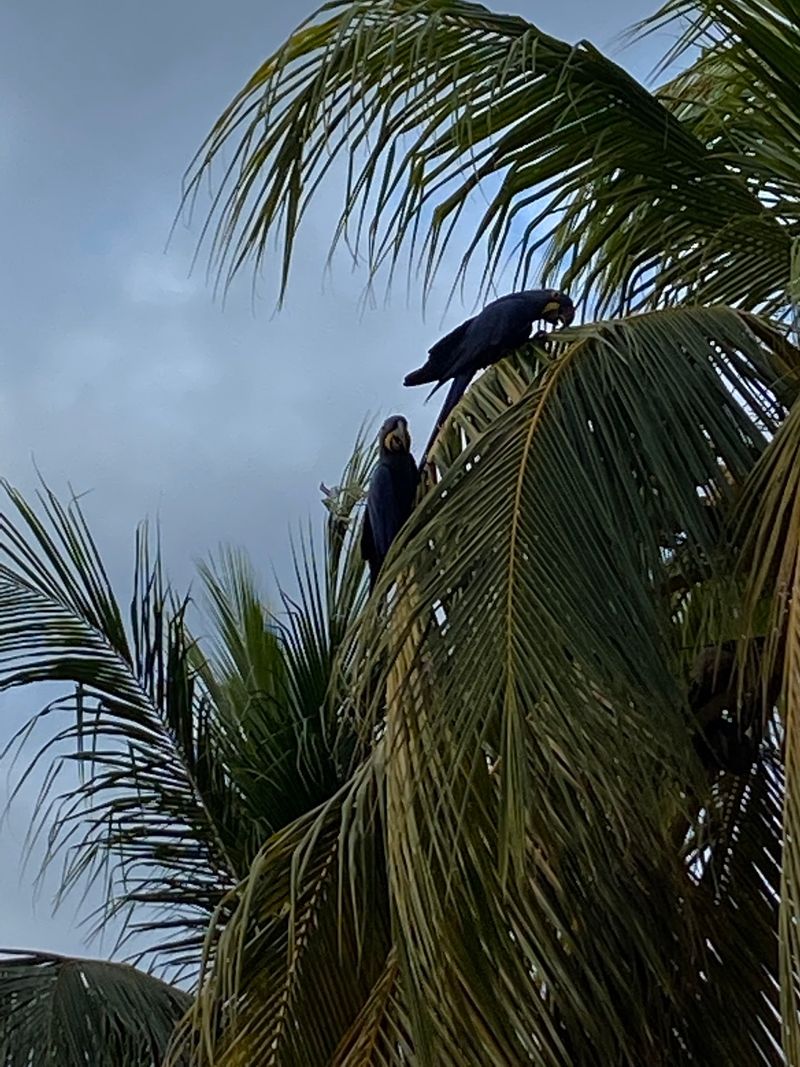
When the Hyacinth Macaw Project established its first field base at Refugio Ecologico Caiman in 1998, it marked the beginning of one of the Pantanal’s most sustained wildlife conservation partnerships. The project has since documented population trends, nesting success, and habitat use for hyacinth macaws across a broad section of the Pantanal wetland system.
Caiman’s landscape of flooded grasslands, gallery forest, and palm stands provides exactly the kind of varied habitat that hyacinth macaws require. The birds use palm trees as food sources and nest in large tree cavities, which the project actively monitors and supplements with artificial nest boxes where natural cavities are scarce.
Guests at the refuge encounter hyacinth macaws as a regular part of the daily wildlife experience rather than a highlight requiring a dedicated expedition. The long-term presence of the research program has made Caiman an important reference site for understanding how macaw populations respond to conservation intervention within a working cattle ranch environment.
11. Pousada Piuval, Poconé, Mato Grosso, Brazil
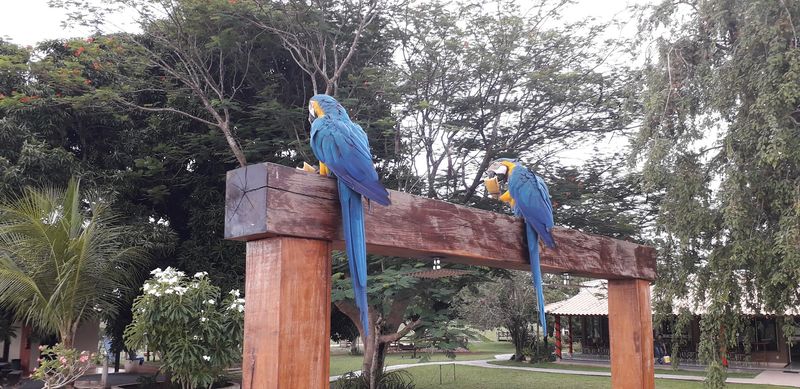
The northern Pantanal around Pocone is among the most wildlife-accessible parts of this vast wetland, and Pousada Piuval has built a reputation as a lodge where hyacinth macaws appear close to the main buildings without requiring a dedicated search. Regular sightings around the property reflect both the health of the local population and the relatively undisturbed character of the surrounding habitat.
Yellow-collared macaws also occur in this part of the Pantanal, adding a smaller, green-and-yellow species to the macaw list for guests who pay attention to the birds moving through the trees and scrub around the lodge. The contrast between the enormous hyacinth macaw and the comparatively compact yellow-collared is striking when both are seen in the same area.
Pousada Piuval’s location along the Transpantaneira highway gives it practical advantages for wildlife observation, since the elevated dirt road passes through flooded fields and forest edges that concentrate birds and mammals in predictable zones throughout the dry and wet seasons.
12. Pousada Rio Claro, Poconé, Mato Grosso, Brazil
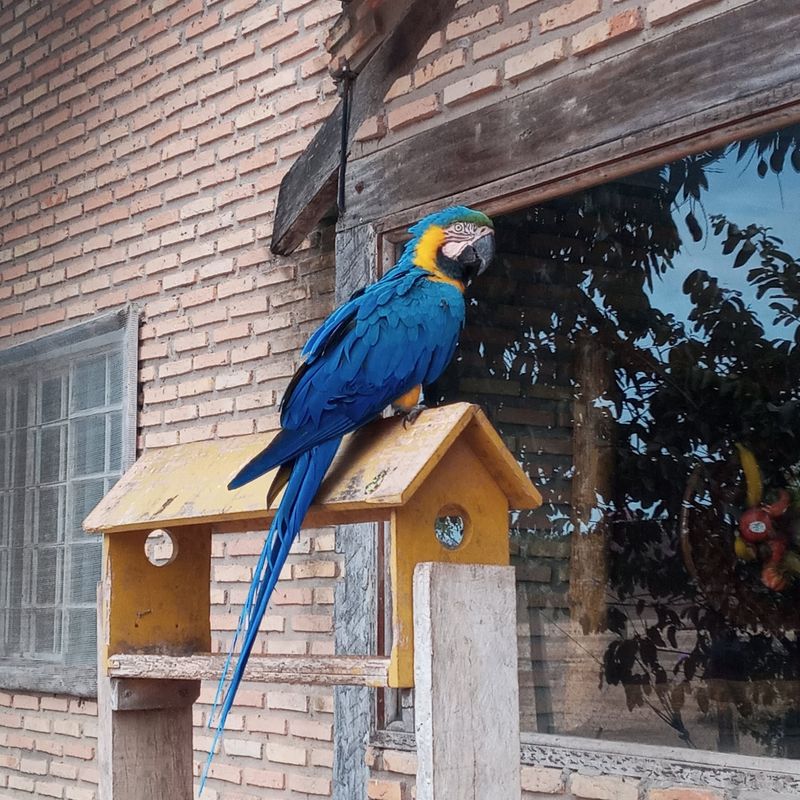
Farther along the Transpantaneira highway from Piuval, Pousada Rio Claro combines river-based excursions with reliable macaw sightings in a setting that feels more remote than many Pantanal lodges closer to Pocone. Hyacinth macaws have been documented in the trees immediately around the property, giving guests the unusual experience of observing the world’s largest flying parrot from the lodge grounds.
Boat trips on the Rio Claro add a different observational angle, with yellow-collared macaws appearing along the riverbanks and in the vegetation overhanging the water. The river excursions also produce a long list of other Pantanal bird species, making them worthwhile beyond the macaw focus alone.
The Transpantaneira itself functions as a wildlife corridor, and the bridges along its length cross rivers and flooded areas that attract concentrations of birds and caimans year-round. Pousada Rio Claro’s position deeper into the wetland means the surrounding habitat faces less pressure from agricultural activity than areas closer to the highway’s northern entrance.
13. Posada Amazonas, Tambopata, Madre de Dios, Peru
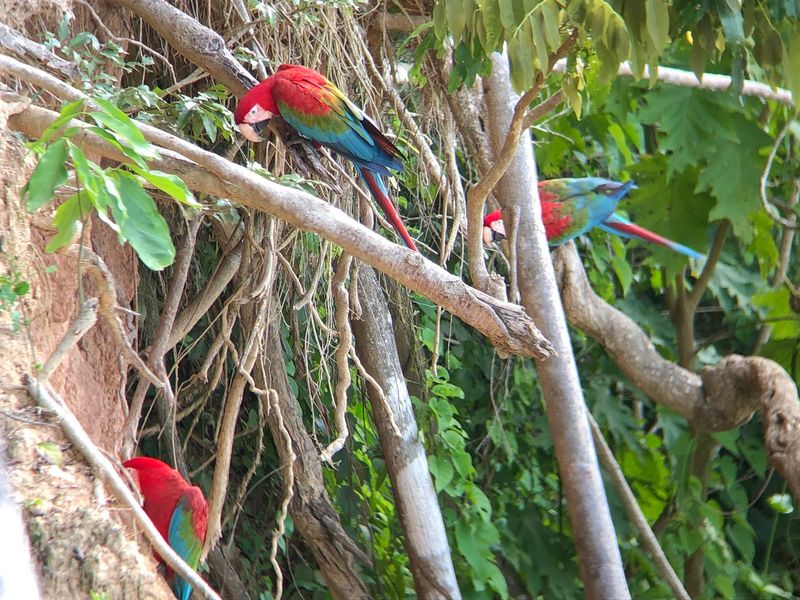
Collpa Hermosa is a clay lick set within the protected forest managed by the Ese Eja indigenous community, and Posada Amazonas provides the primary lodge-based access point for visiting it. During peak macaw season, dozens of macaws and parrot species gather at the clay bank, creating a concentrated display of species diversity that rewards visitors who arrive early and wait quietly.
An observation blind at the site allows guests to watch clay lick activity without standing in the open, which reduces disturbance to the birds and produces longer, more consistent observation windows. The blind design reflects lessons learned from decades of ecotourism management at clay lick sites throughout the Tambopata region.
Posada Amazonas operates through a formal partnership between Rainforest Expeditions and the Ese Eja community of Infierno, with a profit-sharing agreement that has been in place since 1996. That arrangement makes the lodge one of the longer-running indigenous community ecotourism models in the Peruvian Amazon, connecting macaw conservation directly to local economic development.
Share this story