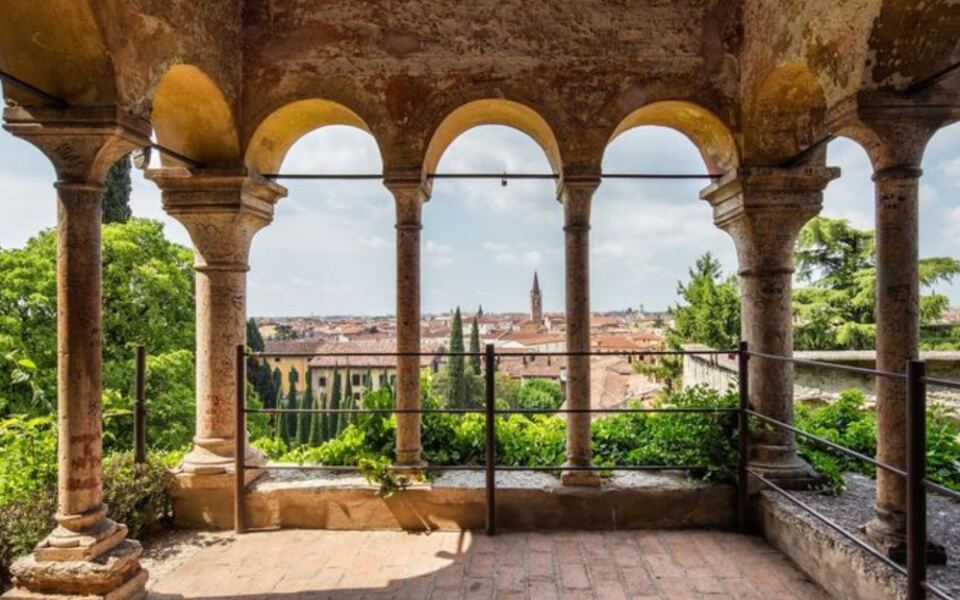
Verona is one of Italy’s most layered cities, where a Roman amphitheater sits just steps away from medieval towers, Gothic tombs, and Renaissance gardens. The Adige River wraps around the historic center like a natural moat, framing centuries of architecture in a single sweeping view.
UNESCO has recognized Verona’s historic center since 2000, calling it an exceptional example of a fortified city that grew continuously for roughly 2,000 years. Whether you are a history lover, a fan of Shakespeare, or simply someone who enjoys beautiful streets and great food, Verona delivers something memorable at every turn.
Arena di Verona
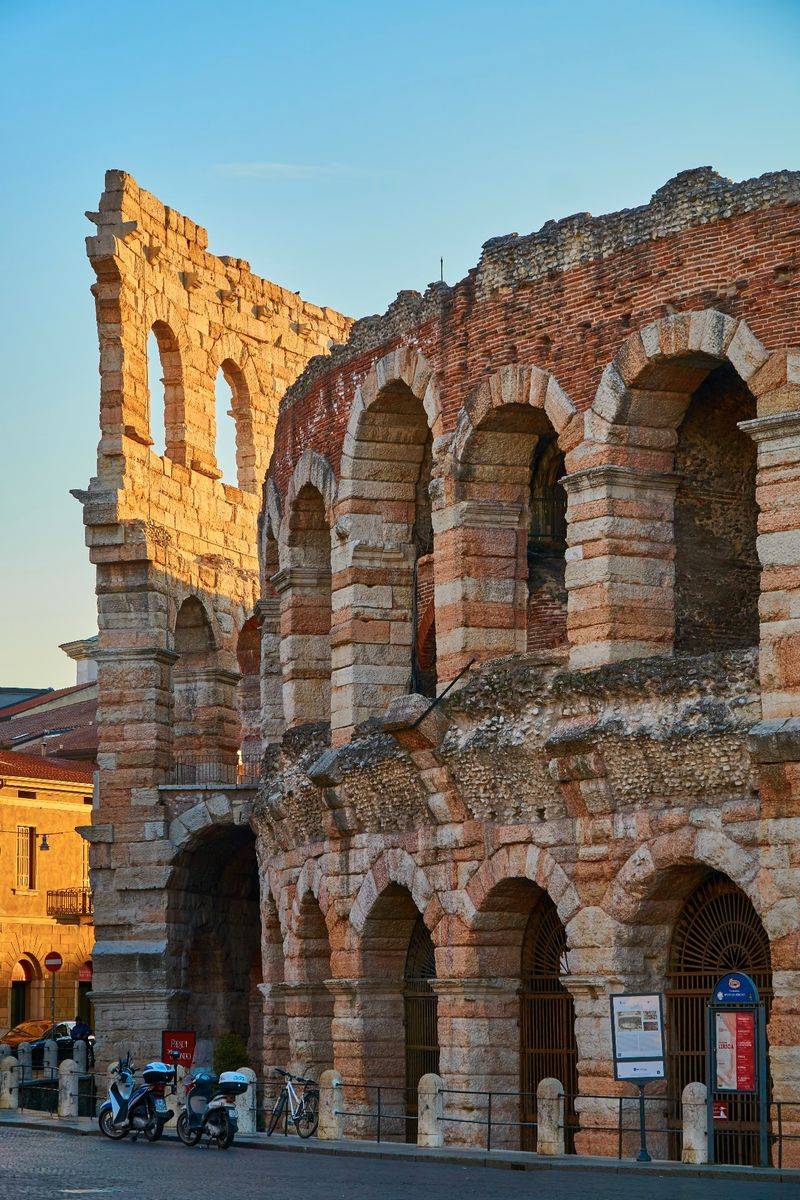
Nearly 2,000 years old and still selling tickets for summer opera, the Arena di Verona is the kind of ancient monument that makes your jaw drop before you even walk inside. Built around 30 CE, the elliptical amphitheater measures roughly 140 by 100 meters and rises about 31 meters above Piazza Bra.
It ranks among the best-preserved Roman amphitheaters on the planet.
What separates the Arena from other Roman ruins is that it never became just a museum piece. The Arena Opera Festival has been running here for over a century, packing the stone seating with tens of thousands of spectators for grand productions each summer.
Seeing a full-scale opera performed inside a Roman amphitheater is genuinely unlike anything else.
Even if opera is not your thing, walking through the arched entrance passages and climbing the ancient stone steps is worth every minute. The view from the upper rows stretches across Verona’s rooftops toward the surrounding hills.
Plan to arrive early in the day to beat the crowds and get the best photos before tour groups fill the piazza.
Piazza delle Erbe
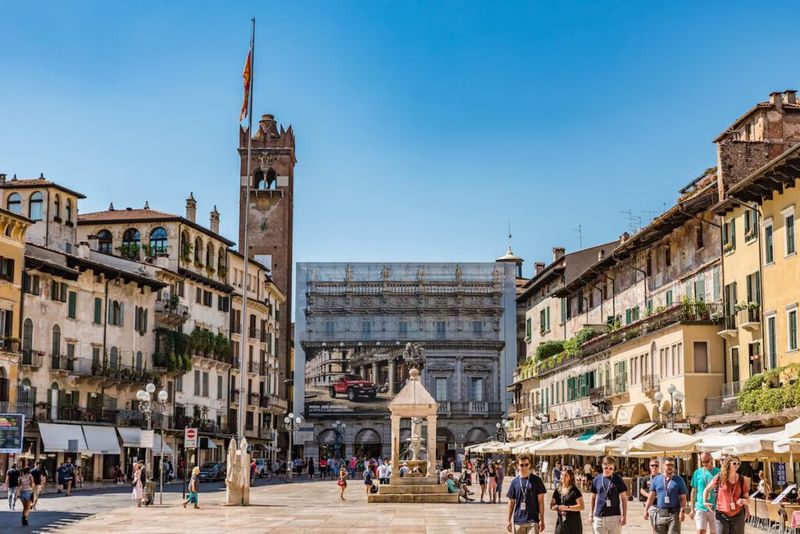
Verona’s most animated square has been the beating heart of city life for roughly two millennia, first as the Roman forum and later as a marketplace that never really stopped being busy. Today, Piazza delle Erbe buzzes with market stalls selling souvenirs and local produce, while café tables spill across the old cobblestones.
Look up and you will spot centuries of architectural ambition layered around the square. Frescoed Mazzanti houses share the skyline with Palazzo Maffei, the old town hall complex, and the tower of Torre dei Lamberti.
The Madonna Verona fountain near the center dates back to ancient times, though it was reassembled using Roman elements in the 14th century.
UNESCO specifically calls out Piazza delle Erbe and the adjacent Piazza dei Signori as the historic core of Verona, and spending time here makes that designation easy to understand. Grab a coffee at one of the outdoor cafés and watch the square shift from morning market energy to evening aperitivo hour.
The whole atmosphere changes beautifully as the day winds down and the lights warm up.
Torre dei Lamberti
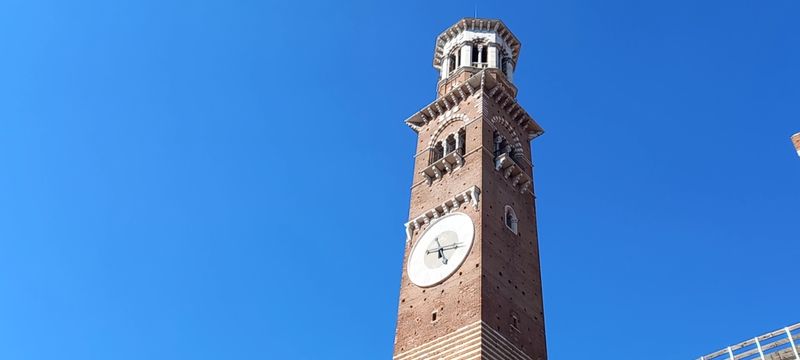
At 84 meters tall, Torre dei Lamberti has been looking down on Verona since the Lamberti family began building it in 1172. The tower grew taller in the 15th century, eventually becoming the highest point in the historic center and home to two bells with very different jobs.
The Marangona bell rang to mark working hours and warn citizens about fires, while the Rengo summoned the government or alerted the population during emergencies. Medieval Verona basically ran on bell time, and those two instruments kept the whole city on schedule.
Knowing that history makes climbing the tower feel a little more meaningful than just chasing a view.
You can reach the top by stairs or by elevator, and either way the panorama waiting up there is spectacular. Looking straight down onto Piazza delle Erbe and Piazza dei Signori from above reveals how tightly packed and logically organized medieval Verona really was.
On clear days, the hills beyond the Adige and even distant mountain outlines appear on the horizon. Budget about 30 to 45 minutes for the full experience.
Piazza dei Signori and the Scaliger Tombs
Step through the archway from Piazza delle Erbe and the atmosphere shifts immediately. Piazza dei Signori feels more composed and serious, framed by palaces that once housed the machinery of medieval government.
A statue of Dante Alighieri stands at the center, a nod to the poet who found refuge in Verona during his exile.
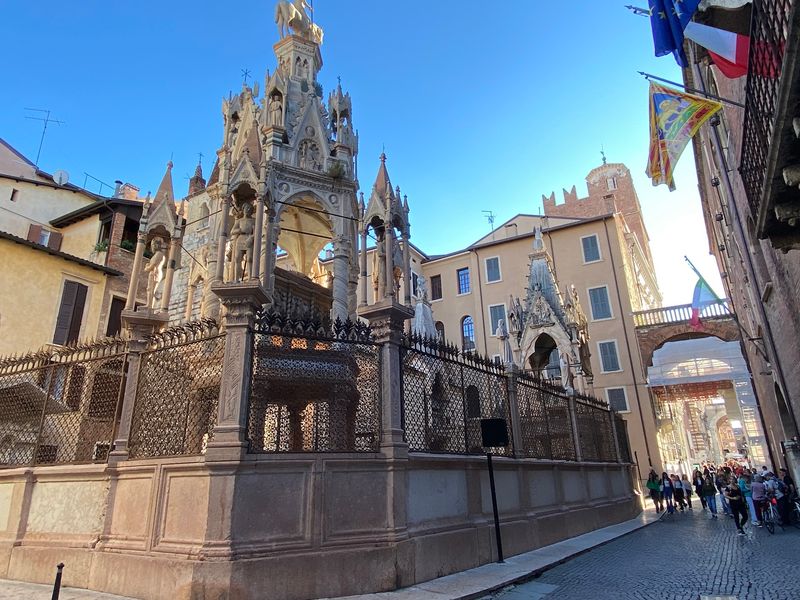
Just beside the square, the Arche Scaligere are the Gothic funerary monuments built for the della Scala family, the dynasty that ruled Verona at the height of its medieval power. Verona’s tourism authority describes them as a kind of stone garden, and that phrase actually fits.
Elaborate stone canopies, equestrian statues, carved sarcophagi, and decorative ironwork crowd together in a small outdoor enclosure.
The contrast between the restrained square and these highly decorated tombs is striking. Cangrande I della Scala, one of the most celebrated rulers in Verona’s history, is among those commemorated here.
Even if Gothic funerary art sounds like a niche interest, the sheer craftsmanship on display makes this one of the most visually striking stops in the city. Admission to the interior enclosure is required for a closer look.
Juliet’s House
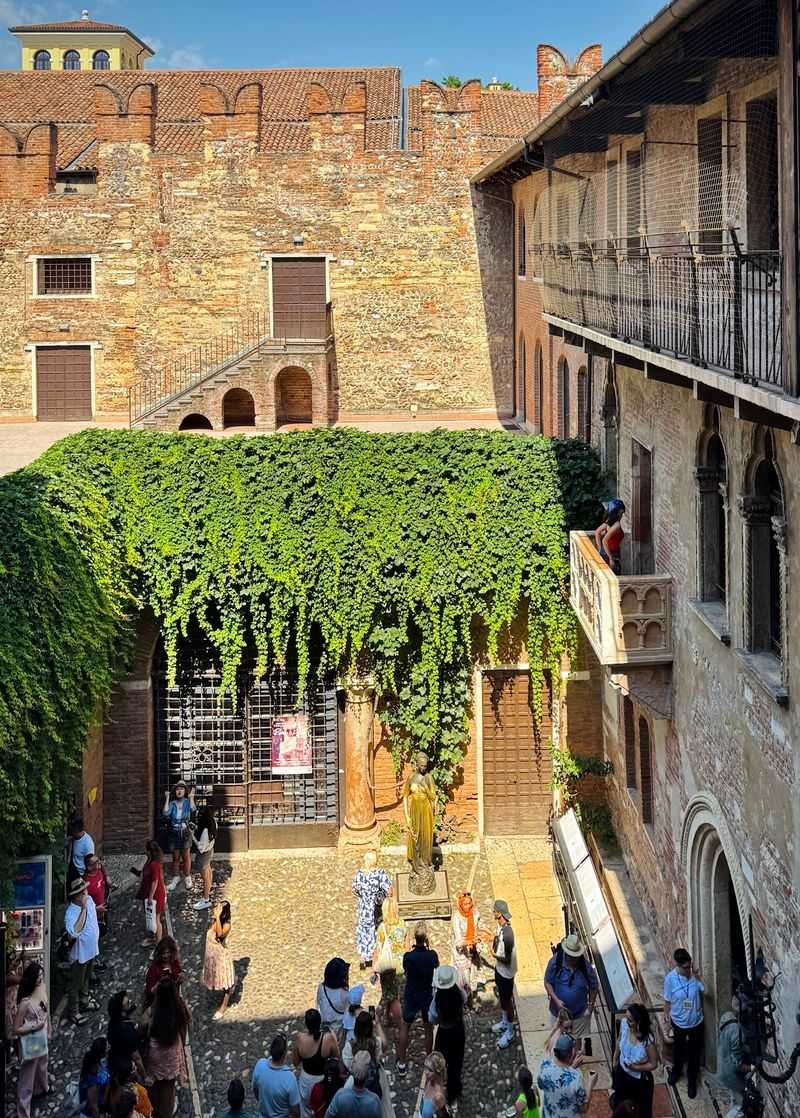
Few places in the world attract visitors based entirely on a fictional love story, but Juliet’s House on Via Cappello pulls it off with remarkable success. The medieval building once belonged to the Dal Cappello family, which is close enough to Shakespeare’s Capulets that the city of Verona leaned into the connection hard.
The famous balcony was actually installed during restorations in 1939 and 1940, assembled from 14th-century stonework that had been sitting in storage at Castelvecchio. Museum director Antonio Avena created the romanticized appearance you see today.
Inside, the museum displays artworks and objects tied to the Romeo and Juliet story, including a bed that appeared in Franco Zeffirelli’s 1968 film adaptation.
The courtyard walls are famously covered in love notes and padlocks left by visitors, and the bronze statue of Juliet has been rubbed so frequently that parts of it gleam bright gold. Since April 2026, entry requires advance online booking through a new route via Teatro Nuovo, so check ahead before showing up.
The courtyard itself is charming, but the real draw is the story layered onto every stone surface.
Castelvecchio and the Scaliger Bridge
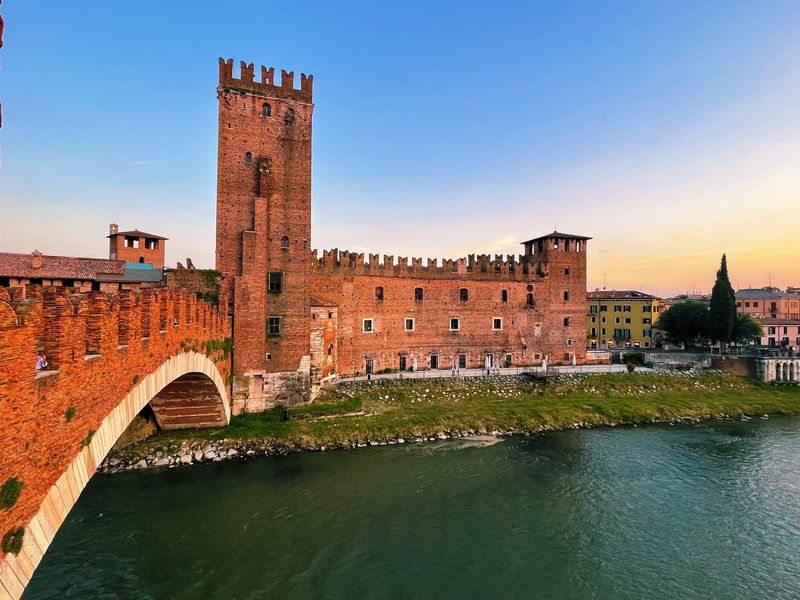
Built in the mid-14th century for Cangrande II della Scala, Castelvecchio was designed to be both a luxurious residence and a fortress that could survive a political crisis. The adjoining Scaliger Bridge, completed between 1354 and 1356, was essentially a private escape route over the Adige, giving the ruler a protected path north if things went badly inside the city walls.
Retreating German forces destroyed the bridge at the end of World War II, but Verona rebuilt it carefully using salvaged original materials. The result is a red-brick structure with three unequal arches and crenellated walls that looks almost exactly as it did in the 14th century.
Walking across it gives you some of the best close-up river views in central Verona.
Castelvecchio itself now houses one of the region’s most respected art museums, with medieval and Renaissance works displayed across the castle’s original rooms and towers. The building was thoughtfully renovated by architect Carlo Scarpa in the 1960s, and the renovation itself is considered an architectural landmark.
Even visitors who skip the museum should at least walk across the bridge and take in the river from both sides.
Basilica of San Zeno
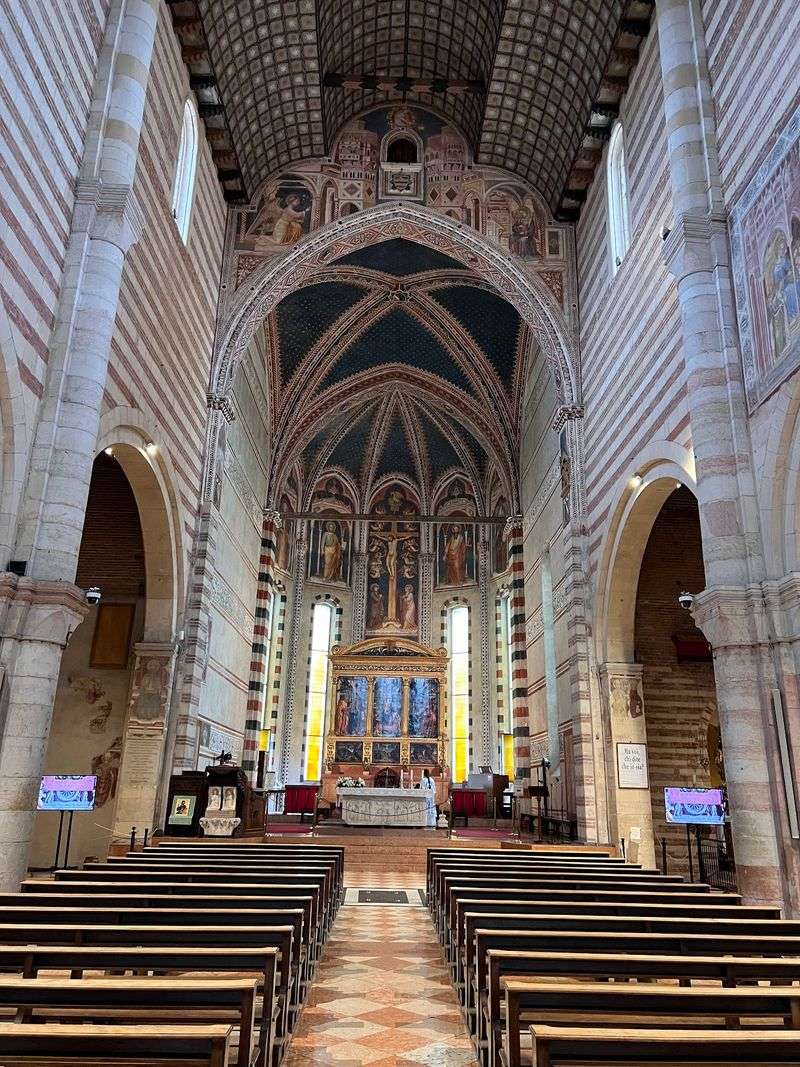
Honestly, the Basilica of San Zeno deserves far more attention than it typically gets from visitors rushing between Juliet’s House and the Arena. This is one of northern Italy’s finest surviving Romanesque churches, and its facade alone rewards a long, careful look.
Pale tuff stone alternates with brick in a pattern that feels both deliberate and surprisingly modern.
San Zeno developed around the burial site of the city’s patron saint on land that had previously served as a Roman and early Christian cemetery. The church grew in stages over centuries, which is why the interior layers Romanesque architecture, medieval frescoes, and Gothic vaulting in a sequence that feels almost like reading a timeline.
Andrea Mantegna’s celebrated altarpiece is the undisputed highlight inside.
The basilica sits slightly west of the busiest tourist streets, which means the walk there takes you through quieter residential blocks that most visitors never see. That combination of a less-crowded route and a genuinely extraordinary destination makes San Zeno one of Verona’s most satisfying half-day decisions.
Go on a weekday morning if possible, when light filters through the windows and the building feels almost entirely yours.
Ponte Pietra
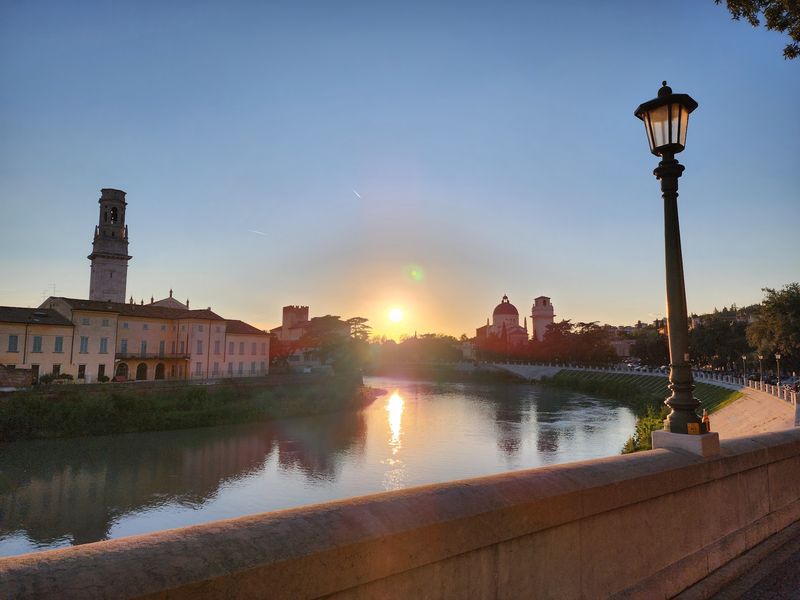
Ponte Pietra is technically a bridge, but it functions more like a compressed history lesson spanning the Adige River. Two of its five arches are genuinely Roman, surviving from antiquity while the rest of the structure was rebuilt multiple times after floods and wartime damage.
Few bridges anywhere combine so many different construction eras in a single crossing.
Like the Scaliger Bridge, Ponte Pietra was destroyed by retreating German forces in 1945. Engineers recovered stone blocks from the riverbed and used them during reconstruction, which means much of what you see today is original material reassembled with great care.
The mixed masonry gives the bridge a character that a clean modern restoration would have erased entirely.
The location is also simply beautiful. Standing on Ponte Pietra and looking downstream reveals riverfront houses in warm terracotta tones, church towers breaking the skyline, wooded hills rising beyond the rooftops, and the curve of the Adige threading through it all.
The bridge also serves as the gateway to the Roman Theatre and the climb toward Castel San Pietro, making it a natural starting point for an afternoon of exploration on the quieter east bank.
Roman Theatre and Archaeological Museum
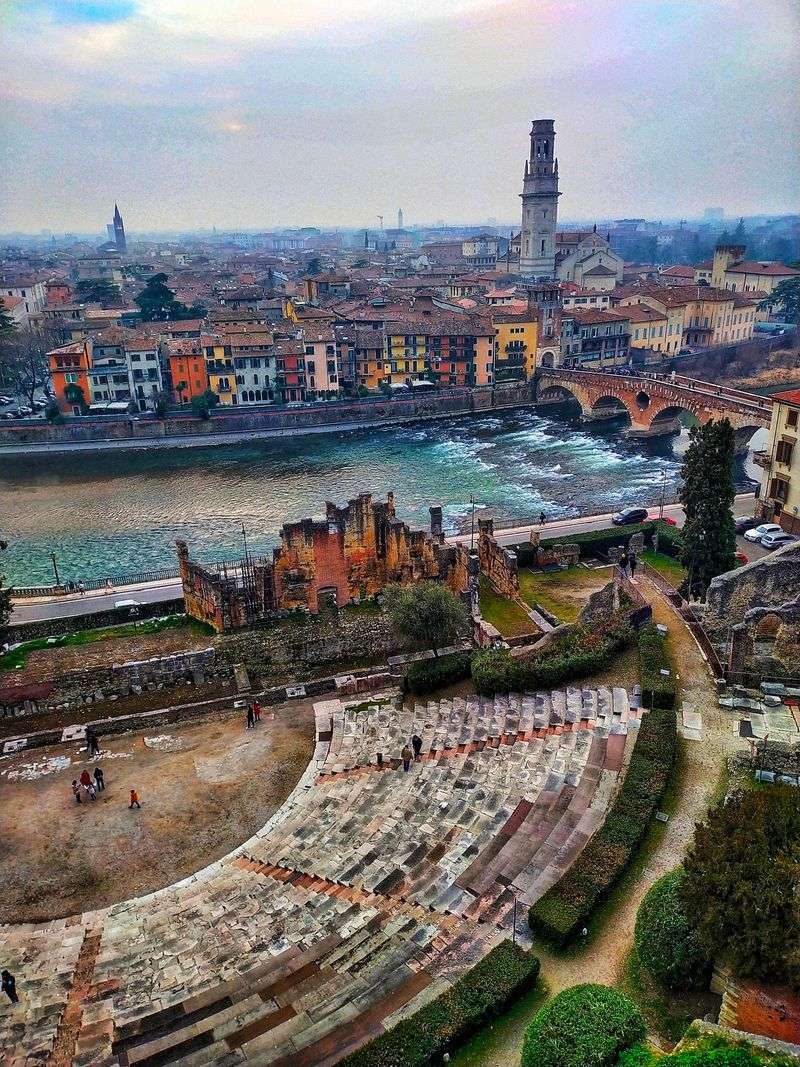
Cross Ponte Pietra and climb the east bank and you quickly realize that the Arena was not Verona’s only major Roman entertainment venue. The Roman Theatre was carved into the slopes of San Pietro hill toward the end of the first century BCE, originally covering an area about 150 meters wide and rising roughly 60 vertical meters up the hillside.
That is a seriously ambitious construction project for any era.
Over the following centuries, houses, churches, and a monastery gradually buried much of the theater under new construction. Archaeological excavations began in the 19th century and slowly uncovered what had been hidden for hundreds of years.
The monastery above the theater now serves as the Archaeological Museum, displaying mosaics, inscriptions, bronze objects, sculptures, and other Roman material recovered from the site and surrounding area.
Summer performances still take place within the ancient theater, continuing a tradition that stretches back to antiquity in a way that feels genuinely unbroken. The hillside setting above the river creates a backdrop that no indoor theater can replicate.
Even outside performance season, the combination of Roman ruins and museum collections makes this one of the most intellectually satisfying stops on the east bank of the Adige.
Castel San Pietro
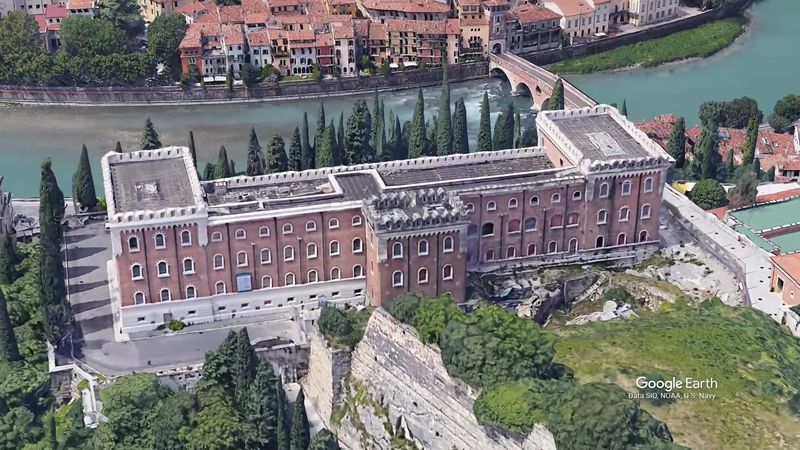
Forget touring the interior because Castel San Pietro is really all about the terrace and what it reveals. Perched on the hill directly above the Roman Theatre, the fortress offers what many visitors call the single best panoramic view of Verona, and it is hard to argue with them once you are standing up there.
The site has a long history beneath its current military-era exterior. A Roman temple once occupied the hilltop, followed by a medieval church dedicated to Saint Peter.
The austere building you see today was constructed by Austrian forces in the 19th century, giving the hill a fortress profile that reads as dramatic from below even if the architecture is not especially elegant up close.
You can reach the terrace by climbing a steep staircase from Ponte Pietra or by taking the funicular, which runs from a station near the base of the hill. The funicular is the easier option and worth taking at least one way.
From the top, the entire curve of the Adige unfolds below, with Ponte Pietra, church domes, medieval towers, and the densely packed red rooftops of the historic center arranged like a living map. Arrive around sunset for peak atmosphere.
Giardino Giusti
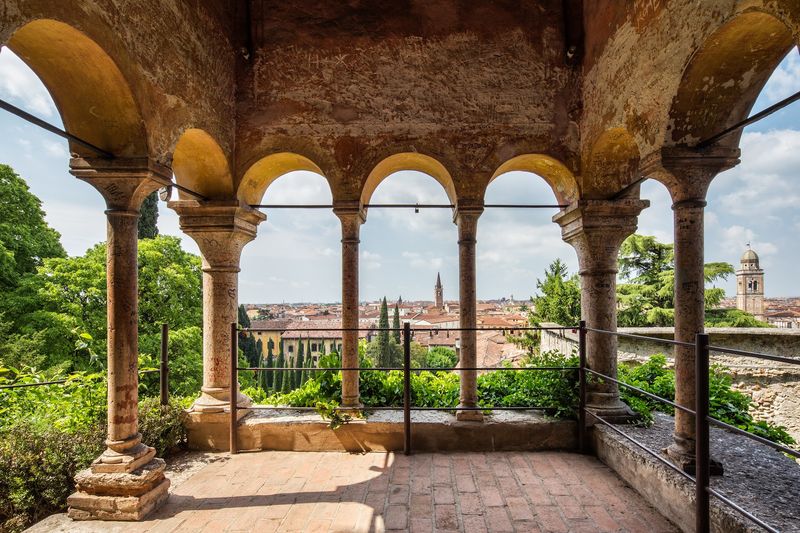
After days of stone streets and crowded squares, Giardino Giusti arrives like a genuinely welcome change of pace. Tucked behind the Veronetta district on the east bank of the Adige, this Renaissance garden was created in the second half of the 16th century and has remained in the same family ever since.
That kind of continuous private ownership for nearly 500 years is rare by any standard.
Citrus trees in terracotta pots, mythological statues, grottoes, fountains, and carefully arranged paths wind upward through terraced levels toward viewpoints over the city. Roman remains are woven into the garden’s fabric, adding another layer of historical texture to an already rich setting.
The adjoining palazzo has recently reopened several historic rooms as Appartamento 900, displaying art and furnishings connected with centuries of Giusti family history.
The upper terraces offer elevated views over Verona’s rooftops and church towers that rival those from Castel San Pietro, but with greenery and garden fragrance replacing stone and military architecture. It is a good spot to slow down, take photos at a relaxed pace, and let the visit breathe a little.
Late morning on a weekday tends to be the quietest time to visit.
Porta Borsari
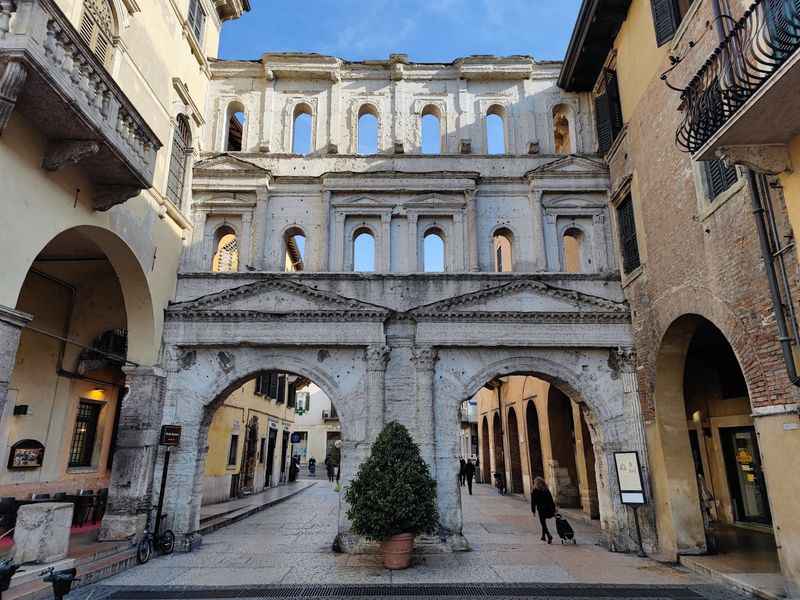
Porta Borsari has a gift for surprising people. You are walking down a busy shopping street, looking at cafe menus and boutique windows, and then suddenly an enormous Roman gateway appears between the buildings like it has always been there.
Which, of course, it has – for roughly 2,000 years.
The monumental stone facade marked a major entrance along the ancient Via Postumia, the road that connected Genoa to Aquileia and passed directly through Verona. From this gate, the road led straight toward the Roman forum, which is now Piazza delle Erbe.
Verona’s official Roman itinerary notes that the gate formed part of a city wall roughly 940 meters long, later reinforced during the third century CE when Roman defenses across the empire were being upgraded.
The pale stone facade preserves decorative arches and columns that give a clear sense of how Roman architects treated civic gateways as statements of civic pride, not just functional openings. Pairing a visit here with a walk to Piazza delle Erbe lets you trace the actual route of one of Roman Verona’s primary streets.
The whole detour takes maybe 20 minutes but adds a satisfying layer of Roman context to the city center.
Walk the Adige Riverfront
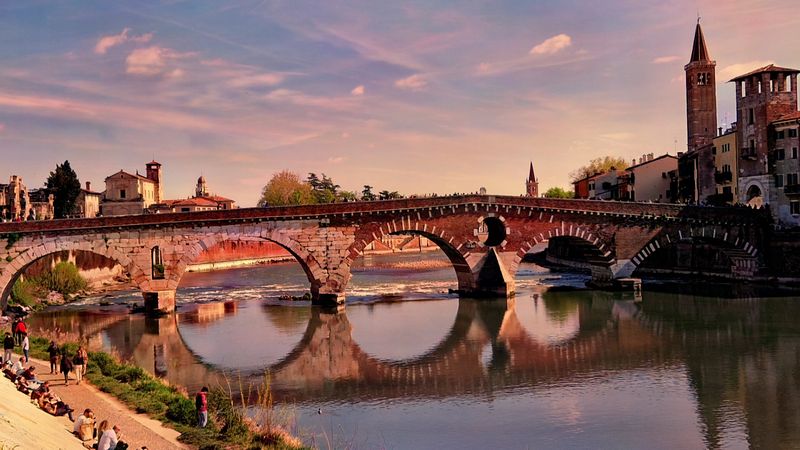
Some of the most memorable scenery in Verona costs absolutely nothing. The Adige River bends around the historic center in a wide curve, creating long stretches of embankment where the city essentially puts its best face on display.
Medieval bridges, church towers, Castelvecchio’s red-brick walls, and rows of warm-toned buildings reflect in the water on calm mornings in a way that feels almost too picturesque to be real.
UNESCO notes that Verona’s Roman core developed within this river loop, while later fortifications expanded around it. That means the Adige has been shaping Verona’s layout, defenses, and daily life for virtually its entire recorded history.
Walking the embankment is not just pleasant scenery; it is tracing the actual boundary of ancient and medieval Verona.
A particularly rewarding route links Castelvecchio with Ponte Pietra before climbing toward Castel San Pietro. This single walk connects fortifications, Roman monuments, historic bridges, and panoramic hilltop views in a logical sequence that takes two to three hours at a relaxed pace.
Bring comfortable shoes, carry water, and leave plenty of time for stops. The light on the river is especially good in the hour before sunset, when the stone bridges glow amber and the water turns gold.
Share this story