Scattered across continents, some of the most jaw-dropping structures on Earth are not bridges or skyscrapers but statues. These colossal figures have been built to honor gods, heroes, and national identities, often taking decades and thousands of workers to complete.
From a towering iron man in India to a golden Buddha rising above rice paddies in Thailand, each monument tells a story that goes far beyond its staggering height. Get ready to look up, way up, at 15 of the most remarkable statues ever built.
Statue of Unity – India
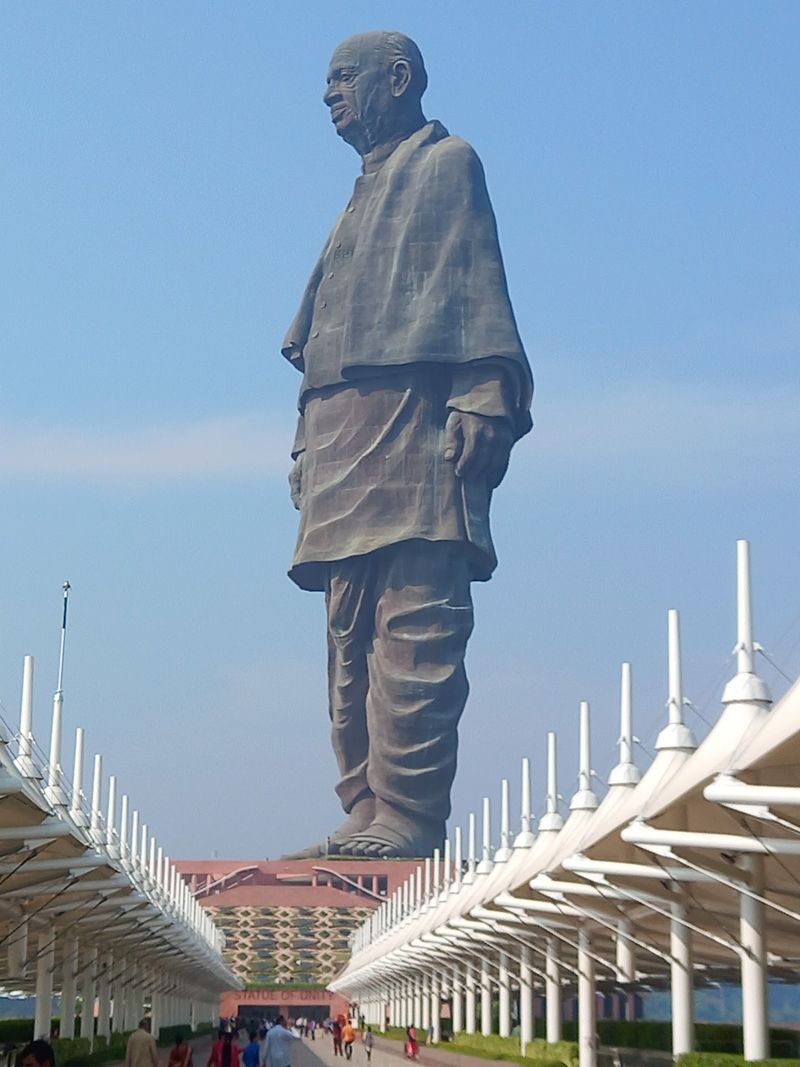
Rising 182 meters above the Narmada River in Gujarat, the Statue of Unity is so tall that clouds occasionally drift past its chest. It honors Sardar Vallabhbhai Patel, the man who helped unite hundreds of independent princely states into one nation after India gained independence in 1947.
His nickname, the Iron Man of India, gives you a sense of just how tough and determined he was.
The statue’s height was not chosen randomly. Gujarat’s state legislature has exactly 182 seats, so the number carries real political meaning.
Construction wrapped up in 2018 after roughly five years of work involving thousands of laborers and engineers. The total monument, including its base, reaches about 240 meters.
Inside the chest area, there is a viewing gallery where visitors can peer out over the surrounding reservoir and hills. The statue used around 70,000 tons of cement, 18,500 tons of steel, and bronze panels covering the exterior.
Farmers across India were even asked to donate old farming tools that were melted down and incorporated into the foundation. Few monuments anywhere blend national symbolism with engineering ambition quite so boldly.
Spring Temple Buddha – China
Before India stole the title in 2018, this colossal golden figure in Henan Province was the undisputed heavyweight champion of the statue world. The Spring Temple Buddha represents Vairocana Buddha and stands approximately 128 meters above its lotus pedestal, which itself sits on top of a large monastery platform.
Stack everything together and the full complex soars well above 200 meters.
Construction finished in 2008, and the project reflected a surge of large-scale Buddhist monument building happening across China at the time. Despite its record-breaking size, the statue sits in a relatively rural part of Henan near the town of Lushan, meaning it draws far fewer international tourists than its dimensions deserve.
Many visitors are domestic pilgrims rather than sightseers from abroad.
The Fodushan Scenic Area surrounding the Buddha includes temples, walkways, and smaller religious structures that create a full devotional landscape around the central figure. The statue’s golden surface catches sunlight in ways that make it visible from remarkable distances across the flat countryside.
For nearly a decade it was the world’s tallest, and even today it comfortably holds second place among the giants of the sculpted world.
Laykyun Sekkya – Myanmar
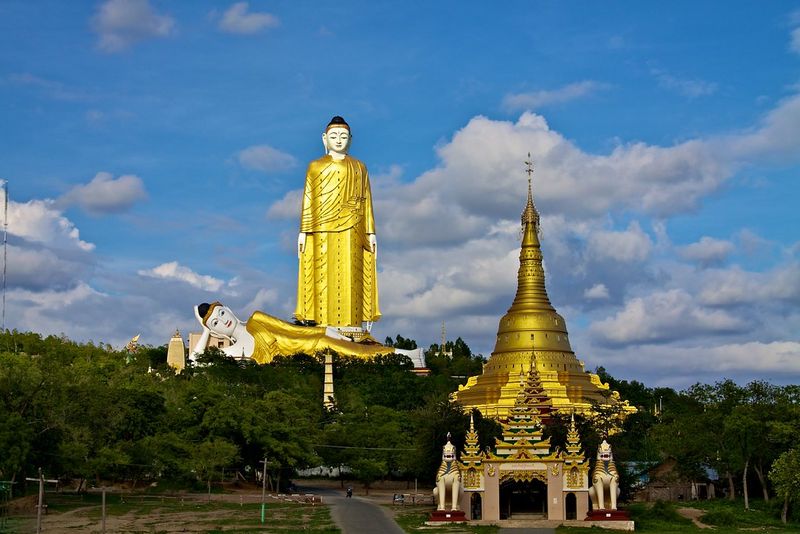
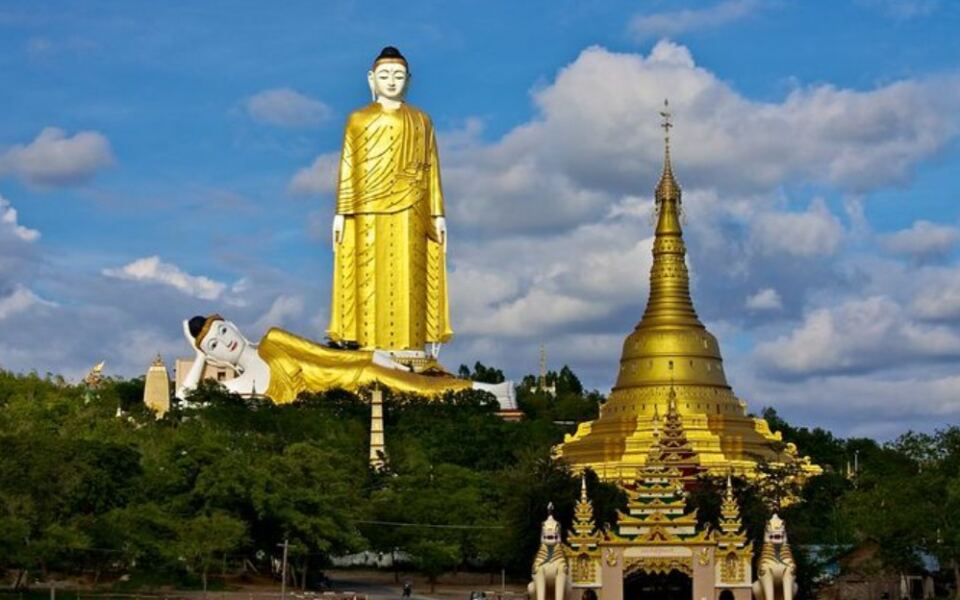
You can spot this golden giant from miles away as you travel through the flat plains around Monywa in Sagaing Region. Myanmar’s Laykyun Sekkya stands approximately 116 meters tall and represents Gautama Buddha in a serene standing pose.
What makes the setting even more striking is that a massive reclining Buddha lies nearby, creating a dramatic religious duo that feels almost theatrical in scale.
Construction began in the 1990s under the guidance of Buddhist monk Ven. Narada and was completed in the early 2000s.
The interior of the standing statue is accessible to visitors, with multiple levels displaying Buddhist artwork, paintings, and sculptural scenes illustrating teachings and stories from Buddhist tradition. Climbing through the interior feels like walking through a devotional illustrated textbook.
The statue belongs to the Maha Bodhi Ta Htaung monastery complex, which also contains thousands of smaller pagodas and Buddha images spread across the surrounding grounds. Myanmar has a long tradition of building oversized religious monuments, and Laykyun Sekkya sits at the top of that tradition.
Its combination of sheer height, interior detail, and surrounding religious landscape makes it one of Southeast Asia’s most genuinely impressive pilgrimage destinations.
Vishwas Swaroopam – India
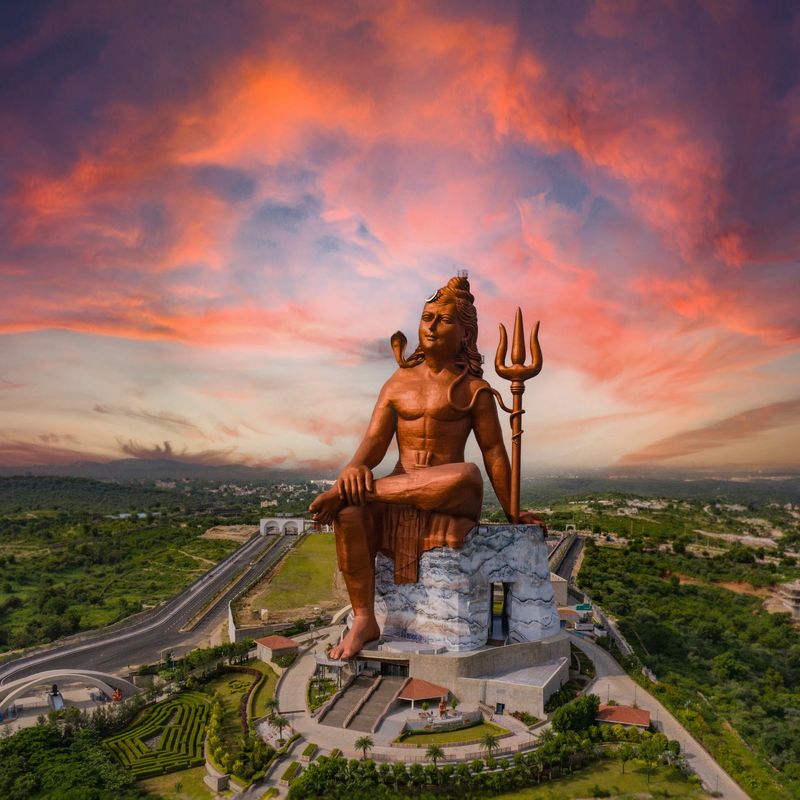
Most giant statues stand upright, arms at their sides, staring straight ahead. Vishwas Swaroopam breaks that pattern completely by depicting Shiva seated in a calm meditative posture, which created serious engineering puzzles for the teams who built it.
Located near Nathdwara in Rajasthan, the sculpted figure reaches roughly 106 meters, with the full monument measuring about 112 meters including its supporting structure.
The project took close to a decade to complete and opened to the public in 2022. Hundreds of workers contributed to constructing the interior steel framework and applying the copper-toned exterior finish that gives the statue its distinctive warm appearance.
Engineers designed the structure to handle strong winds and seismic activity, challenges that become especially tricky when a figure’s arms extend outward from a seated position.
Nathdwara is already a well-known pilgrimage town famous for the Shrinathji temple, so Vishwas Swaroopam added a massive new attraction to an area already accustomed to large numbers of religious visitors. Shiva is shown with a serene expression, a trident resting nearby, and the Ganges River symbolically flowing from his hair.
The statue quickly became known by its English name, the Statue of Belief, reflecting the devotion that drove its creation.
Ushiku Daibutsu – Japan
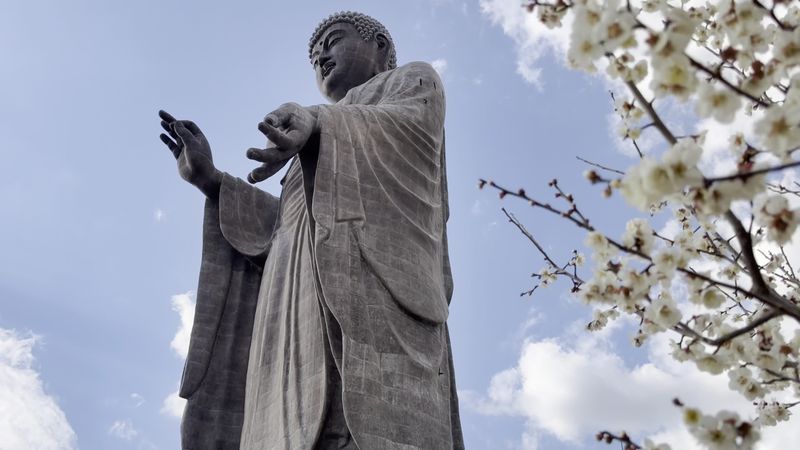
Imagine riding an elevator inside a Buddha statue to reach windows nearly 85 meters off the ground. That is exactly what visitors do at the Ushiku Daibutsu in Ibaraki Prefecture, where the bronze figure of Amitabha Buddha stands 100 meters tall above its lotus platform, with the full structure reaching 120 meters.
From 1993 until 2008, this was the world’s tallest statue, holding the record for fifteen years.
The statue was built to honor Shinran, the 12th-century monk who founded the Jodo Shinshu school of Japanese Buddhism. The connection makes the location feel genuinely meaningful rather than just a tourist attraction chasing a height record.
Inside, a level near the base contains thousands of tiny golden Buddha figures lining the walls, creating an almost otherworldly atmosphere.
The complete structure weighs around 4,000 tons, which is roughly equivalent to 2,500 average-sized cars stacked together. A surrounding nature park with deer roaming freely gives the monument a peaceful, almost fairy-tale setting that contrasts with its enormous scale.
Seasonal flowers bloom around the base in spring and autumn, making the grounds a popular spot for photographers. Few statues in the world manage to be both record-breaking in size and genuinely beautiful in their surroundings.
Guishan Guanyin – China
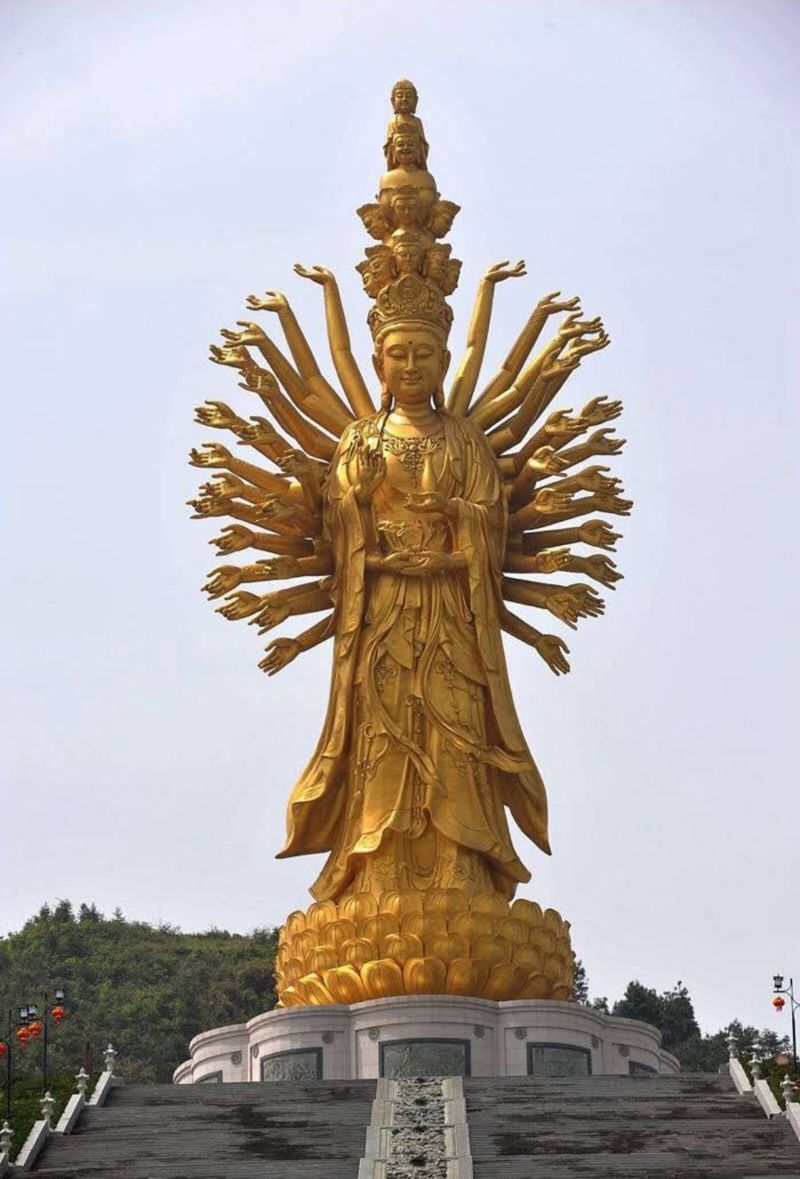
Standing 99 meters tall at Miyin Temple in Hunan Province, the Guishan Guanyin is one of the most visually complex giant statues anywhere on the planet. The figure represents a special form of Guanyin, the Buddhist bodhisattva of compassion, shown with a thousand hands and a thousand eyes.
The idea behind this imagery is that Guanyin can see suffering everywhere and reach out in countless directions to offer help.
Completed in 2009, the gilded bronze surface catches sunlight brilliantly, making the statue glow against the surrounding forested hills. The arms do not literally number one thousand, but they are organized in a carefully designed arrangement of radiating limbs, each holding symbolic objects or forming meaningful gestures.
Getting the structural engineering right for a figure with so many outward-extending elements required serious planning.
The elevated temple setting adds to the dramatic effect, placing the statue above a landscape of traditional Chinese religious architecture. Visitors approaching from below get a gradually unfolding view as the figure rises above the rooftops and treetops.
China has built many enormous Buddhist statues, but the Guishan Guanyin stands out for its ornate complexity rather than simply its height. The combination of gold, symmetry, and sheer size makes it genuinely unforgettable to anyone who sees it in person.
Mother of All Asia – Tower of Peace, Philippines
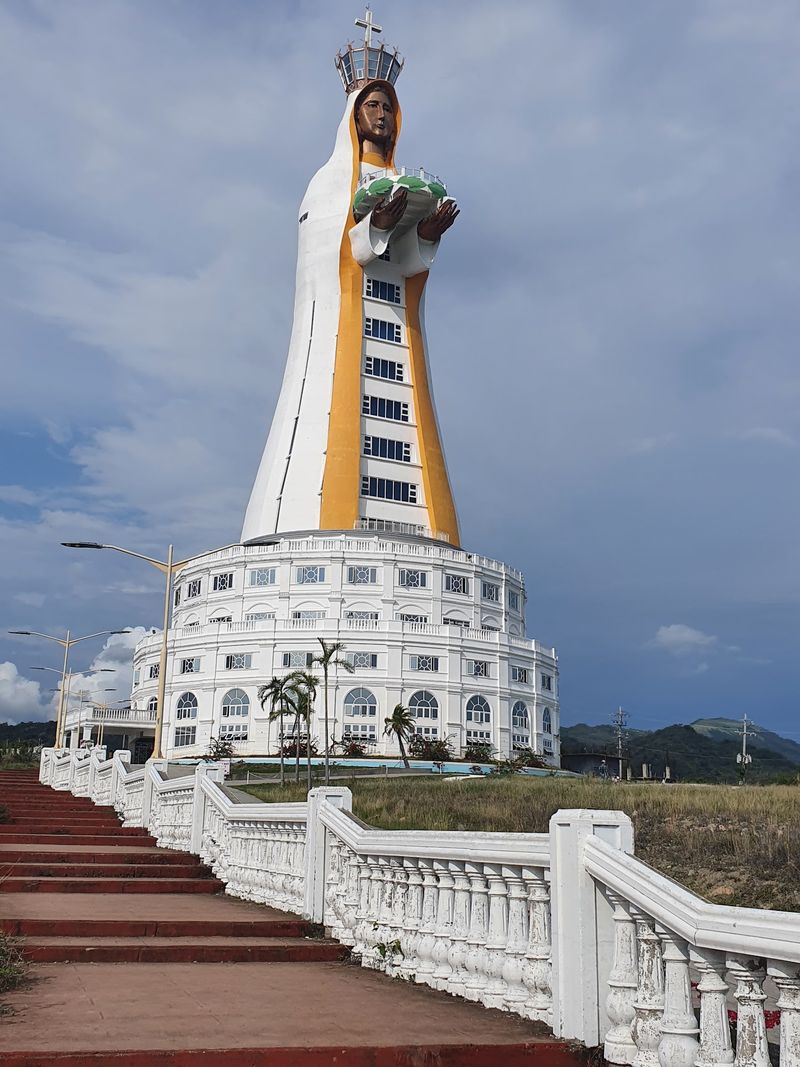
Perched above Batangas Bay in the Philippines, the Mother of All Asia stands as the world’s tallest statue of the Virgin Mary, reaching approximately 98.15 meters. Completed in 2021, the monument rises at the Montemaria International Pilgrimage and Conference Center, a sprawling religious complex designed to welcome visitors from across Asia and beyond.
The view from the site, with the bay stretching out below, adds a sense of peaceful grandeur that photographs barely capture.
The statue was conceived as a symbol of unity and hope, with its name reflecting the aspiration that the Virgin Mary serves as a mother figure for all of Asia’s diverse peoples. Unlike many giant statues that are essentially solid exterior sculptures, the lower sections of this structure contain interior spaces integrated into the pilgrimage complex.
That makes it functional as well as monumental.
Among the world’s tallest statues, this one stands out because it represents a Christian tradition, joining a list otherwise dominated by Buddhist and Hindu figures. The Philippines is the most heavily Catholic country in Asia, so the statue carries deep cultural and religious meaning for millions of Filipinos.
Construction of a monument this size in a country with frequent typhoons required careful engineering to ensure the structure could withstand powerful storms.
Great Buddha of Thailand – Wat Muang
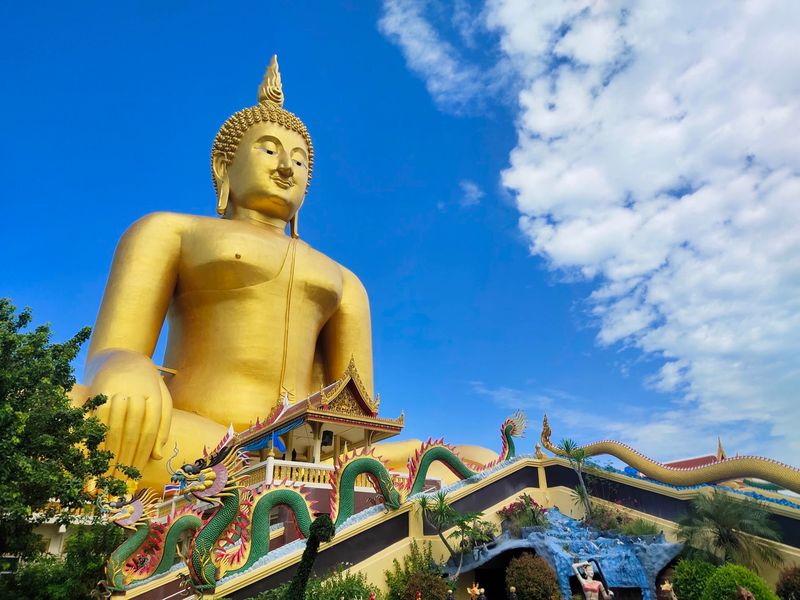
Standing in the middle of Thailand’s flat Ang Thong Province, the Great Buddha at Wat Muang is the kind of sight that makes you pull over and stare. The golden seated figure rises approximately 95 meters above the surrounding rice fields, making it visible from a considerable distance before you even reach the temple grounds.
The Tourism Authority of Thailand notes that construction took around 16 years to complete.
The Buddha is depicted in the bhumisparsha mudra, the earth-touching posture, which represents the moment Gautama Buddha achieved enlightenment under the Bodhi tree. This posture is one of the most significant in Buddhist art, and seeing it executed at this scale gives the gesture a completely different impact than any museum statue could.
Visitors standing at the base look up at knees that dwarf full-grown trees.
Wat Muang is not just about the giant Buddha. The temple complex includes a series of vivid sculptural displays depicting Buddhist ideas about heaven and hell that are both educational and surprising.
Families visit with children who are as fascinated by the unusual scenes as by the towering central figure. The combination of spiritual gravity and visual spectacle makes Wat Muang one of central Thailand’s most rewarding stops for any curious traveler.
Sendai Daikannon – Japan
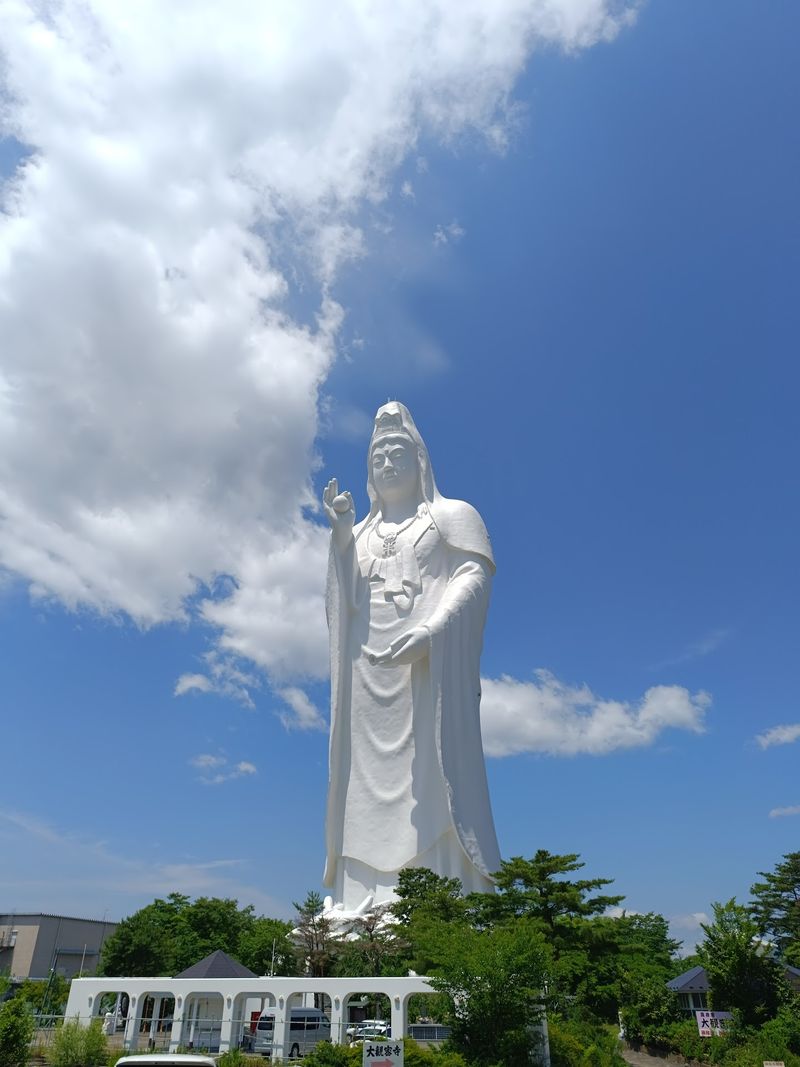
Sendai’s white Kannon statue is the kind of landmark that surprises first-time visitors who spot it suddenly rising above the city’s rooftops. The full structure reaches 100 meters, with the sculpted figure itself measuring roughly 92 meters above its pedestal.
The total height was chosen deliberately to mark the 100th anniversary of Sendai being established as a city, giving the monument a civic significance beyond its religious imagery.
There is even more symbolism packed into the design. An additional 21 meters of structure extend below ground level, representing hope for prosperity in the 21st century.
Visitors enter through an opening shaped like a dragon’s mouth, which sets the tone for the interior, where 108 Buddhist figures and other religious imagery line the walls across multiple levels. The number 108 holds traditional significance in Buddhism.
An elevator carries visitors toward the upper sections, where observation windows offer sweeping views across Sendai and toward the mountains and Pacific coast beyond. The statue depicts Kannon, the bodhisattva of compassion known in Japan as a protector of sailors, travelers, and those facing hardship.
Despite its enormous size, the white figure has a quieter, more elegant presence than many of the golden giants on this list. Sendai residents have genuinely taken it to heart as part of their city’s identity.
Dai Kannon of Kita no Miyako Park – Japan
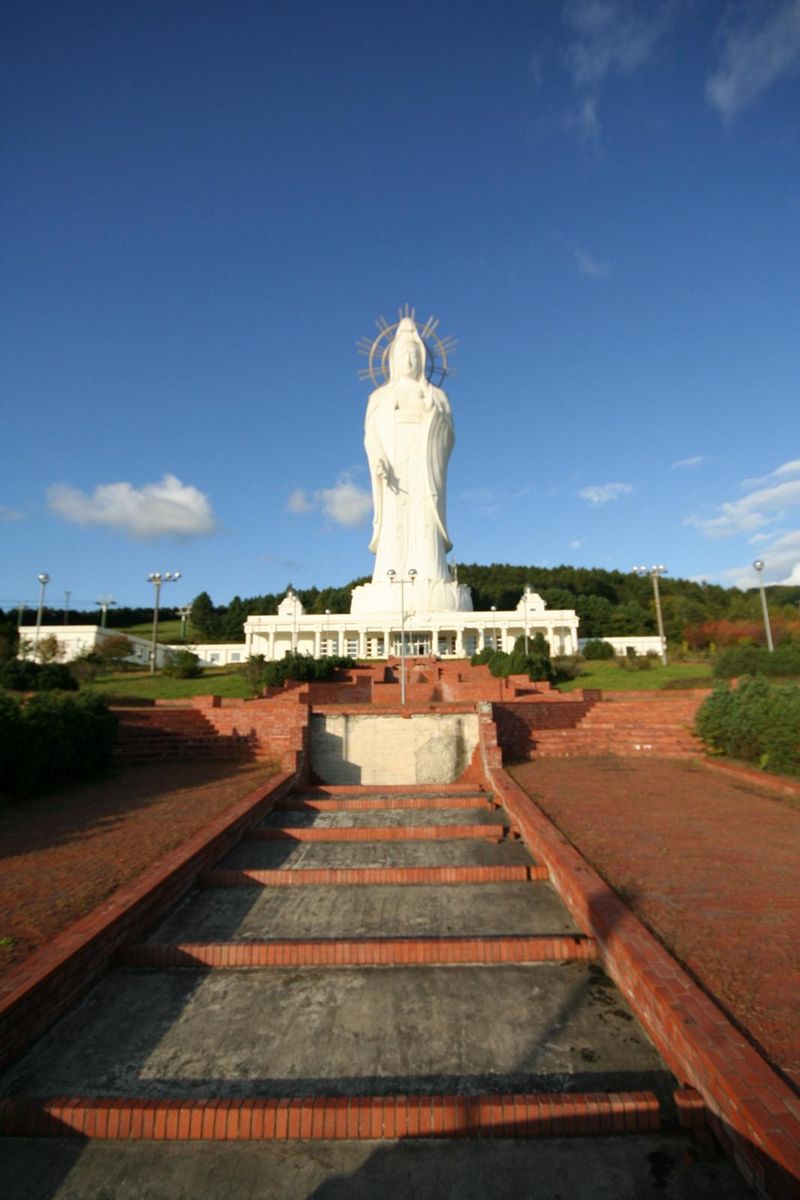
For a brief, shining moment in the early 1990s, a white Kannon statue in Ashibetsu, Hokkaido, held the title of the world’s tallest statue. Completed in 1989, the 88-meter figure stood at the top of the rankings until 1991, when it was overtaken.
That two-year reign tells you something important about how rapidly countries were racing to build bigger and bigger monuments during that era.
The statue represents Kannon, the Japanese bodhisattva of compassion and mercy, and stands in what is now called Kita no Miyako Park. Despite losing its record, 88 meters is still a genuinely enormous height.
To put it in perspective, the sculpted portion of New York’s Statue of Liberty reaches only about 46 meters, meaning this Hokkaido Kannon is nearly twice as tall as Lady Liberty’s figure alone.
The statue emerged during a period when Japan was experiencing economic growth and ambitious development projects were appearing across the country. Theme parks, resorts, and large-scale attractions were being built at a rapid pace.
Ashibetsu itself is a small city in central Hokkaido that once relied on coal mining, and the statue was part of efforts to reinvent the area as a tourism destination. Today it remains a striking sight against Hokkaido’s forested landscape.
The Motherland Calls – Russia
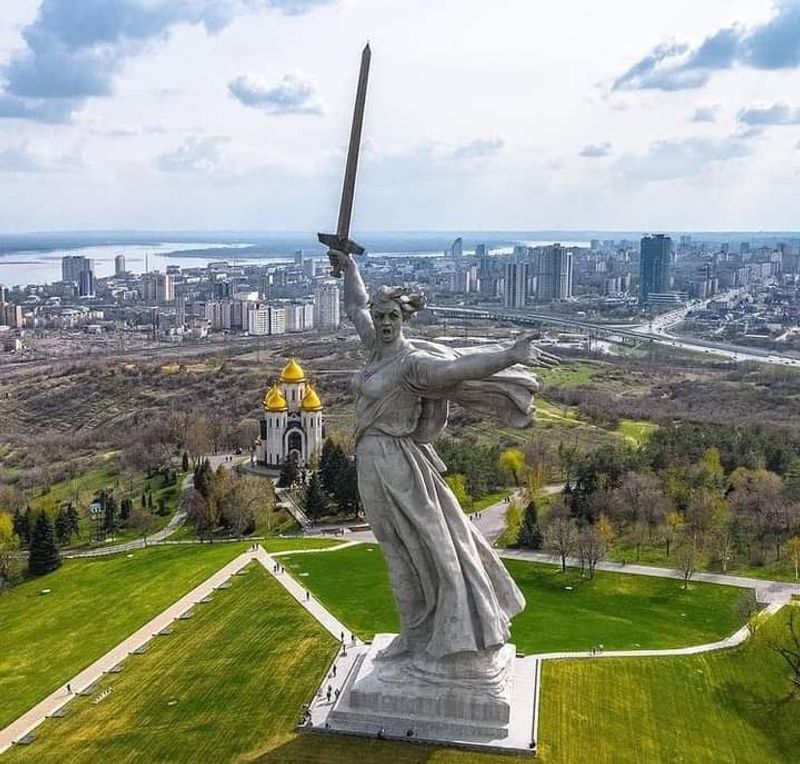
Few statues in the world look like they are actually moving, but The Motherland Calls in Volgograd looks like she is sprinting directly toward you. The female figure leans forward urgently, one arm stretched out and the other raising an enormous sword overhead.
The sword alone is 33 meters long, and the complete monument reaches 85 meters from base to blade tip. It was the world’s tallest statue when completed in 1967.
The monument was built to honor the Battle of Stalingrad, fought between 1942 and 1943, which was one of the deadliest battles in all of human history. More than a million Soviet soldiers died during the fighting, and the city itself was almost completely destroyed.
The Mamayev Kurgan hill where the statue stands was a key strategic point during the battle and remains a place of deep national mourning and pride.
Sculptor Yevgeny Vuchetich designed the figure to represent Russia herself calling her people to fight. The engineering required to support a 33-meter sword extending from a figure in mid-stride was genuinely complex, and the sword has been replaced and reinforced over the decades.
Walking up the long ceremonial staircase toward the statue, past eternal flames and carved walls, builds a sense of gravity that hits hard by the time you stand beneath her feet.
Grand Buddha at Ling Shan – China
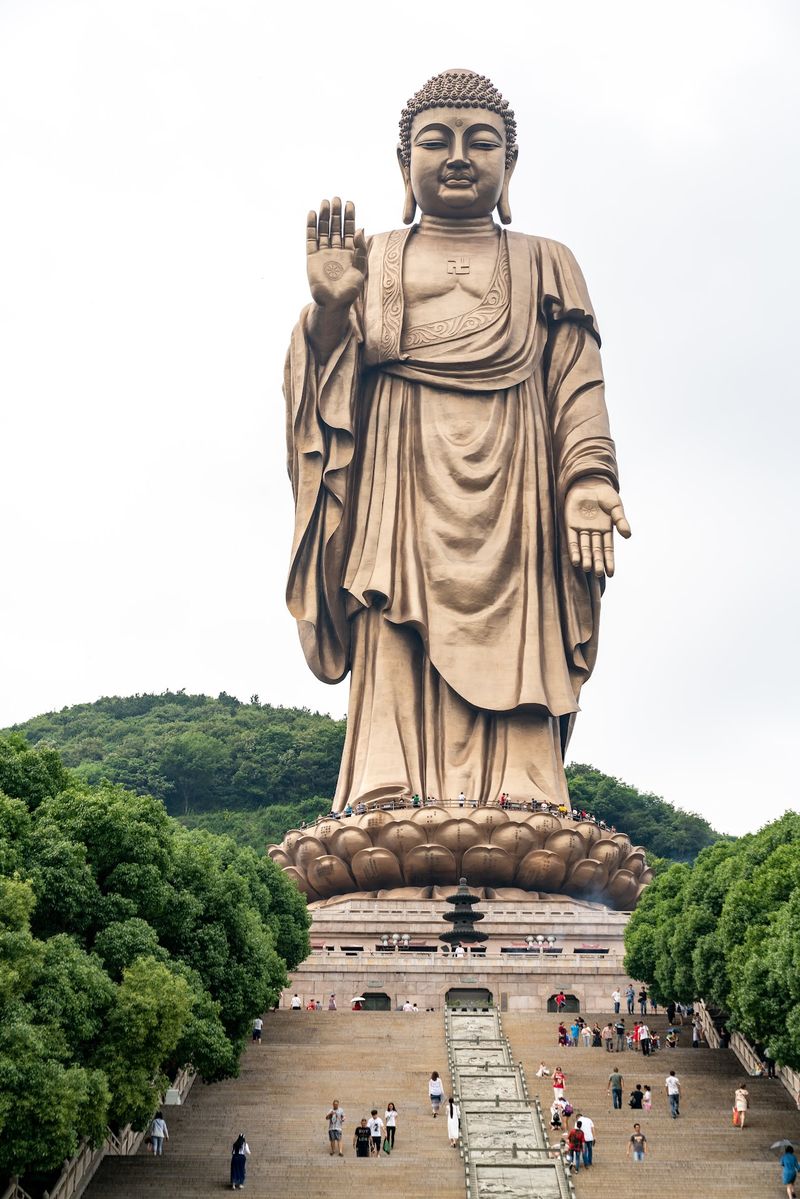
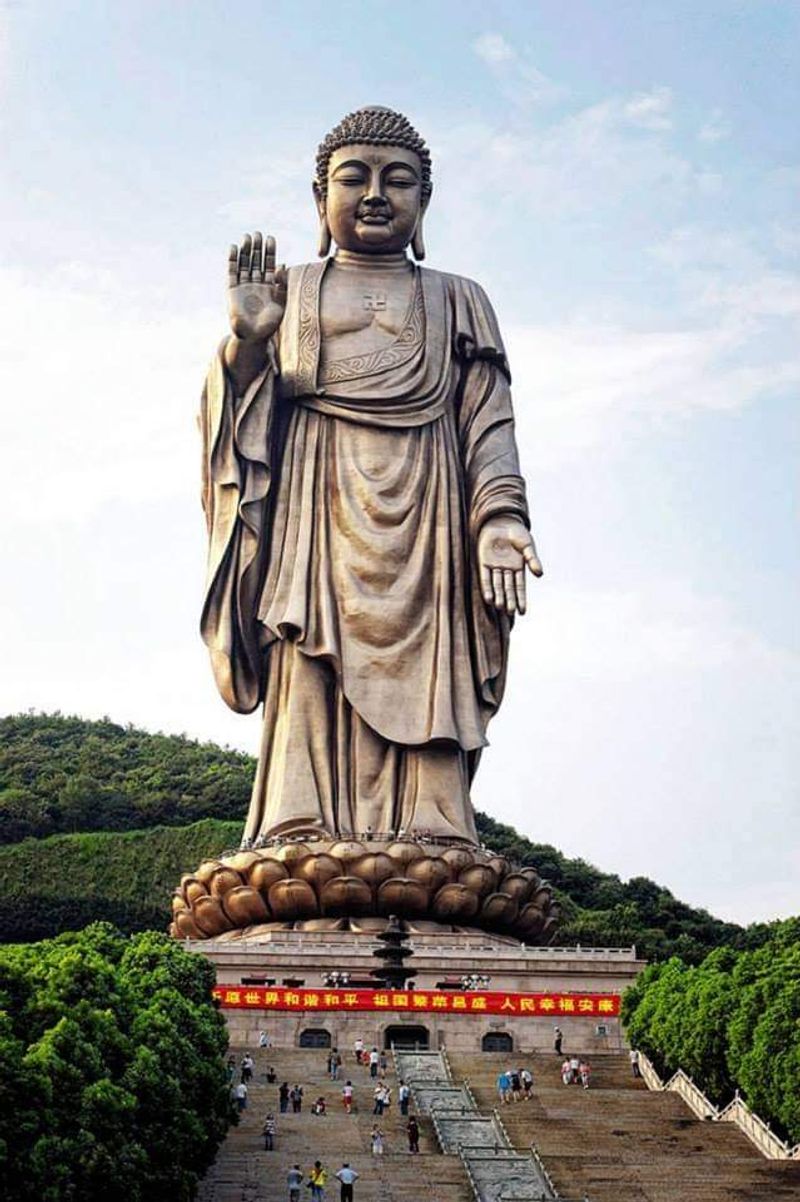
Before China’s wave of record-chasing Buddhist monuments arrived in the 2000s, the Grand Buddha at Ling Shan near Wuxi was already making a serious statement. Completed in the 1990s, the bronze figure stands approximately 79 meters tall above its lotus pedestal, with the total monument reaching around 88 meters.
It depicts Amitabha Buddha with one hand raised in a gesture of reassurance, a pose that feels welcoming rather than imposing.
Getting to the statue involves walking along an extensive ceremonial approach lined with halls, fountains, and smaller religious sculptures. By the time visitors reach the base of the giant bronze figure, they have already passed through a carefully designed sequence of spaces that build anticipation.
The surrounding Ling Shan Buddhist Cultural Zone has grown into one of Jiangsu Province’s major attractions.
The Grand Buddha at Ling Shan holds a historically interesting place in the story of monumental statue building. When it was completed, it was among the tallest statues in the world, and it helped inspire the even more ambitious projects that followed in China over the next two decades.
Seeing it today, knowing what came after, gives it the feeling of a pioneering effort, a monument that helped prove that bronze figures of this scale were actually buildable, which encouraged others to go even bigger.
Guanyin of Nanshan – China
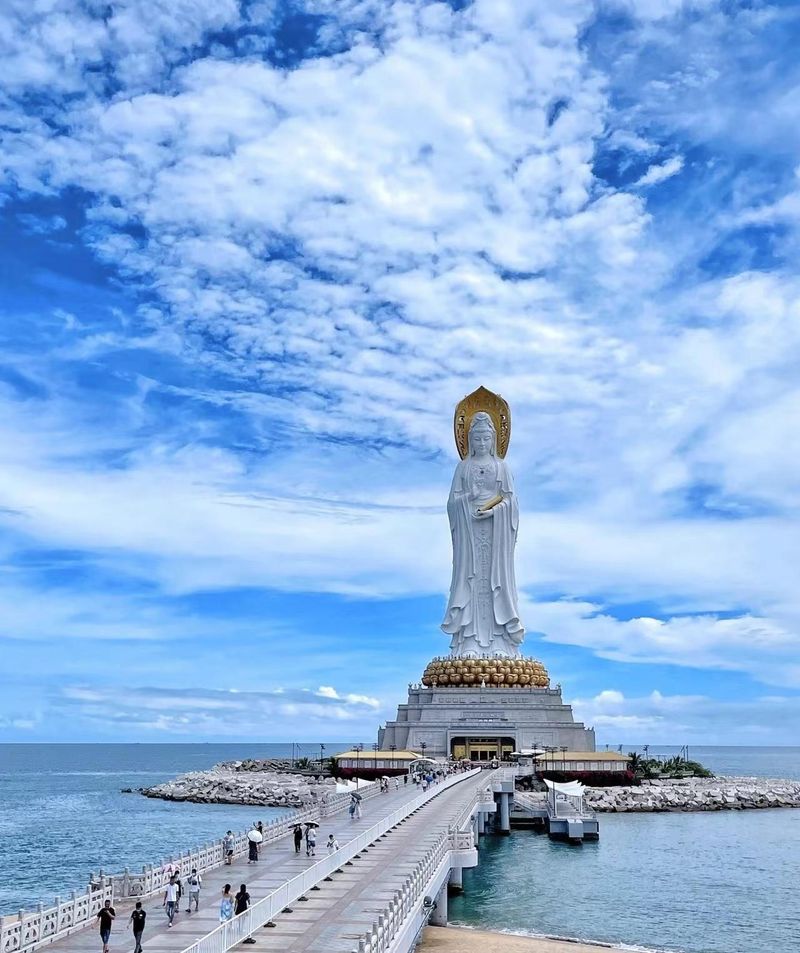
Most giant statues stand on a hilltop or in a temple courtyard, but the Guanyin of Nanshan rises from a platform built into the sea off the tropical coast of Hainan near Sanya. Completed in 2005, the white figure reaches approximately 78 meters tall, with the pedestal pushing the total monument to around 108 meters.
Approaching it along a causeway with ocean on both sides creates an experience that feels genuinely different from any other statue visit.
The monument has three distinct faces, each looking in a different direction. One face gazes toward Hainan Island while the other two look out over the South China Sea.
Each face presents Guanyin holding different symbolic objects or forming different hand gestures, representing various aspects of Buddhist compassion, wisdom, and protection for those at sea. For fishing communities and sailors in the region, the statue carries practical spiritual significance.
The surrounding Nanshan Buddhist Cultural Tourism Zone includes temples, gardens, and religious exhibits that flesh out the visit beyond the statue itself. Hainan’s warm tropical climate means the site stays lush and green year-round, which contrasts beautifully with the pure white of the statue’s surface.
Among all the giant Guanyin statues built in China, the Nanshan version stands out simply because no other major monument in the country shares its dramatic ocean setting.
Gautama Buddha of Kyaikhto – Myanmar
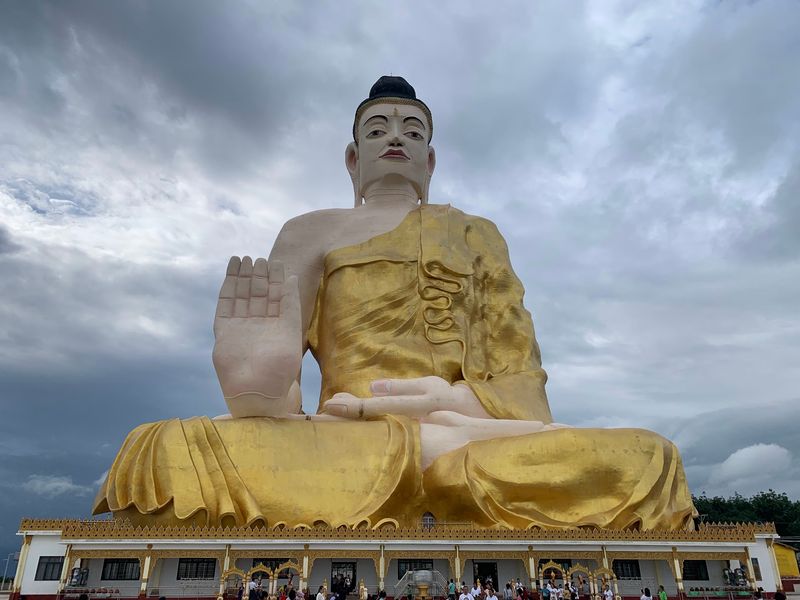
Myanmar keeps building giant Buddhas, and the seated Gautama Buddha near Kyaikhto in Mon State is one of the newest additions to that tradition. Completed in 2019, the figure rises about 77.9 meters tall and was built to function not just as an exterior sculpture but as a pagoda, connecting its enormous modern construction with the country’s ancient tradition of devotional tower building.
That combination of old form and new scale is distinctly Burmese.
The statue’s height was not chosen casually. Published accounts note that its measurements were linked to the Buddhist calendar year 2556, which corresponded to the period when the project was being developed.
Embedding calendar symbolism into a building’s physical dimensions is a practice with deep roots in Southeast Asian religious architecture, and it gives the structure a layer of meaning that goes beyond simple record-chasing.
Myanmar already has Laykyun Sekkya, one of the world’s tallest standing Buddhas, plus countless other oversized religious images scattered across the country. The Kyaikhto statue shows that this tradition shows no signs of slowing down.
Mon State is also home to the famous Kyaiktiyo Pagoda, a golden boulder balanced on a cliff edge that draws massive crowds of pilgrims, meaning the area already has a strong devotional culture ready to embrace another major religious monument.
Garuda Wisnu Kencana – Indonesia
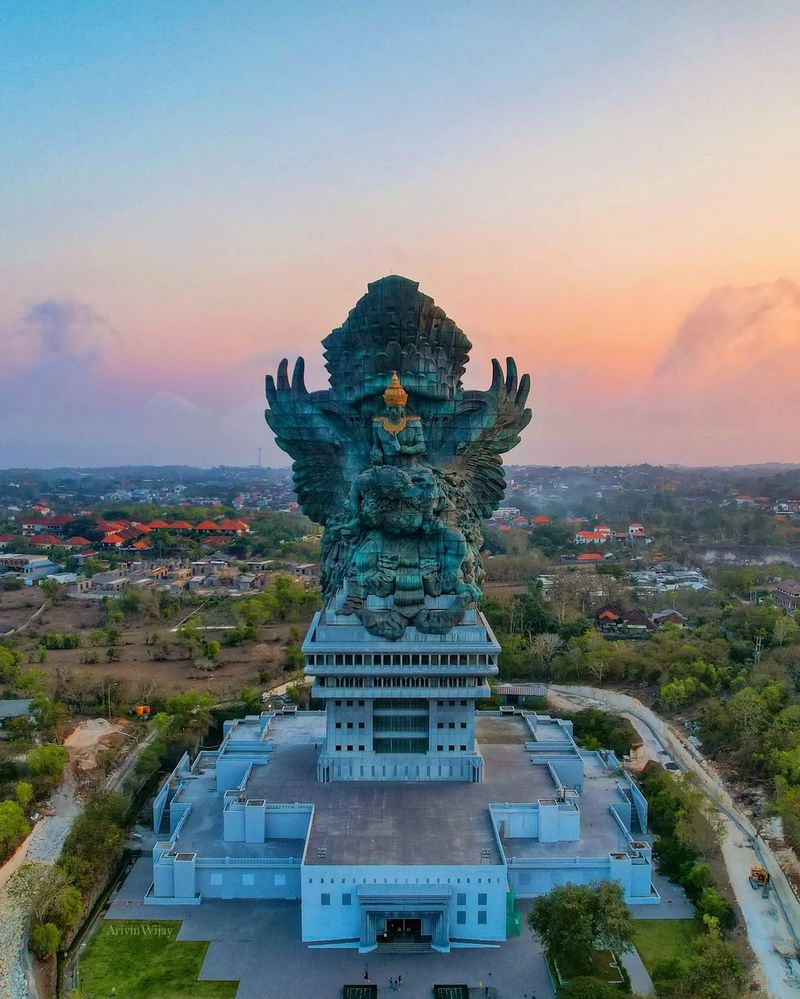
Bali’s Garuda Wisnu Kencana is the only statue on this list that features two figures in motion together, the Hindu god Vishnu riding his mount, the mythical bird Garuda, in a pose full of energy and movement. The sculpted portion stands about 76 meters tall, but the enormous pedestal brings the full monument to roughly 122 meters, making it one of the most imposing structures in all of Southeast Asia.
It dominates southern Bali’s skyline in a way that surprises even repeat visitors to the island.
The project took decades from initial concept to completion in 2018, surviving funding challenges and long construction pauses before finally being finished. Indonesian artist Nyoman Nuarta led the design, and the result is a statue that feels genuinely artistic rather than just massive.
The golden copper surface catches Bali’s tropical light in ways that shift dramatically depending on the time of day.
Garuda is not just a religious symbol in Indonesia. The mythical bird appears on the country’s national coat of arms and represents the national airline, making it one of the most recognized symbols of Indonesian identity.
Vishnu is one of Hinduism’s three principal deities. Combining both figures into one monument ties Balinese Hindu tradition directly to modern Indonesian national pride, giving the Garuda Wisnu Kencana Cultural Park a significance that reaches well beyond the island of Bali itself.
Share this story