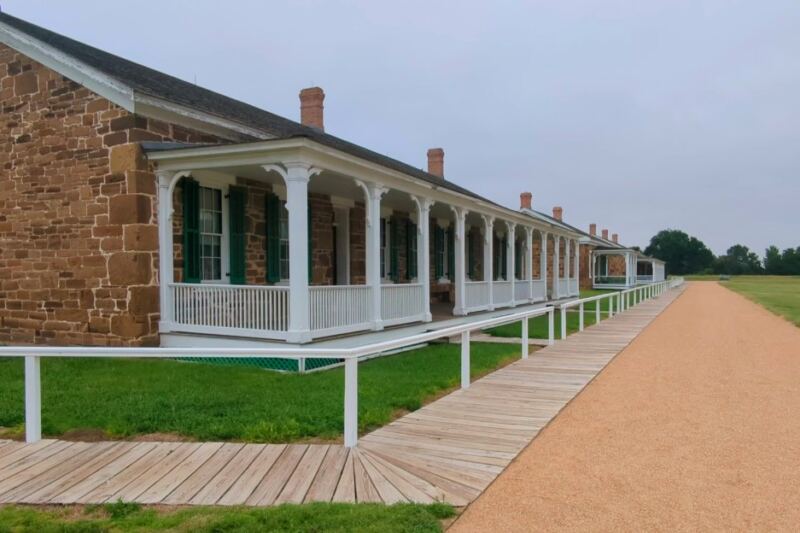
Nine original sandstone buildings from the 1860s still stand at Fort Larned National Historic Site in Kansas, making it one of the best-preserved frontier army posts in the country. Visitors can explore historic barracks, officers’ quarters, and other buildings where soldiers once lived and worked along the Santa Fe Trail.
The fort operated from 1859 to 1878, protecting mail routes and wagon traffic during a turbulent period of westward expansion. Today, the site offers furnished historic rooms, living history demonstrations on select dates, and nearby wagon ruts left by travelers more than a century ago.
What makes Fort Larned especially unusual is how much of it survived. After the Army abandoned the post, ranchers reused its buildings for decades, helping preserve structures that might otherwise have disappeared.
Admission is free, and the fort’s history includes a former defensive blockhouse that became a jail, Buffalo Soldiers, and a remarkable ranching story that helped save this piece of the American frontier.
A Fort Hiding in Plain Sight
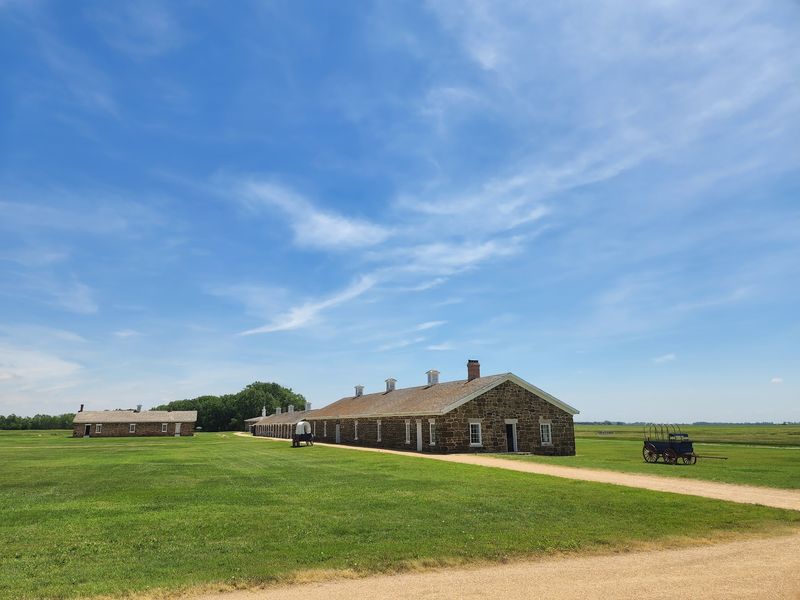
Finding this place felt like solving a small riddle. Fort Larned National Historic Site sits at 1767 KS-156, Larned, Kansas 67550, in the United States, about 5.5 miles west of the town of Larned.
The parking lot gives away nothing. Signs near the lot set the stage, and then a short walk of roughly a quarter mile takes you across a wooden bridge over the Pawnee Fork and through a grassy field.
Then the buildings pop into view, and I honestly stopped walking for a second. The whole post spreads out around a wide parade ground, quiet and tidy under a huge Kansas sky.
A few practical notes helped me. Parking is free and roomy enough for RVs, buses, and trailers, and wheelchairs are available near the lot for guests who need them.
Hours run from 8:30 a.m. to 4:30 p.m. every day, and you can call 620-285-6911 with questions. Cell service can be spotty, so download anything you need before you arrive.
Once I reached the parade ground, the real question became how this camp got started.
From a Muddy Camp to a Stone Stronghold
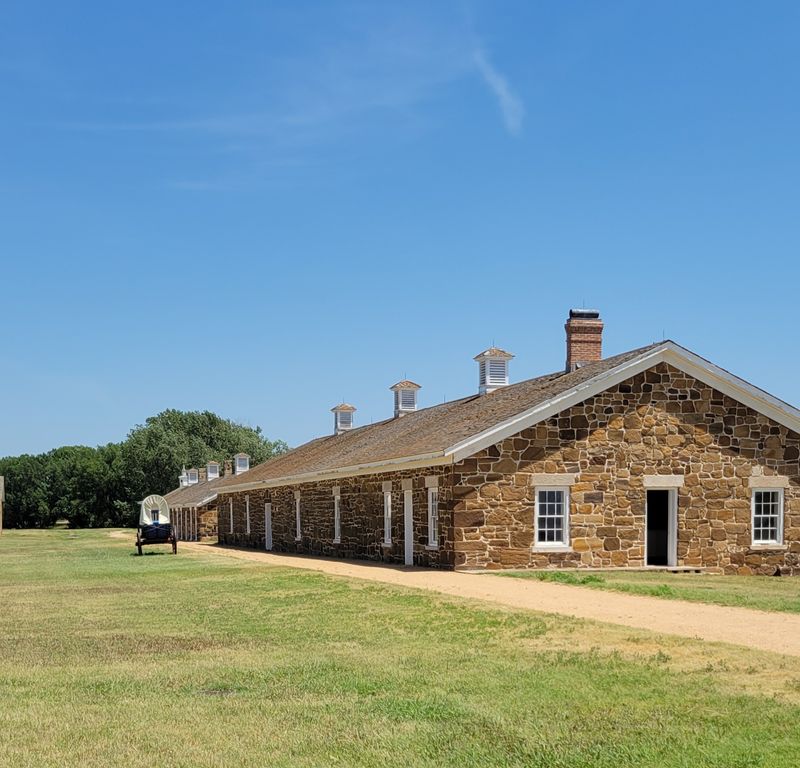
Big things often start small, and this fort began as a humble tent site. In 1859, soldiers set up “Camp on Pawnee Fork” to guard workers building an adobe mail station.
The early buildings were made of sod and adobe. Wood was scarce on the plains, so builders used what the ground gave them.
Those first shelters did not last long against Kansas weather. Between 1866 and 1868, under the direction of Captain A.
F. Rockwell, crews replaced them with sturdy sandstone buildings.
Rockwell clearly knew his craft. Every building from that period still stands today, which is a pretty strong report card for any construction boss.
The army kept the post active until 1878. That is nearly twenty years of bugle calls, supply wagons, and long prairie winters.
I loved running my hand along the thick stone walls. They felt cool even on a warm afternoon, and you can see chisel marks if you look closely.
Of course, a fort needs a reason to exist, and this one had a famous road to watch over.
Guarding the Busiest Road on the Plains
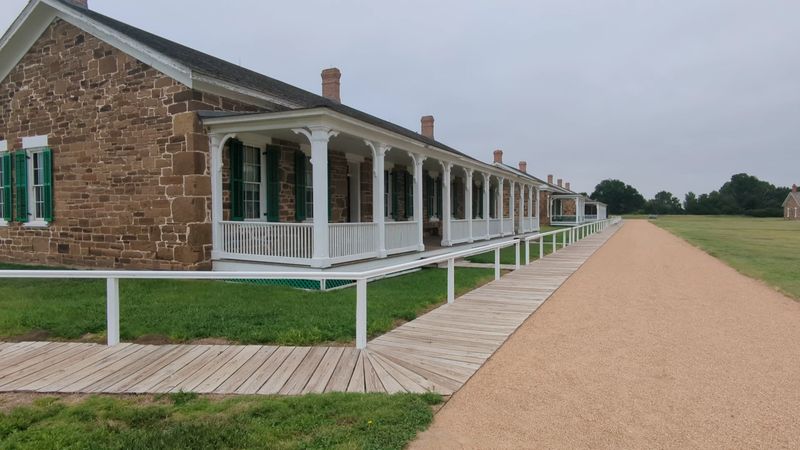
Picture a highway with no pavement, no gas stations, and no rest stops for hundreds of miles. The Santa Fe Trail was exactly that, linking Missouri to Santa Fe, New Mexico, from the 1820s to the 1880s.
Traders hauled huge amounts of goods along this route. Mail coaches and military supply wagons also needed safe passage.
Before the fort existed, travelers faced a long, unprotected stretch between Fort Riley in Kansas and Fort Union in New Mexico. Fort Larned filled that gap.
Soldiers escorted mail and supply trains across the plains. As more settlers and gold seekers moved west, tensions with tribes in the region grew, and the fort’s job got busier.
Its spot on the Pawnee Fork, near the Arkansas River, gave it water and a good view of the land. Location really was everything back then.
The exhibits in the visitor center explain this role clearly, with maps that helped me picture the trail’s path.
Yet guarding a road was only half the story, because this fort also became a meeting place.
Where Many Cultures Shared One Prairie
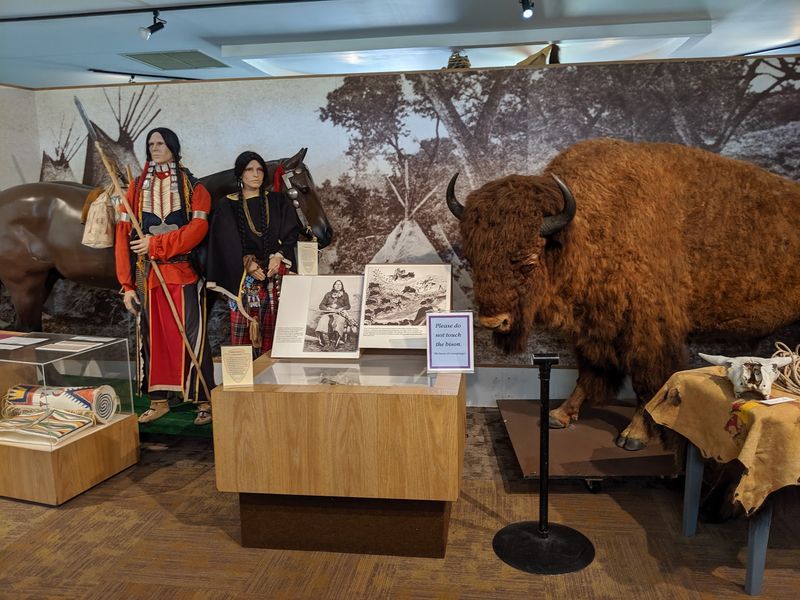
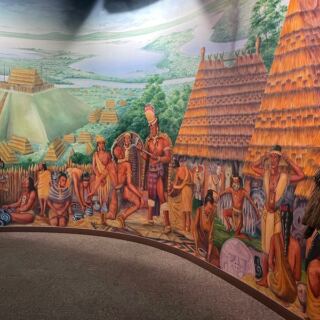
Here is something I did not expect. From 1861 to 1868, this army post also served as an Indian Agency for the Indian Bureau.
That meant the Cheyenne, Arapaho, Kiowa, Comanche, Plains Apache, and other tribes came here to meet with government agents. Agents such as Edward W.
Wynkoop and Jesse Leavenworth handed out annuities, which were goods promised to tribes in exchange for land.
Those deliveries included flour, coffee, sugar, bacon, clothing, beads, and tools. Tribal camps sometimes gathered on the nearby prairie while they waited.
The soldiers themselves came from many backgrounds. The 10th U.S.
Cavalry, famous as Buffalo Soldiers, was stationed here from 1867 to 1869.
Hispanic teamsters drove supply wagons, and former Confederates sometimes served alongside regular army troops. Hide hunters, railroad workers, and homesteaders passed through too.
I left the exhibit hall seeing the fort as a crowded crossroads rather than a lonely outpost. So many lives overlapped on this one patch of grass.
Those meetings sometimes turned into big conversations about peace, which brings us to the fort’s quieter role.
Peace Talks on the Parade Ground
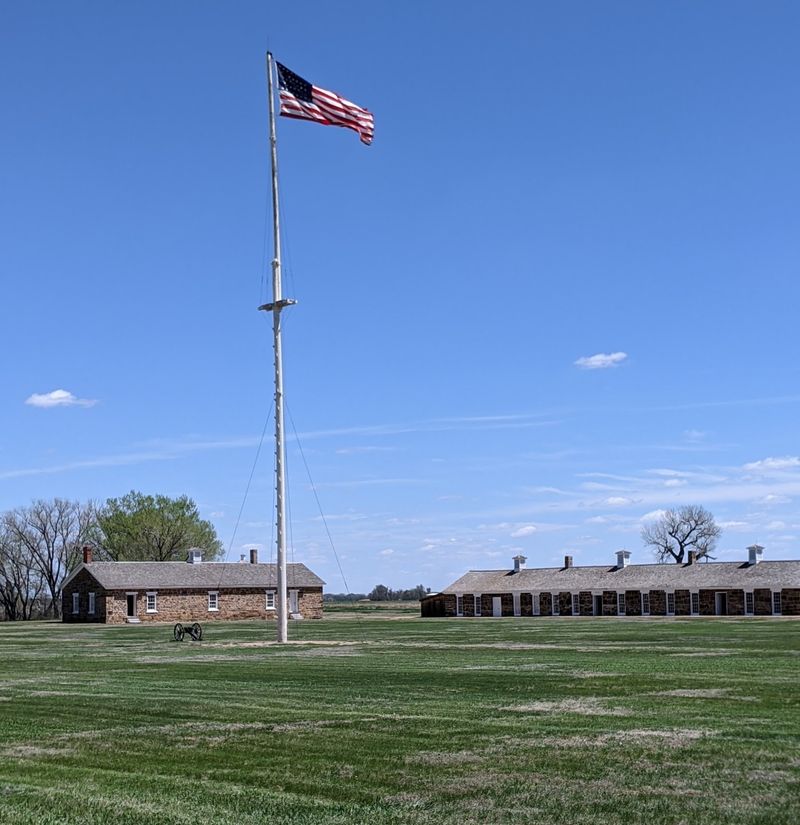
Forts usually make people think of battles. This one also hosted serious talks about peace.
In 1867, peace commissioners appointed by Congress met at Fort Larned to plan the Medicine Lodge Treaties. Those agreements shaped life for many Plains tribes.
The talks were complicated. The government wanted tribes who lived by hunting to settle down and farm, which clashed with their traditional ways of life.
For many Plains people, the fort stood for lost freedom. The rangers did a good job explaining both sides without sugarcoating anything.
One story surprised me. Early in its history, the fort helped a group of Caddo people who had fled their village, and they received land and money.
Standing near the flagpole, I tried to imagine leaders and officers gathered nearby, choosing words carefully. The parade ground looks peaceful now, but big decisions once hung in the air.
My tip is to ask a ranger about these treaties. They fill in gaps that movies about the West tend to skip.
Next up, I wandered indoors to see how ordinary soldiers actually lived.
Bunks, Bread, and Barracks Life
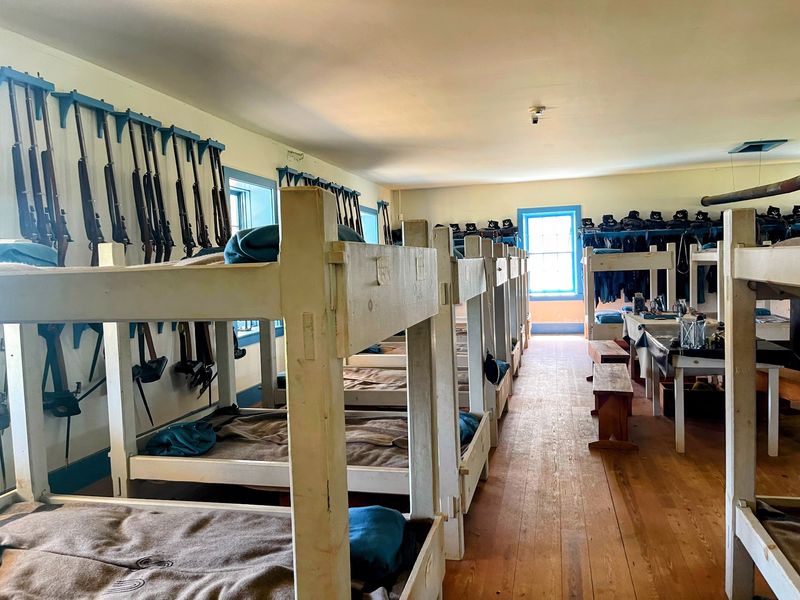
Peek into the barracks and you will see neat rows of bunks, wool blankets, and uniforms hanging on pegs. My first thought was that privacy was not on the menu.
The barracks could hold several companies, though the post often had around 100 to 150 troops. Rooms are furnished to look the way they did in the 1860s.
Most buildings are open to walk through. Many rooms hold period artifacts, and some original items are still inside.
A fort worked like a small town. It had a hospital, a bakery, a commissary for supplies, and shops for skilled workers.
Civilian blacksmiths, carpenters, saddlers, and wheelwrights earned good pay for their skills. Soldiers sometimes picked up extra duty in these shops too.
The bakery mattered a lot, because fresh bread was a welcome treat in a plain frontier diet. I could almost smell the loaves.
Take your time in each room and read the signs. Little details, such as a tin cup or a boot on the floor, tell big stories.
Then follow the sound of a hammer, because someone was busy nearby.
The Blacksmith Who Steals the Show
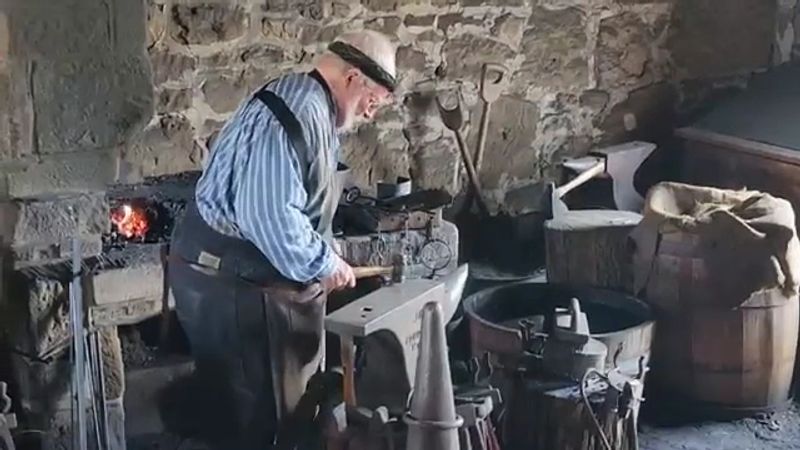
Clang, clang, hiss. That sound led me straight to the blacksmith shop, which is easily a crowd favorite here.
On many days, a costumed blacksmith works the forge and explains what smiths made and repaired for soldiers. Horseshoes, wagon parts, and tools all passed through this shop.
The demonstrator I met chatted with kids and adults alike. He showed how heat turns stiff iron into something you can bend and shape.
Fun detail: lucky visitors sometimes get a small item the blacksmith made that day. I will not promise you one, but it is worth stopping by.
Watching the work helped me understand why the army paid skilled civilians so well. Without a smith, wagons would break down and horses would go lame.
Bring patience, because the craft takes time. Stand back a bit from the forge, since it gets hot quickly.
Families will find this stop especially fun. It turns a history lesson into something you can hear, see, and even feel.
Blacksmithing is only one slice of the living history, though, and the bigger events are something else.
Living History That Talks Back
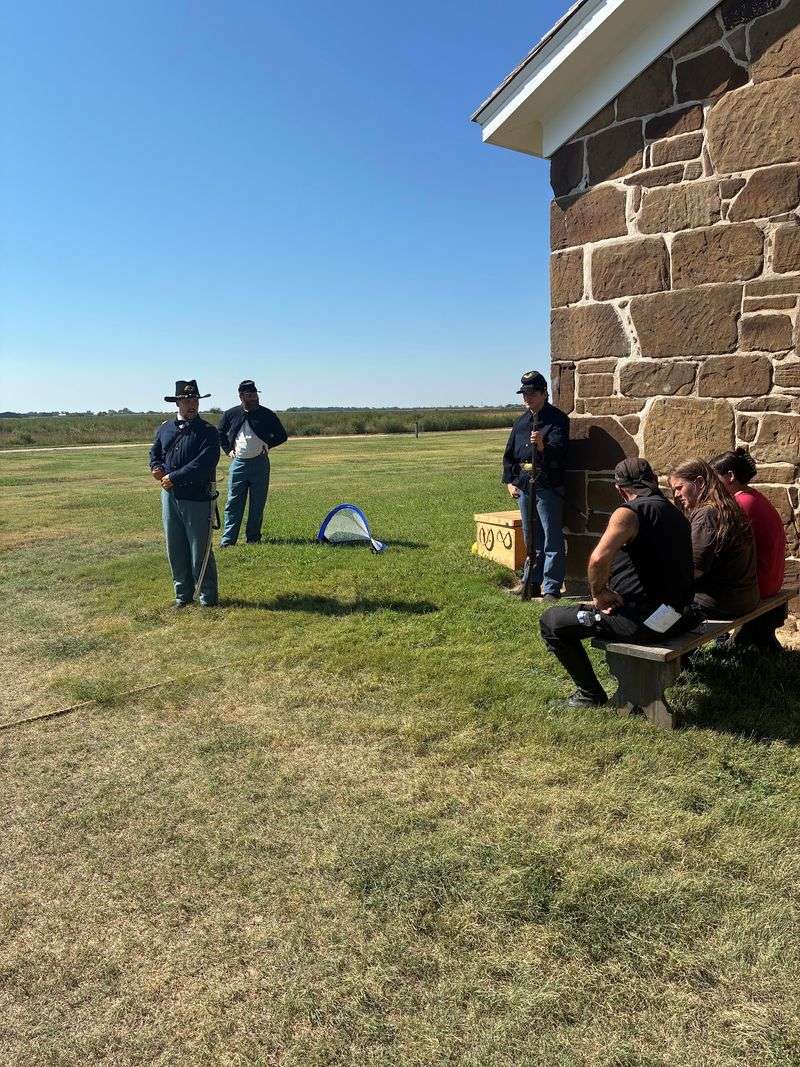
Some museums ask you to stay quiet. At this fort, history practically introduces itself and asks how your drive was.
Staff and volunteers dress in period clothing to show daily life from the 1860s and 1870s. Weekends between Memorial Day and Labor Day are especially lively.
You might see weapons demonstrations, military drills, cooking, sewing, quilting, or baking in the fort’s ovens. Some programs compare old muskets and rifles.
Big events fill the calendar. Look for Memorial Day and Labor Day weekends, a Fourth of July celebration, a fall Candlelight Tour, and a holiday program called Christmas Past.
Flag lowering ceremonies and cannon salutes often add extra drama. The boom really echoes across the flat prairie.
My advice is to check the park website before you go, since schedules change each season. A reenactment day gives you a very different visit than a quiet weekday.
Both options are good, honestly. Quiet days let you wander slowly, while event days feel like the fort woke up.
One building in particular has a twist that made me laugh.
The Fortress That Became a Jail
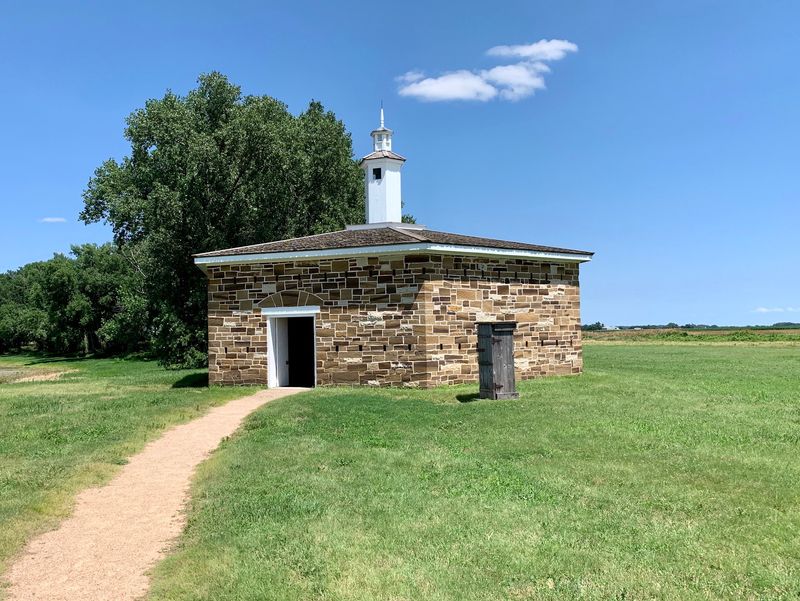
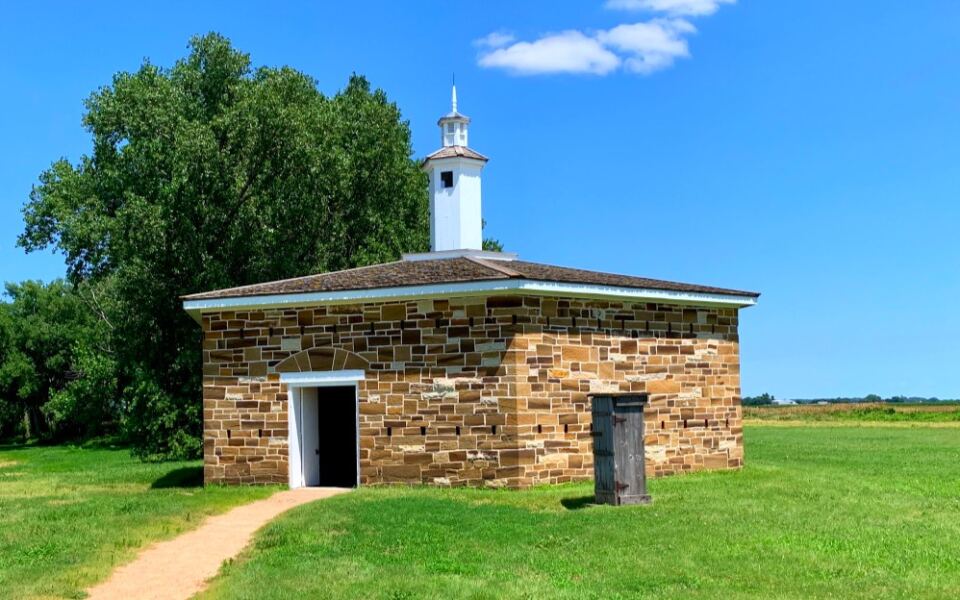
In June 1864, a Kiowa raid took 172 horses and mules from the fort. That was a huge blow, and the army decided it needed stronger defenses.
The answer was a six-sided stone blockhouse, built in the winter of 1864 to 1865. It was the first stone building at the fort.
Plans included two levels of rifle slits, a powder magazine, a well, and an underground passage. Most frontier forts had no walls, so a blockhouse made sense.
Here is the funny part. It never had to defend anything.
By 1867, the army turned it into a guardhouse, and it became the post jail. From fortress to timeout room is quite a career change.
Private owners took it apart around 1900 and reused the stones. In 1986, it was rebuilt using at least 200 of the original stones.
Look closely at the walls and you may spot the older, weathered blocks. It is a neat puzzle to solve.
Speaking of things left behind, the trail itself still has marks in the ground.
Wagon Ruts You Can Still See
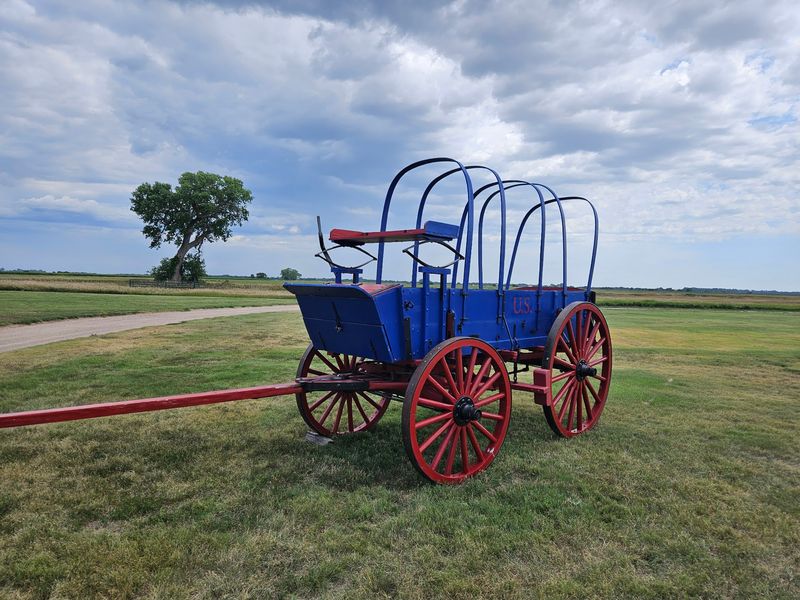
Thousands of wagons rolled through this area, and the land still remembers them. A few miles southwest of the fort, you can see preserved Santa Fe Trail ruts.
They look like long, shallow grooves cutting across the prairie. A viewing platform lets you take them in without trampling anything.
I stood there longer than planned. It is one thing to read about trade traffic and another to see the ground shaped by it.
Back at the fort, a History and Nature Trail loops behind the buildings. It points out spots where long-gone structures once stood and lets you enjoy the creek and prairie.
Dress for the weather before you set out. Kansas wind can be chilly in early spring, and summer sun can be strong.
Plan extra time if you want both the trail and the buildings. A quick visit takes about two hours, but trail lovers can easily stretch it to most of the day.
All that walking made me wonder how these old walls lasted so long, and the answer is wonderfully odd.
Saved by Cows, Hay, and Plain Old Luck
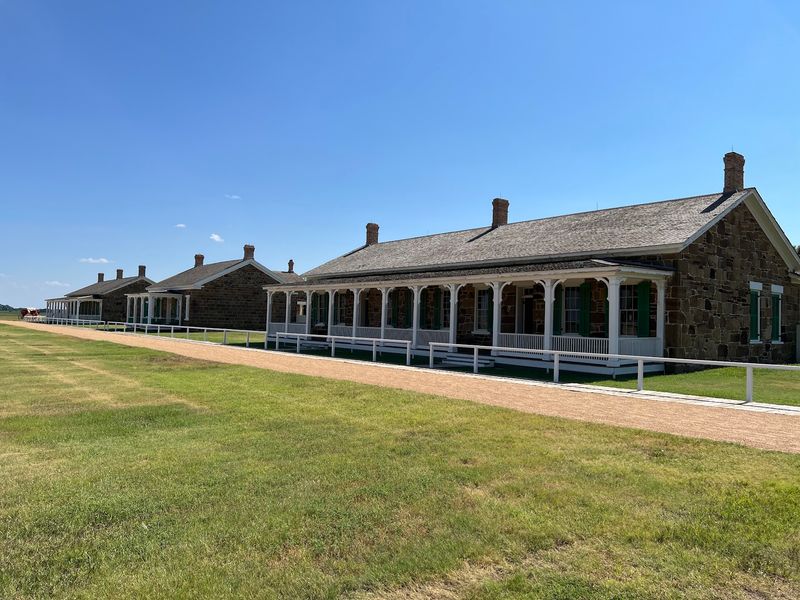
The army left in 1878, and many frontier forts simply crumbled after that. Fort Larned took a different path.
Private owners bought it in 1884 and turned it into a working ranch. Barracks became barns, and the officers’ quarters became homes.
Ranching continued for decades. Using the buildings kept them standing, even if hay replaced soldiers for a while.
The site joined the National Park System in 1964. Later ranch additions were removed, so the original army buildings stand out again.
Today it is often called the best-preserved frontier army post along the Santa Fe Trail. Not bad for a place that spent years storing feed.
Start your visit at the visitor center inside a historic barracks. Watch the 10-minute film, browse the exhibits, and grab two Passport stamps if you collect them.
Admission is free, pets on leashes are welcome outside, and a shady picnic area waits near the entrance. Buying a book at the shop is a nice way to give back.
Walking back over that little bridge, I realized the fort had been worth every windy step.
Share this story