Some bridges carry boats instead of cars. Others are grown from living tree roots, tilt to let ships pass, or hang hundreds of feet above deep canyons.
In Wales, a 200-year-old aqueduct carries an entire canal across a river. In India, villagers have spent generations guiding tree roots into walkable bridges.
And in Colorado, visitors can cross a suspension bridge 956 feet above the Arkansas River.
These crossings were built for everything from salmon fishing and railroad travel to hiking and sightseeing. Some are engineering landmarks, while others rely on techniques passed down for centuries.
Here are 12 remarkable bridges with unusual purposes, surprising histories, and experiences you won’t find on an ordinary road.
1. Pontcysyllte Aqueduct, Llangollen, Wales
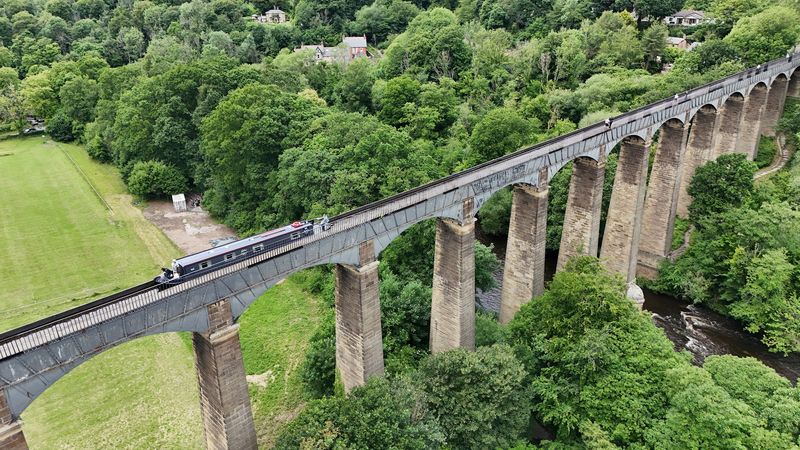
Boats in North Wales get a bird’s-eye view that most pilots would envy. The Pontcysyllte Aqueduct lifts the Llangollen Canal 126 feet above the River Dee, and it has done so since 1805.
Engineers Thomas Telford and William Jessop used a cast-iron trough to hold the water. That choice was bold for the time, since heavy stone aqueducts were the normal plan.
Eighteen slim stone piers hold up a channel that runs 1,007 feet long and only 11 feet wide. The joints were sealed with Welsh flannel dipped in boiling sugar, then finished with hot lead.
Yes, sugar helped build a famous landmark. Engineers back then clearly had a sweet tooth for problem solving.
Today, the aqueduct is a UNESCO World Heritage Site. You can ride a narrowboat across or walk the towpath beside the water.
One side has railings and the other side mostly does not, so boat passengers get a very open view. Every five years, crews drain the whole channel to inspect the iron trough.
2. Gateshead Millennium Bridge, Gateshead, England
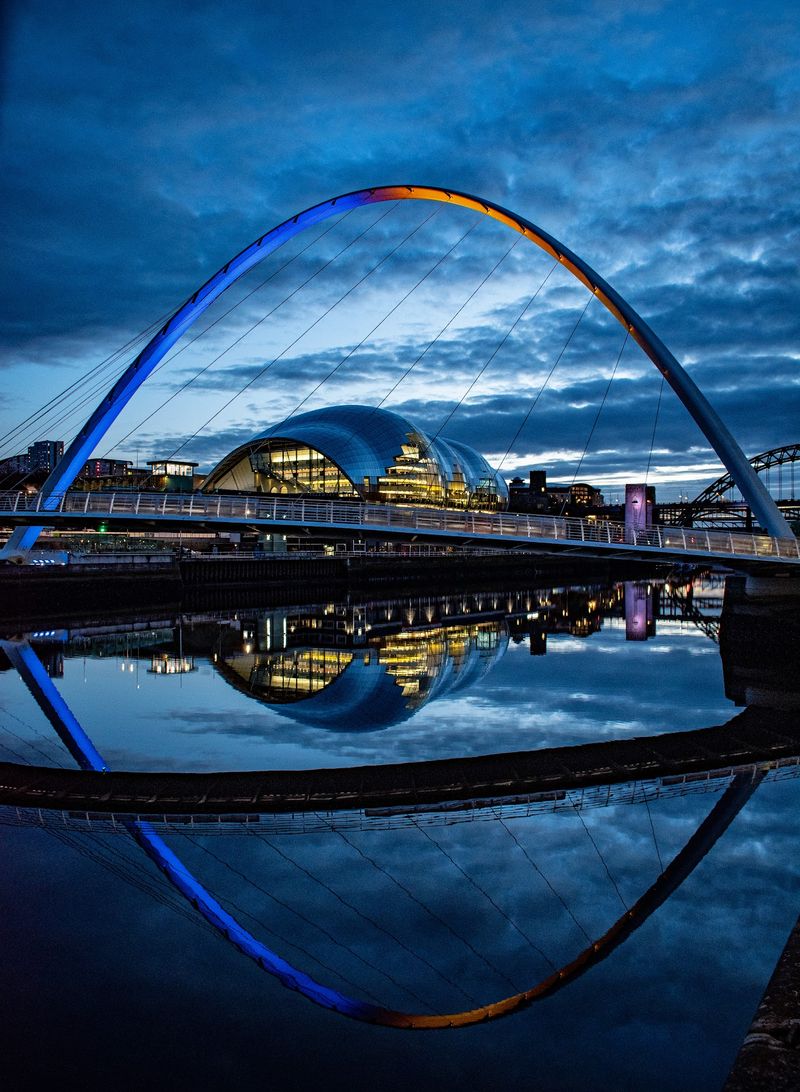
Locals call it the Blinking Eye Bridge, and the nickname fits perfectly. When a tall boat needs to pass, the whole bridge tilts upward in one smooth motion.
Opened in 2001, it was the first tilting bridge ever built. It links the arts quarter in Gateshead with the Quayside in Newcastle upon Tyne.
The design uses two steel arches. One is the walkway for people and bikes, and the other is a support arch above it.
To make room for boats up to 80 feet tall, the 850,000 kg structure rotates through 40 degrees. Six hydraulic rams do the heavy lifting, and each blink takes about four minutes.
Here is a clever detail. Trash on the walkway rolls into special containers when the bridge tilts, so it does not end up in the river.
The bridge won the 2002 RIBA Stirling Prize for architecture. It has also appeared on a stamp and a one-pound coin.
Check local listings for tilt times so you can watch it wink in person.
3. Double Decker Living Root Bridge, Nongriat, Meghalaya, India
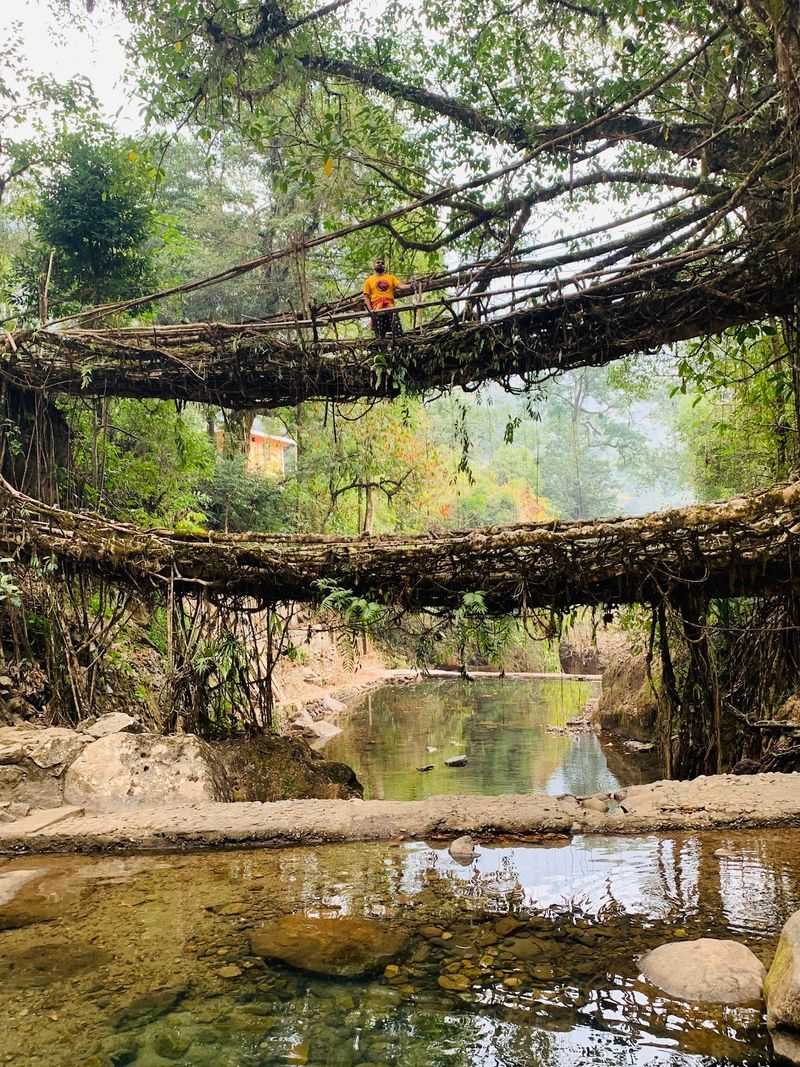
Nobody poured concrete or bolted steel here. The Khasi people grew this bridge, one root at a time.
Over many years, villagers guided the roots of rubber fig trees across a stream. They used hollow betel nut trunks to steer the young roots until they reached the far bank.
As the roots thicken and twist together, the bridge actually gets stronger with age. Most bridges wear out, but this one keeps building itself.
The Double Decker Living Root Bridge has two levels and is thought to be around 200 to 250 years old. It is about 30 meters long and can hold 50 or more people at once.
Getting there is a real workout. Visitors climb down roughly 3,500 steep steps from Tyrna village, and the same steps wait for the trip back up.
Bring water, wear shoes with good grip, and start early in the day. Plenty of travelers stay overnight in Nongriat to rest their legs.
The reward is a bridge that is part plant, part history lesson, and fully alive.
4. SkyBridge Michigan, Boyne Falls, Michigan
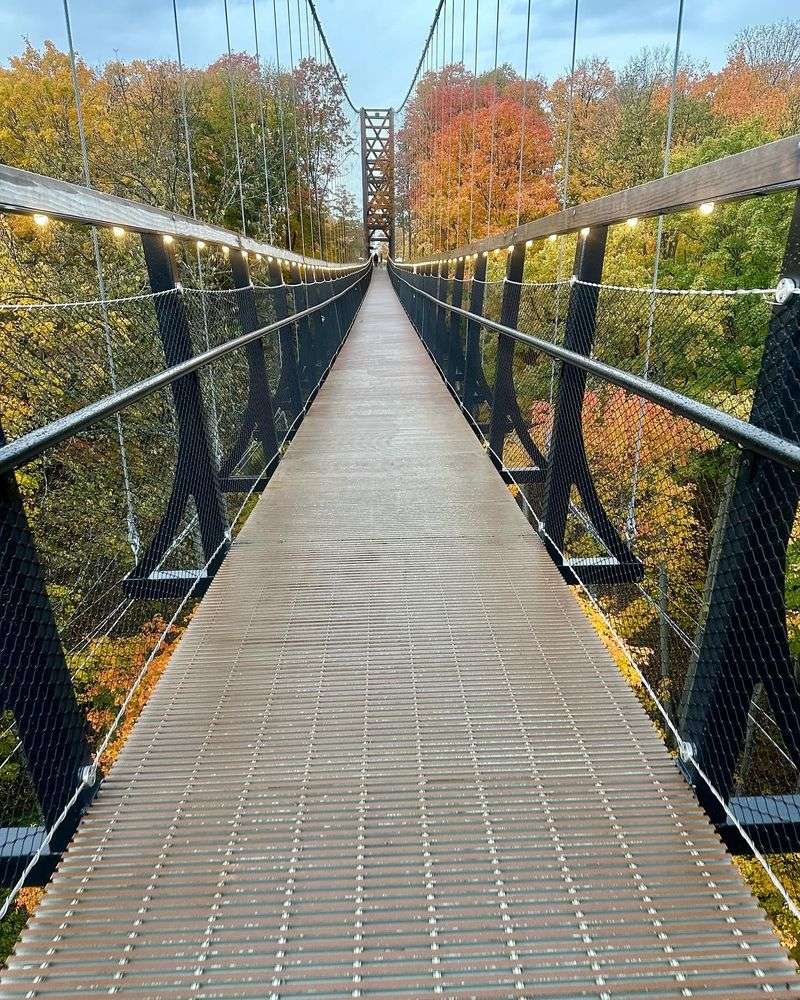
Michigan has a bridge that ends with a free view of your own shoes floating over a forest. SkyBridge Michigan opened at Boyne Mountain Resort in October 2022.
It stretches 1,200 feet between two ridges and is billed as the world’s longest timber-towered suspension bridge. Only people on foot are allowed, so no cars and no traffic cones.
The deck hangs about 118 feet above the valley floor. In the middle sits a 36-foot glass section where you can look straight down at the treetops.
Each wooden tower stands 52 feet tall and weighs more than 111,000 pounds. Galvanized steel cables and a fiberglass grating deck complete the design.
Your trip starts with a chairlift ride to the summit. That lift is part of the fun, so do not rush it.
Fall is the busiest time because the leaves turn bright red and orange. Winter visits are quieter, and the snowy hills offer a totally different scene.
The bridge sways a little on purpose. That movement helps protect the cables.
5. Carrick-a-Rede Rope Bridge, Ballintoy, Northern Ireland
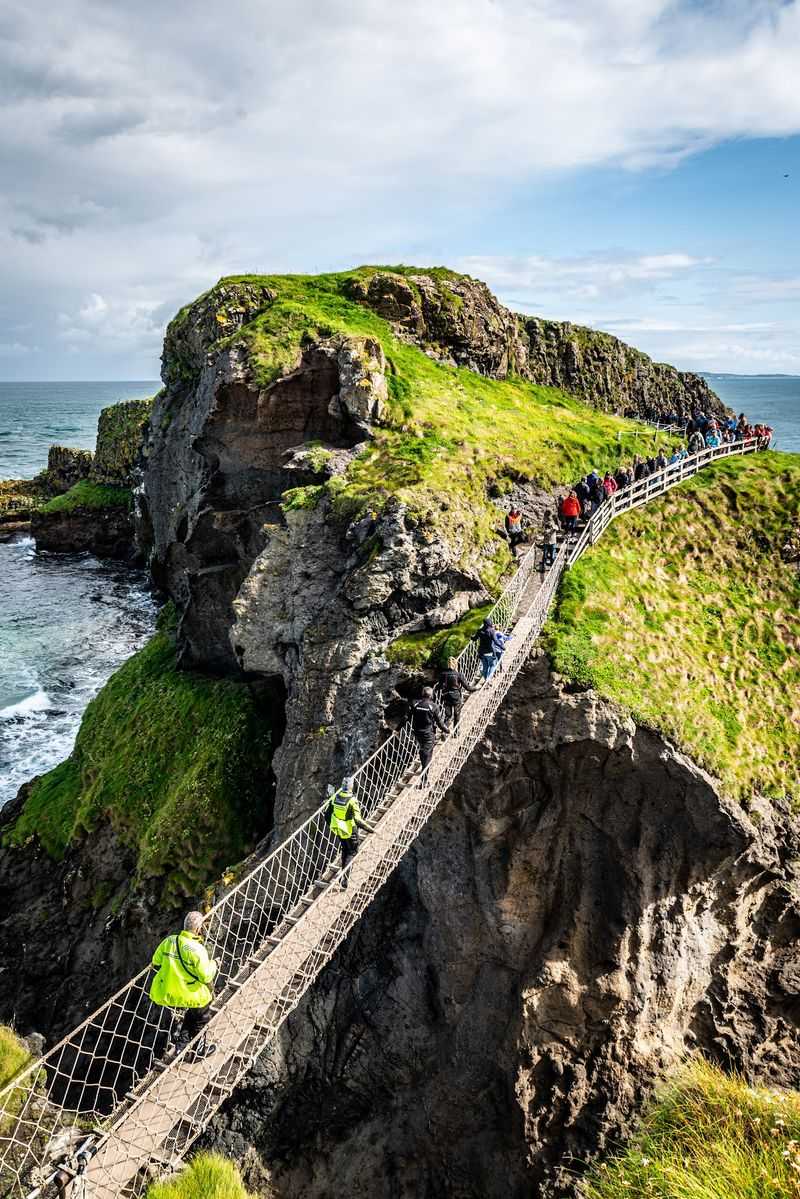
Salmon came first, and tourists showed up much later. Fishermen strung the earliest version of this crossing in 1755 to reach the tiny island of Carrick-a-Rede.
The name comes from Irish words meaning the rock of the casting. It refers to the nets fishermen set off the island to catch salmon.
Early bridges were pretty shaky. Some had just one handrail and wide gaps between the planks.
Today’s version, built in 2008, uses wire rope and Douglas fir. It spans 20 meters and sits about 30 meters above the Atlantic Ocean.
Fishing here ended in 2002 when salmon numbers dropped. The National Trust now manages the site for visitors.
The crossing takes only a minute or two, but the full visit with the coastal path lasts about 90 minutes. On clear days, you may spot Rathlin Island and even Scotland.
Fun fact: a few nervous visitors could not face the walk back. They had to leave the island by boat.
Book a time slot ahead, especially in summer.
6. High Trestle Trail Bridge, Madrid, Iowa
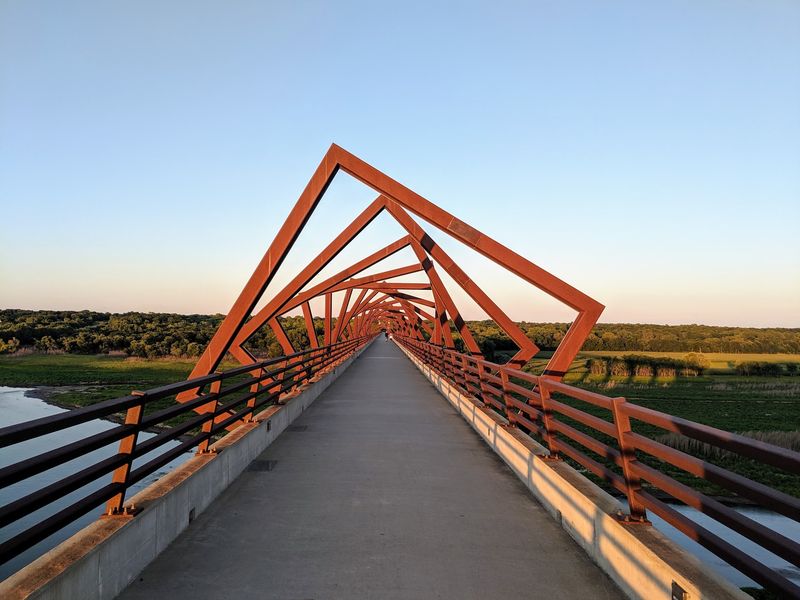
Trains used to rumble across this spot in central Iowa. Now bikes and walking shoes have taken over.
The High Trestle Trail Bridge runs half a mile long and stands about 130 feet above the Des Moines River Valley. That is roughly 13 stories high.
After the old rail deck was removed, the tall concrete piers stood alone for years. People jokingly called them Iowa’s Stonehenge.
In 2011, the bridge reopened for people on foot and on bikes. Artists added 41 steel frames that twist along part of the span.
Those frames honor the area’s coal mining past. Walking through them looks a lot like moving through a mine shaft.
Visit after sunset for the best show. Blue LED lights turn on in 23 of the frames each evening.
The bridge is part of the 25-mile High Trestle Trail. Its smooth paved surface works well for runners, cyclists, and wheelchair users.
Pack a bike light and plan your ride so you reach the bridge around dusk.
7. Henderson Waves, Singapore
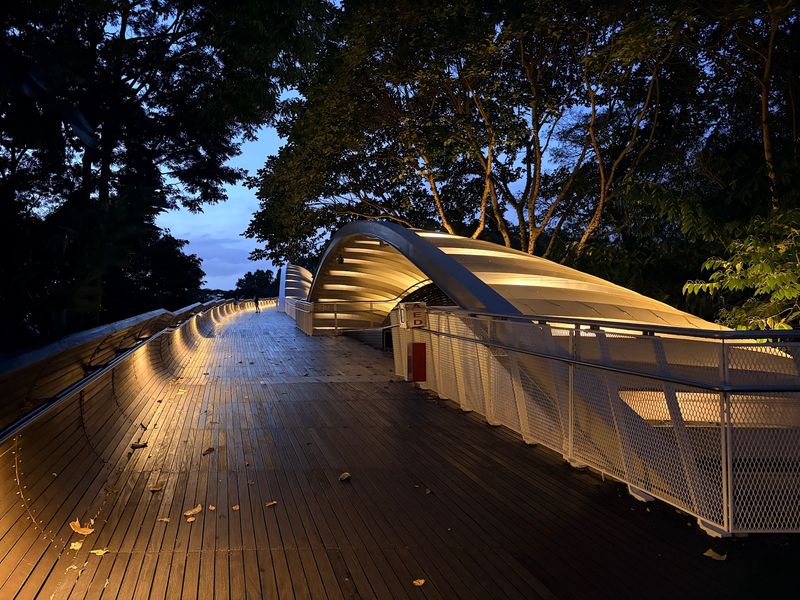
Benches are rare on most bridges, but Henderson Waves builds them right into its curves. The bridge rises and falls in seven big waves, and the dips form shaded seating spots.
At 36 meters above Henderson Road, it is the highest pedestrian bridge in Singapore. It stretches 274 meters and links Mount Faber Park with Telok Blangah Hill Park.
The design came from an international competition. It opened in 2008 as part of the Southern Ridges walking network.
Builders used steel for strength and yellow Balau wood for the deck and curved ribs. Balau is a tough tropical hardwood that handles hot, rainy weather well.
From the bridge, visitors can spot parts of the city, the harbor, and nearby islands. Many people stop in the alcoves for a snack break before continuing the hike.
LED lights switch on from 7 p.m. to 2 a.m. daily. Evening walkers get to see the waves outlined in color.
Go early in the morning if you want cooler temperatures and fewer crowds.
8. Trift Bridge, Gadmen, Switzerland
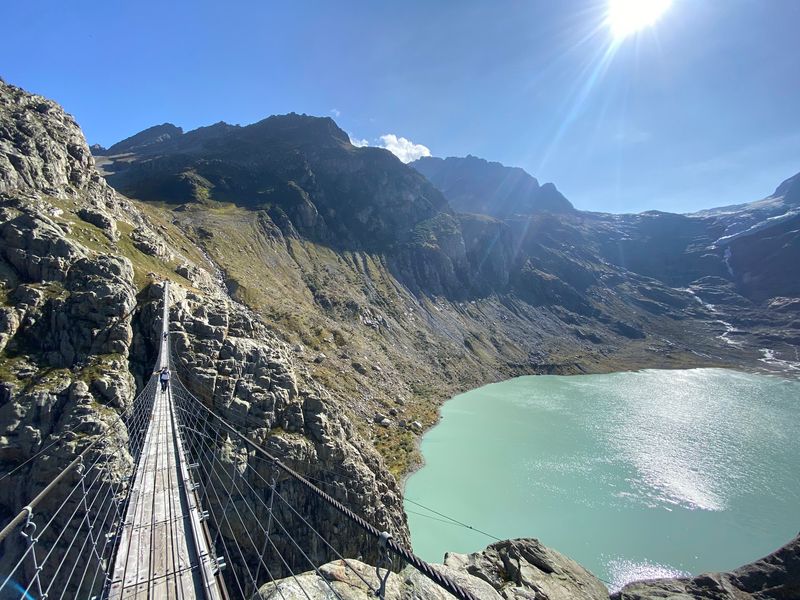
A shrinking glacier is the reason this bridge exists. As the Trift Glacier melted back, the old path to the Trift Hut stopped working.
So in 2004, a suspension bridge was strung across the gap. A stronger replacement followed in 2009, and builders finished it in only six weeks.
The current bridge is about 170 meters long. It hangs roughly 100 meters above the Triftsee, a turquoise lake left behind by the glacier.
Steel cables, wooden planks, and safety netting keep walkers secure. It still bounces gently with each step, so a steady pace helps.
Getting there takes some effort. First, ride the tiny Triftbahn cable car, which carries only eight people at a time.
After that comes an uphill hike of about 1.5 hours. Wear hiking boots and check the weather, since alpine conditions can change fast.
The old 2004 bridge was not thrown away. It was reused as the Salbitbrücke, another mountain crossing in the region.
9. Royal Gorge Bridge, Cañon City, Colorado
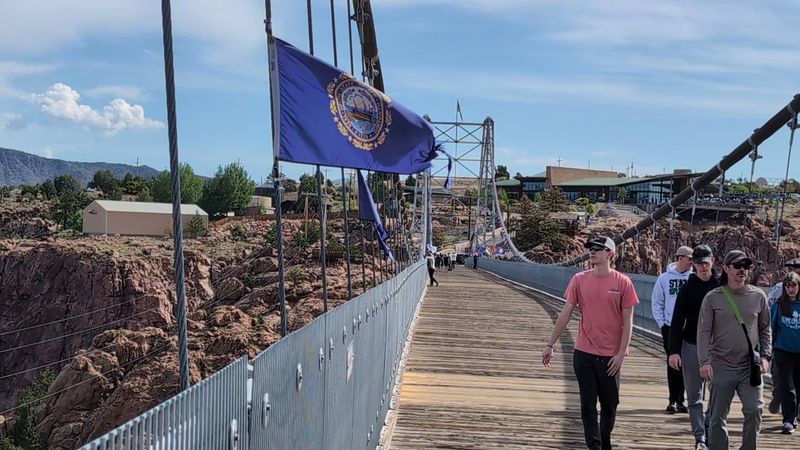
Here is a bridge built mainly so people could stare down a canyon. Back in 1929, the Royal Gorge Bridge went up as a tourist attraction, not a highway.
It sits 956 feet above the Arkansas River. From 1929 until 2001, it held the title of the highest bridge in the world.
It still ranks as the highest bridge in the United States. The span is 1,260 feet long and 18 feet wide.
The deck uses 1,292 wooden planks between 150-foot steel towers. Crews finished the job in about six to seven months without modern machines.
Personal cars are not allowed across. Visitors walk it, ride a gondola above the gorge, or try the Cloudscraper Zip Line.
A wildfire in 2013 burned most of the park buildings. The bridge survived, and only some planks needed replacing.
Plan a few hours to enjoy the whole park. Bring a jacket, since the canyon edge can get breezy.
10. Magdeburg Water Bridge, Magdeburg, Germany
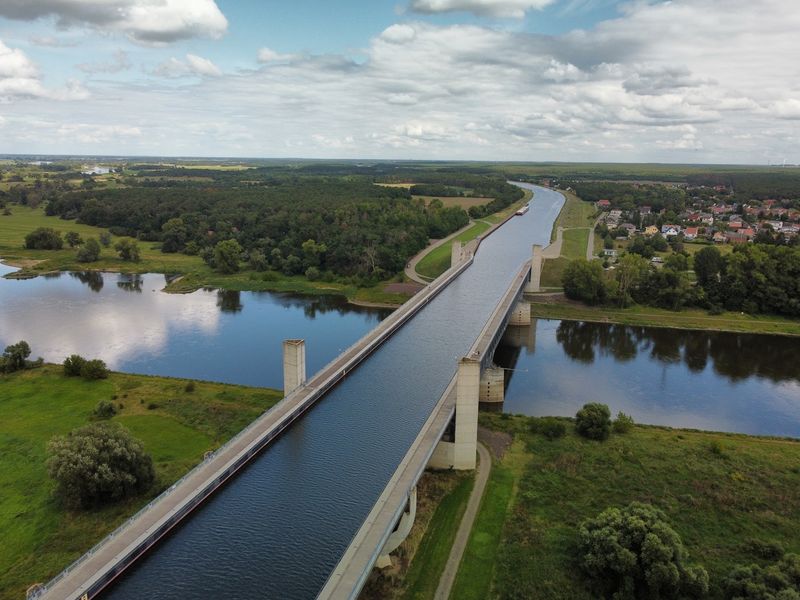
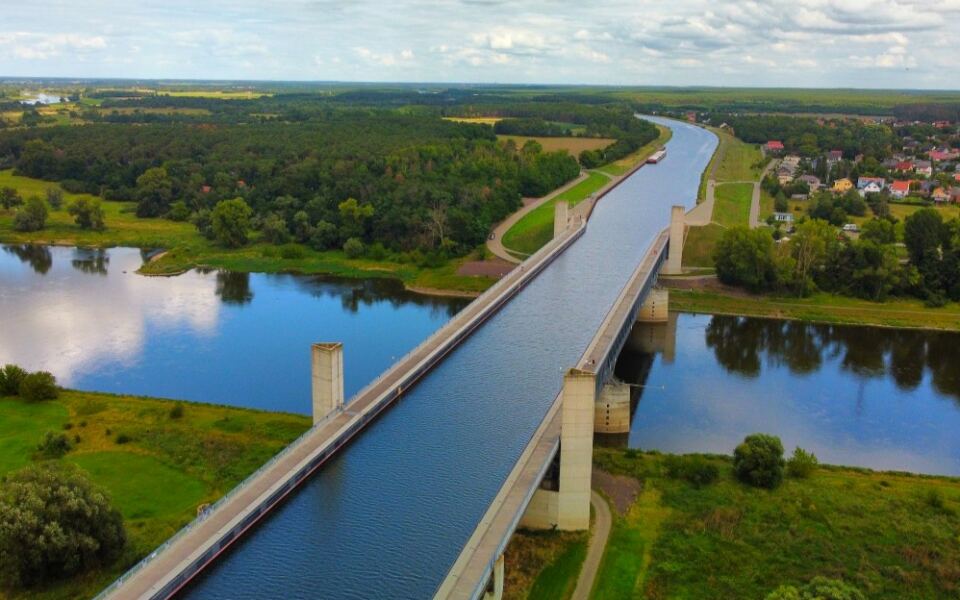
River traffic in Germany has its own overpass. At Magdeburg, boats cruise across the Elbe River on a bridge filled with water.
The Magdeburg Water Bridge opened in 2003. At 918 meters, it is the longest navigable aqueduct in the world.
It connects the Mittelland Canal with the Elbe-Havel Canal. Before it existed, ships faced a 12-kilometer detour through the Elbe.
Plans began in the early 1900s, and work started in the 1930s. World War II and the division of Germany stopped the project for decades.
After reunification, building restarted in 1997 and took six years. The structure used 24,000 tons of steel and 68,000 cubic meters of concrete.
Cargo ships carrying up to 1,350 tons now cross without worrying about low river levels. That makes trade between the Rhineland and Berlin much easier.
Visitors can walk or bike the paths beside the canal. Boat tours also let you ride over the river yourself.
11. Capilano Suspension Bridge, North Vancouver, British Columbia, Canada
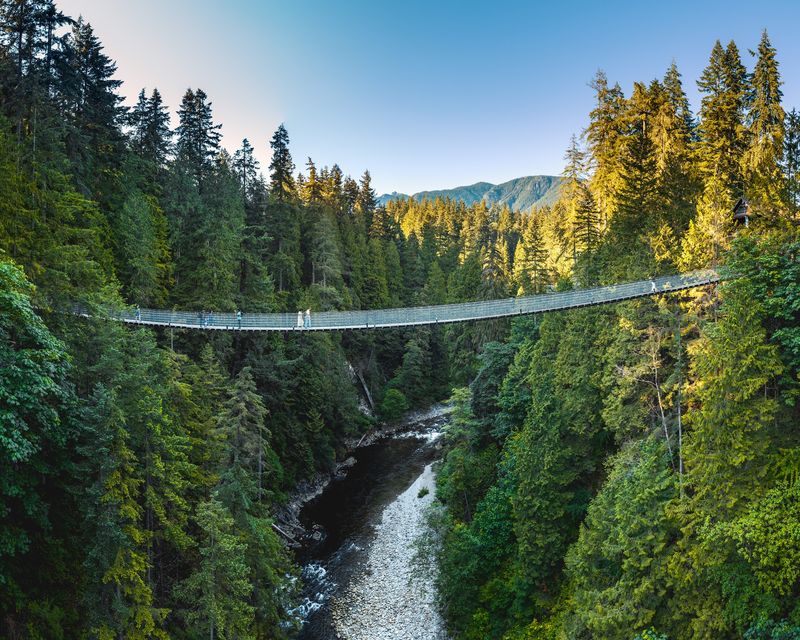
Hemp rope and cedar planks were all George Grant Mackay used in 1889. The Scottish engineer built the first Capilano Suspension Bridge to reach his land across the canyon.
Local hikers called the Capilano Tramps soon came to test it out. The bridge has been drawing curious visitors ever since.
Wire cables replaced the rope in 1903. Then the whole bridge was rebuilt in 1956.
Today it spans 137 meters and hangs 70 meters above the Capilano River. It still sways, which is half the fun.
The park now has much more than one crossing. Treetops Adventure adds seven small suspension bridges among Douglas firs, some about 250 years old.
Cliffwalk, opened in 2011, is a narrow walkway attached to a granite cliff. Parts of it have see-through grated floors.
The Kia’palano area shares Indigenous totem poles and stories. A history center explains how the bridge changed over time.
Arrive early in summer, when lines can grow long by midday.
12. Alexandra Arch, Singapore
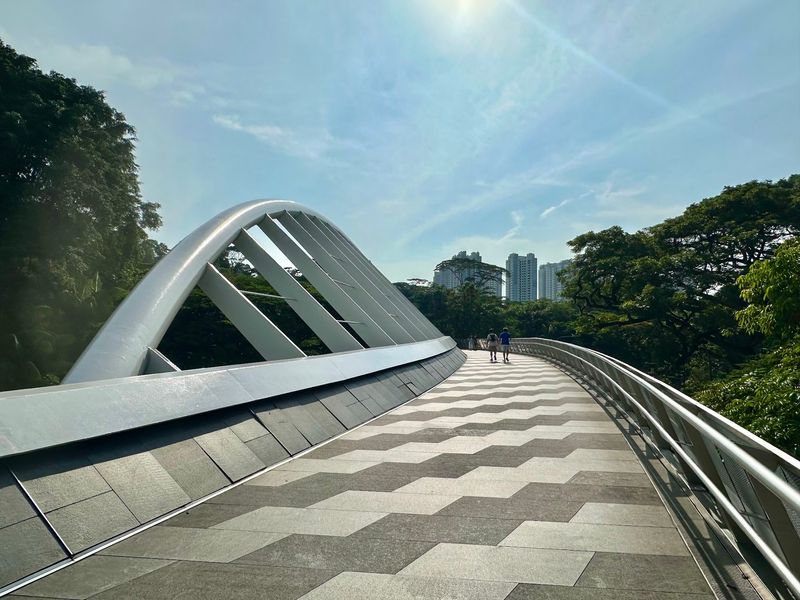
Some pedestrian overpasses are just plain walkways. Singapore turned this one into a giant leaf.
Alexandra Arch has a curved deck and a steel arch tilted to one side. Together, they look like a leaf opening up.
The bridge is 80 meters long and sits 17 meters above Alexandra Road. It lets walkers and cyclists cross six busy lanes without waiting at a light.
It also links the Forest Walk and Hilltop Walk to HortPark. That makes it a handy part of the Southern Ridges trail network.
Completed in 2008, the bridge uses steel and granite. It won an award from the Singapore Structural Steel Society for creative use of steel.
From 7 p.m. to midnight, LED lights cycle through sunset-style colors. That timing makes an evening walk a smart choice.
Pair this stop with Henderson Waves for a full Southern Ridges hike. Two of the most unusual bridges on this list sit just a short trek apart.
Share this story