There is a skyscraper standing in the middle of Pyongyang that has never hosted a single guest. It has 105 floors, roughly 3,000 rooms, and a pyramid-shaped top that cuts sharply into the sky.
Construction began in 1987, and the building has been sitting largely unfinished and empty ever since. What makes this story so fascinating is not just the size of the building, but everything behind it, the ambition, the mystery, and the decades of silence surrounding one of the most unusual structures on Earth.
Few construction projects in modern history carry as much weight as this one. The Ryanggang Hotel, also known as the Ryugyong Hotel, was conceived in the 1980s as a statement of national pride and architectural power.
North Korean leadership wanted to build the tallest hotel in the world at the time, a structure so massive it would place Pyongyang on the global map.
The plan called for 105 floors, three rotating restaurants at the top, and thousands of rooms spread across a building shaped like a concrete pyramid. Nothing about the design was modest.
Everything about it was meant to signal strength and progress to the outside world.
Understanding why this building was started helps explain why it has never been finished. The ambition behind it was enormous, and the gap between that ambition and reality has defined the Ryanggang Hotel ever since.
The Ryanggang Hotel stands at 330 meters tall, making it one of the tallest buildings in the world by raw height. Its shape is unlike most skyscrapers.
Three separate wings rise at angles and converge into a single pyramidal point at the top, giving it an almost alien silhouette against the Pyongyang skyline.
The exterior is covered in glass panels that were installed during a partial renovation effort that began around 2008. Before those panels were added, the building was entirely bare concrete, earning it the nickname “Hotel of Doom” among Western journalists and observers.
Even with the glass facade in place, the building has a cold and unfinished quality up close. The windows do not reflect light the way a completed building would.
There is no activity inside, no movement, no lights at night. It is visually striking and deeply quiet at the same time.
Work on the Ryanggang Hotel started in 1987, during a period when North Korea was preparing to host the 1989 World Festival of Youth and Students. The goal was to have the hotel ready in time for that event, which would bring tens of thousands of visitors to Pyongyang.
That deadline was never met. By 1992, construction had ground to a complete halt.
The reasons given by outside observers include severe economic problems following the collapse of the Soviet Union, which had been a major source of support for North Korea. The country was facing serious shortages, and a massive luxury hotel project became impossible to sustain.
For sixteen years, from 1992 to 2008, the building sat completely untouched. A bare concrete shell rising 330 meters into the sky, visible from nearly everywhere in Pyongyang, yet officially almost never acknowledged by the North Korean government.
One of the strangest chapters in this building’s story is not the construction itself but the silence that followed. For sixteen years, the North Korean government essentially pretended the building did not exist.
It was removed from official maps of Pyongyang. State media never mentioned it.
Foreign journalists who photographed it risked having their images confiscated.
This was not easy to do. The building is so tall that it is visible from almost any point in the city.
Residents of Pyongyang could look up and see it every single day, yet it was treated as if it were invisible by official sources.
The silence ended around 2008 when construction resumed and the government began allowing limited references to the project. But those sixteen years of denial added another layer of mystery to a building that was already one of the most unusual structures on the planet.
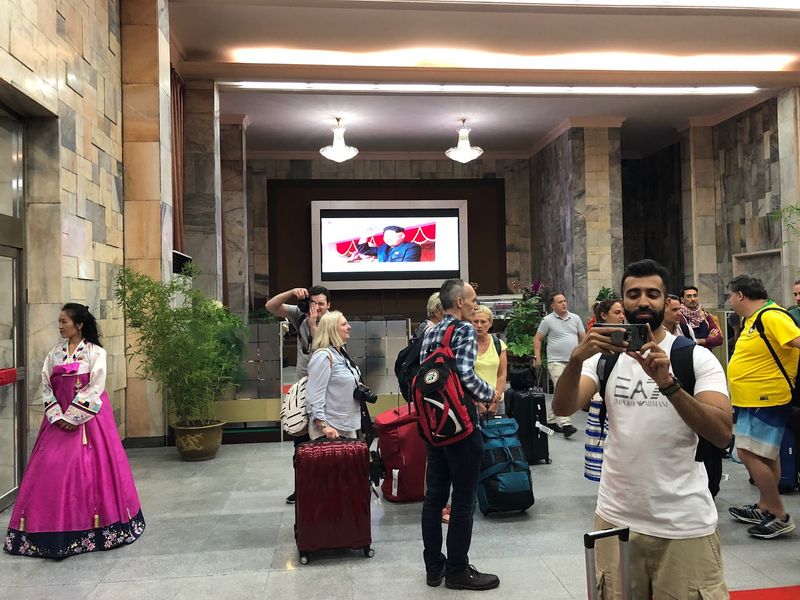
The most obvious question anyone asks about the Ryanggang Hotel is simple: why has no one ever stayed there? The answer has several layers.
The most basic is that the building has never been completed to a standard that would allow it to function as a hotel. There are no working elevators known to be operational throughout the structure, no confirmed functional plumbing on the upper floors, and no interior finishing in most of the building.
Beyond the physical incompleteness, North Korea has extremely strict controls on foreign visitors. Even if the hotel were finished tomorrow, access would be tightly regulated.
Tourism in North Korea is limited to organized group tours with government-assigned guides, and visitor numbers remain very small by global standards.
The combination of an unfinished structure and a closed country means the Ryanggang Hotel exists in a kind of permanent holding pattern, fully visible but completely inaccessible to the outside world.
Numbers alone do not fully capture what 105 floors and 3,000 rooms actually means in practice. To put it in perspective, the building contains more rooms than many entire city blocks of hotels combined.
If it were ever completed and filled to capacity, it could theoretically house more guests than many small towns have residents.
The floor area of the building is enormous. Each of the three wings that make up the structure adds to a total footprint that would take several minutes just to walk around at the base.
The pyramid tip at the top was originally designed to hold three rotating restaurant floors, a feature that would have been remarkable even in a fully functional building.
Most visitors to Pyongyang who have seen it from a distance report that photographs do not do justice to how large and dominant it appears against the rest of the city’s skyline.
The story of the Ryanggang Hotel cannot be told without understanding what happened to North Korea’s economy in the early 1990s. When the Soviet Union collapsed, North Korea lost a critical source of financial and material support almost overnight.
The country entered a prolonged period of severe economic contraction that affected nearly every aspect of daily life.
Large infrastructure projects were among the first things cut. The Ryanggang Hotel, which required enormous amounts of steel, concrete, and specialized equipment, became impossible to continue without outside support.
Workers stopped showing up. Cranes sat idle.
The bare concrete structure stood frozen in place as the country around it struggled.
The economic hardship of that decade, which included a devastating famine in the mid-1990s, left a mark on North Korea that lasted for years. The hotel became a physical symbol of that period, a monument to interrupted plans and difficult times.
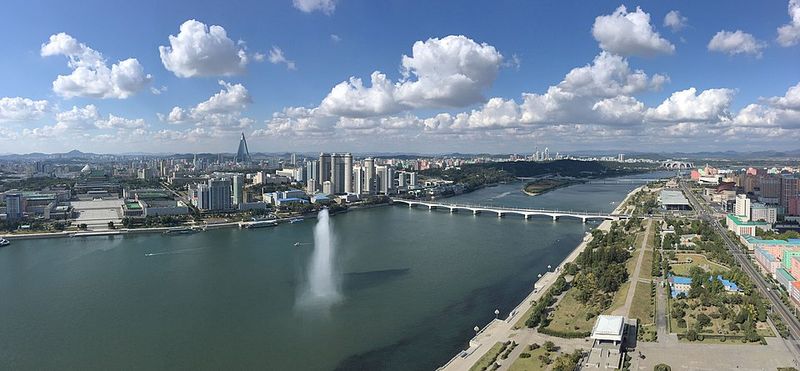
Pyongyang is a city of wide boulevards, monumental public buildings, and large open squares. Most of its architecture is low to mid-rise by international standards.
Against that backdrop, the Ryanggang Hotel stands completely apart. It rises so much higher than everything around it that it creates a visual anchor for the entire city.
From certain vantage points, you can see it from kilometers away. At dusk, when the light catches the glass panels at an angle, the building takes on a different character.
It briefly looks almost finished, almost ready. Then the light shifts and the emptiness becomes visible again.
Travelers who have visited Pyongyang on authorized tours often describe the experience of seeing it in person as genuinely surreal. You know intellectually that it is empty, but the scale of it makes that fact difficult to fully accept.
It looks like it should be full of people.
One of the most talked-about features in the original design was the rotating restaurant system planned for the upper floors. Three separate restaurants were designed to slowly rotate, giving diners a 360-degree view of Pyongyang as they ate.
This kind of feature was considered cutting-edge in the 1980s and would have been a genuine draw for visitors.
Rotating restaurants require complex mechanical systems, precise engineering, and ongoing maintenance. None of that infrastructure has ever been confirmed as installed in the Ryanggang Hotel.
The floors designated for those restaurants remain part of the unfinished upper section of the building.
The idea of those restaurants captures something important about what the hotel was supposed to represent. It was not just a place to sleep.
It was meant to be an experience, a showcase. The gap between that original vision and what actually exists today is one of the most compelling parts of this building’s story.
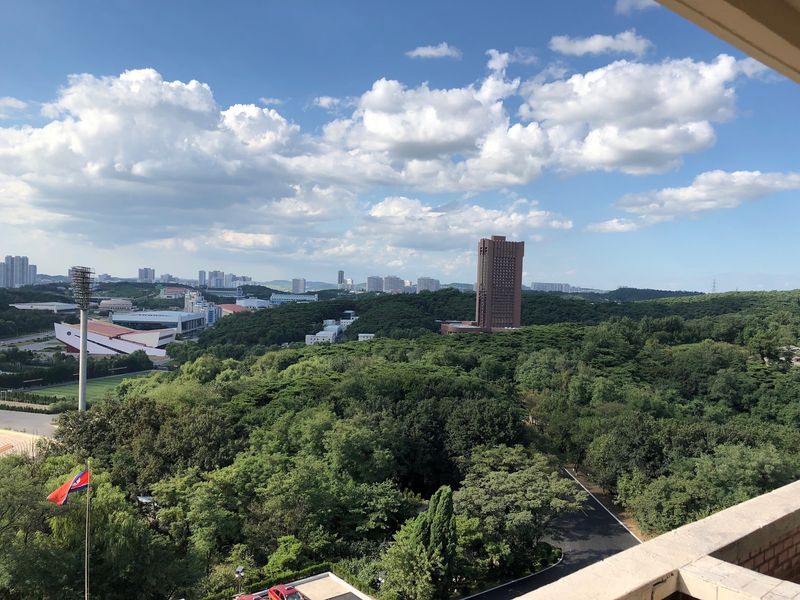
After sixteen years of complete inactivity, cranes appeared around the Ryanggang Hotel again in 2008. Construction crews began applying the glass panel cladding to the exterior, transforming the building’s appearance from raw concrete to something that looked, at least from a distance, closer to a finished structure.
Reports at the time suggested that an Egyptian telecommunications company had invested in the project, which may have helped fund the resumed work. The glass installation continued over several years and covered a significant portion of the exterior.
However, progress on the interior remained unclear. No credible reports confirmed that the inside of the building was being finished at the same pace as the exterior.
The glass facade gave the Ryanggang Hotel a new look, but the fundamental questions about whether it would ever actually open remained unanswered. Work has slowed and stopped multiple times since 2008 without any official opening date announced.
Official communication from North Korea about the Ryanggang Hotel has been minimal and inconsistent over the decades. For most of the 1990s and early 2000s, the government said nothing at all.
The building appeared on no official tourism materials, no government broadcasts, and no state media coverage despite being the most visible structure in the capital.
When the government did begin acknowledging the building after 2008, statements were vague. There were references to an impressive construction project and to the future potential of the building, but no specific opening timelines were ever confirmed publicly.
North Korea’s relationship with this building reflects a broader pattern in how the government manages information about projects that have not gone according to plan. Silence, delay, and carefully controlled messaging have kept the Ryanggang Hotel in a state of permanent official ambiguity, neither confirmed as open nor officially acknowledged as abandoned.
Because access to North Korea is so restricted, much of what the outside world knows about the Ryanggang Hotel comes from satellite imagery rather than on-the-ground reporting. Commercial satellite companies have captured detailed images of the building over the years, allowing analysts to track changes in construction activity without ever setting foot in the country.
Those images have shown periods of visible crane activity followed by long stretches of nothing. They have revealed the scale of the building’s footprint, the layout of the surrounding area, and changes to the exterior over time.
Some images have captured what appear to be antenna installations near the top of the building.
Satellite analysis has become one of the primary tools researchers use to monitor developments in North Korea generally, and the Ryanggang Hotel has been one of the most consistently observed structures. It is, in a sense, the most watched empty building in the world.
Western media gave the Ryanggang Hotel a nickname that has followed it for decades: the Hotel of Doom. The name first gained wide circulation in the early 2000s when international journalists began writing more openly about the building’s abandoned state and its eerie presence over Pyongyang.
The nickname stuck because it captured something real about the building’s atmosphere. A 105-floor structure with no guests, no activity, and decades of silence does carry a certain weight that a cheerful name would not reflect.
Journalists, travel writers, and architecture critics have used it consistently ever since.
Interestingly, the nickname may have actually increased global awareness of the building more than any official promotion could have. The Ryanggang Hotel is now one of the most recognized structures in North Korea among international audiences, largely because of a name that its builders almost certainly never intended it to have.
Architecture and engineering professionals who have studied the Ryanggang Hotel from publicly available information have raised serious questions about the building’s structural integrity after decades of incomplete construction and exposure to the elements. Concrete that is poured and left unfinished for years can develop problems that are expensive and technically complex to address.
Some analysts have suggested that the building may require significant structural work before it could safely function as a hotel, regardless of how the interior is finished. The quality of the original construction materials and methods has also been questioned, given the economic conditions in North Korea during the building’s early phases.
None of this has been confirmed by independent inspection, since no outside engineering team has been given access to assess the building. What is known comes from analysis of available images and general principles of construction science applied to what can be observed from the exterior.
The Ryanggang Hotel has become more than just a curiosity about one country’s unfinished construction project. It has become a reference point in discussions about architecture, urban planning, political symbolism, and the relationship between governments and their built environments.
Buildings tell stories about the societies that create them. The Ryanggang Hotel tells a story about ambition that outpaced resources, about the cost of isolation, and about what happens when a project becomes too symbolic to abandon but too complicated to complete.
That combination is rare in the modern world.
For anyone interested in architecture, history, or the way physical structures reflect political realities, this building offers a genuinely unique case study. It is not just the tallest building in North Korea.
It is one of the most thought-provoking unfinished structures anywhere on Earth, and its story is still being written with every year that passes without an opening date.
Share this story