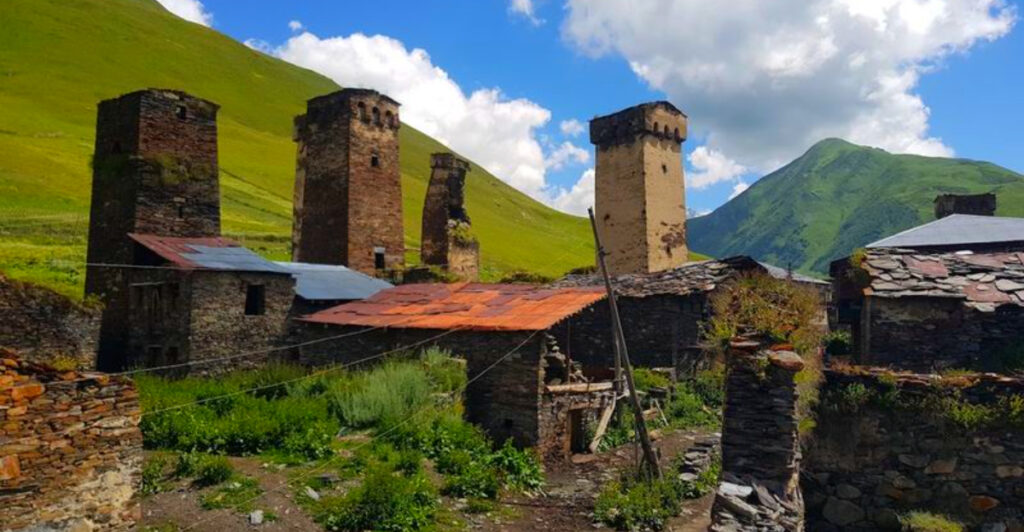
Hidden in the folds of the Caucasus Mountains, a region of Georgia called Svaneti holds one of the world’s most extraordinary secrets: medieval stone towers that have never been abandoned. Built between the 9th and 13th centuries, these tall, narrow fortresses were constructed by Svan families for protection during raids and feuds, and remarkably, many of those same families still live beside them today. You will not find crumbling ruins cordoned off behind museum ropes here. Instead, cows wander past tower bases, children play in their shadows, and grandmothers hang laundry within arm’s reach of walls that are over a thousand years old.
The twelve communities featured here stretch across Upper Svaneti, each one preserving a landscape that feels genuinely medieval without being a reconstruction or a theme park. From Europe’s highest permanently inhabited villages to quiet hamlets barely touched by tourism, this list takes you through a living piece of history that most travelers never get to see.
1. Ushguli, Samegrelo-Zemo Svaneti, Georgia
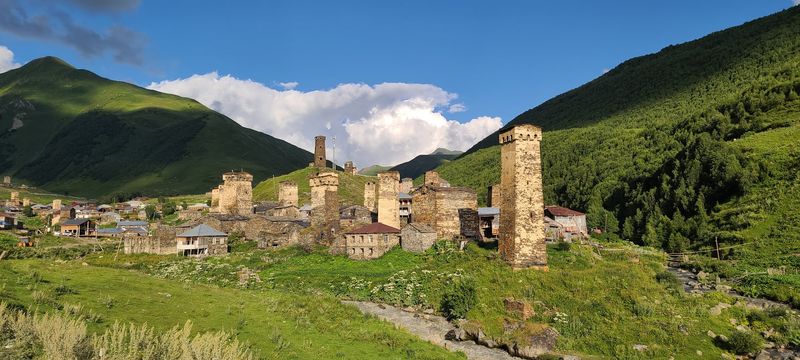
Europe’s highest permanently inhabited settlement is not a museum exhibit but a functioning village where roughly 200 people still wake up every morning surrounded by medieval stone towers.
Ushguli sits between 2,100 and 2,200 meters above sea level, and its cluster of four historic hamlets forms one of the most recognized skylines in the entire Caucasus region.
The towers, called koshki, were built primarily between the 9th and 13th centuries and served as both defensive structures and family refuges during blood feuds.
Roads into the village are frequently buried under snow for up to six months each year, which has unintentionally kept the community remarkably intact.
Ushguli became part of the UNESCO World Heritage Site in 1996, and some towers are still used for storage today. A handful of families even allow visitors to climb inside, offering a rare, firsthand look at centuries of Svan heritage.
2. Chazhashi, Ushguli Community, Samegrelo-Zemo Svaneti, Georgia
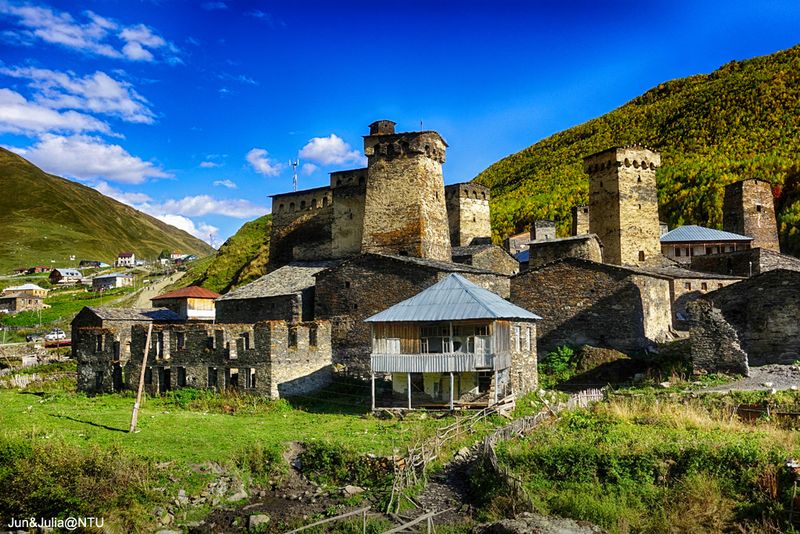
No other quarter in the entire Ushguli community packs more medieval towers into a smaller space than Chazhashi, and walking its narrow lanes genuinely feels like navigating a stone forest.
This is the core site specifically inscribed on the UNESCO World Heritage List, recognized for its extraordinary concentration of 9th to 12th-century architecture.
Researchers have counted not only 13 well-preserved tower houses but also four castle structures and 21 traditional machubis, the residential buildings that historically attached to each tower compound.
The village name itself translates roughly to “horse stall” in the Svan language, a nod to local legends claiming Queen Tamar once kept her horses here.
A 10th-century slate-built Church of the Savior, decorated with 17th-century murals, adds another layer of history to an already remarkable streetscape. Despite its museum-quality appearance, Chazhashi remains a living settlement where local families continue traditional mountain farming practices each day.
3. Zhibiani, Ushguli Community, Samegrelo-Zemo Svaneti, Georgia
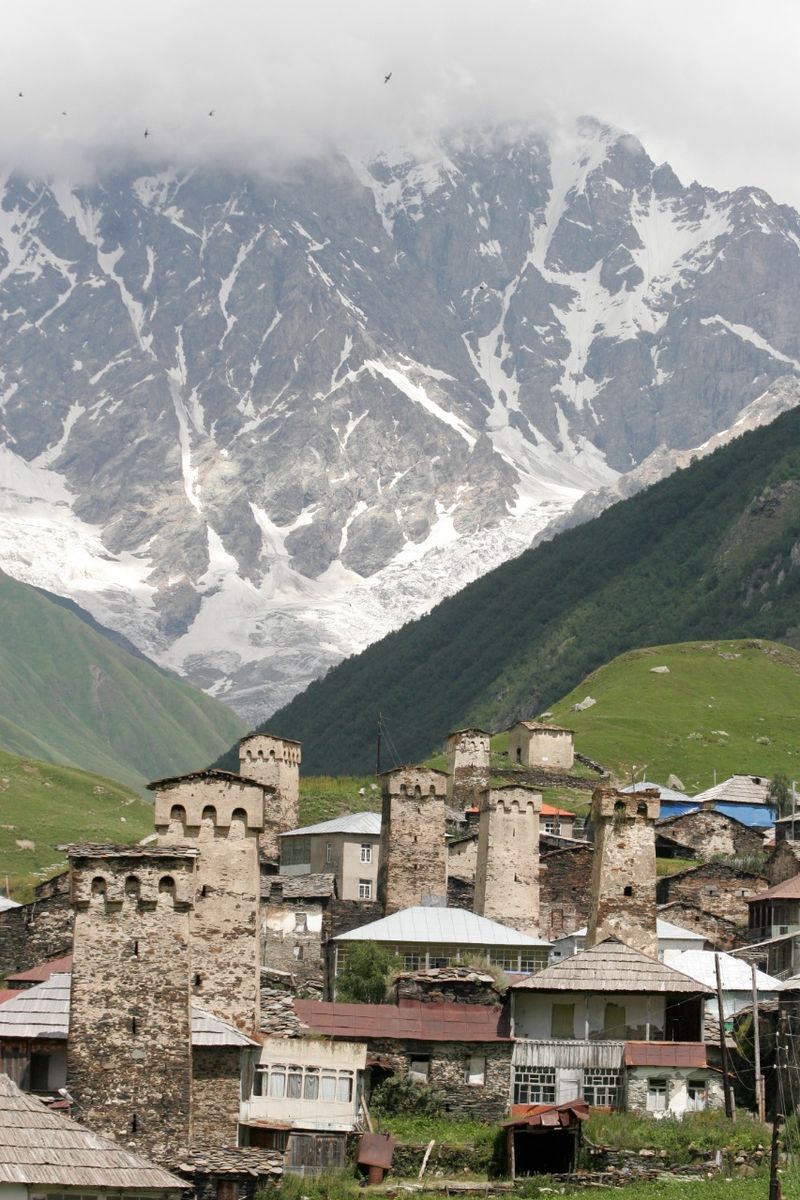
Mount Shkhara, Georgia’s tallest peak, forms the backdrop of Zhibiani so completely that the mountain appears almost close enough to touch from the village lanes.
At 2,100 meters above sea level, this hamlet is one of Ushguli’s four historic villages and contributes its own distinctive architectural details, including a rare twin-towered residential structure found almost nowhere else in Svaneti.
The Lamaria Church, also known as the Church of the Mother of God, perches on a hilltop above the village and dates to the 9th and 10th centuries. Its fortified stone wall and integrated tower give it the silhouette of a compact medieval stronghold rather than a conventional house of worship.
Original frescoes from the 10th through 13th centuries once covered its interior walls, though time has worn many of them considerably.
Zhibiani also hosts the annual Lamproba festival at Lamaria Church, keeping its spiritual traditions firmly alive within the rhythms of modern village life.
4. Chvibiani, Ushguli Community, Samegrelo-Zemo Svaneti, Georgia
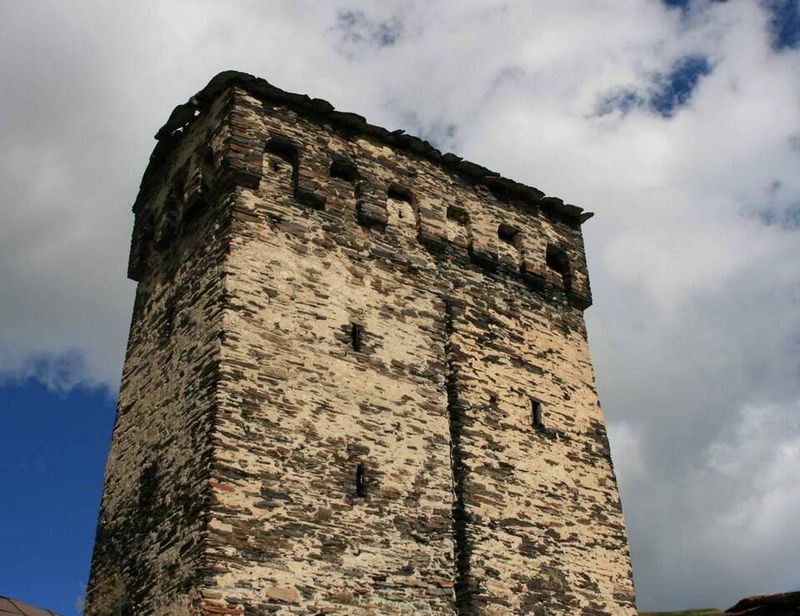
Known locally as the Lower Village, Chvibiani sits at 2,080 meters and carries the same architectural DNA as its uphill neighbor Zhibiani, yet maintains its own quiet, unhurried character.
Towers here were built between the 9th and 12th centuries, functioning as family strongholds that offered protection from invaders, feuding clans, and even the periodic threat of avalanches sweeping down from the surrounding peaks.
The medieval Church of the Savior, locally called Fusdi, is a 10th-century hall-church built from local stone with walls thick enough to handle the harshest alpine winters. Its interior once displayed frescoes painted as early as the late 10th century, with additional layers added through the 12th and 13th centuries.
Around 30 residents continue to maintain traditional Svan hospitality and farming routines in Chvibiani today.
Every August 3rd, the village hosts the folk festival Livskhvari, a celebration that underscores just how much cultural energy this small community still generates within the broader Ushguli landscape.
5. Murqmeli, Ushguli Community, Samegrelo-Zemo Svaneti, Georgia
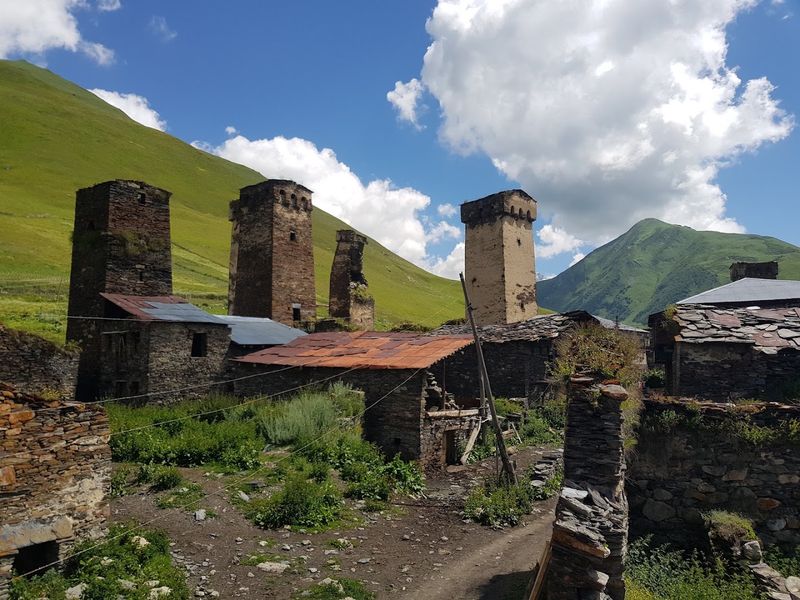
The name Murqmeli translates directly to “place of towers” in the Svan language, which tells you immediately that this tiny hamlet takes its architectural heritage very seriously.
Positioned on the right bank of the Enguri River, Murqmeli is typically the first village a traveler encounters when approaching Ushguli from Mestia, serving as an unassuming but historically loaded introduction to the community.
In the 19th century, the village reportedly contained around 80 towers. Catastrophic avalanches during the winter of 1986 and 1987 destroyed many homes and caused families to abandon the settlement for nearly two decades, leaving only about 10 towers standing by 2021.
Several of those survivors have damaged roofs, and because Murqmeli sits outside the UNESCO-protected core zone, it has received less governmental preservation funding than its neighbors.
Families have returned and continue to live among these enduring stone landmarks, and the Church of St. Barbare remains a notable historical anchor for the community’s ongoing identity.
6. Mestia, Samegrelo-Zemo Svaneti, Georgia
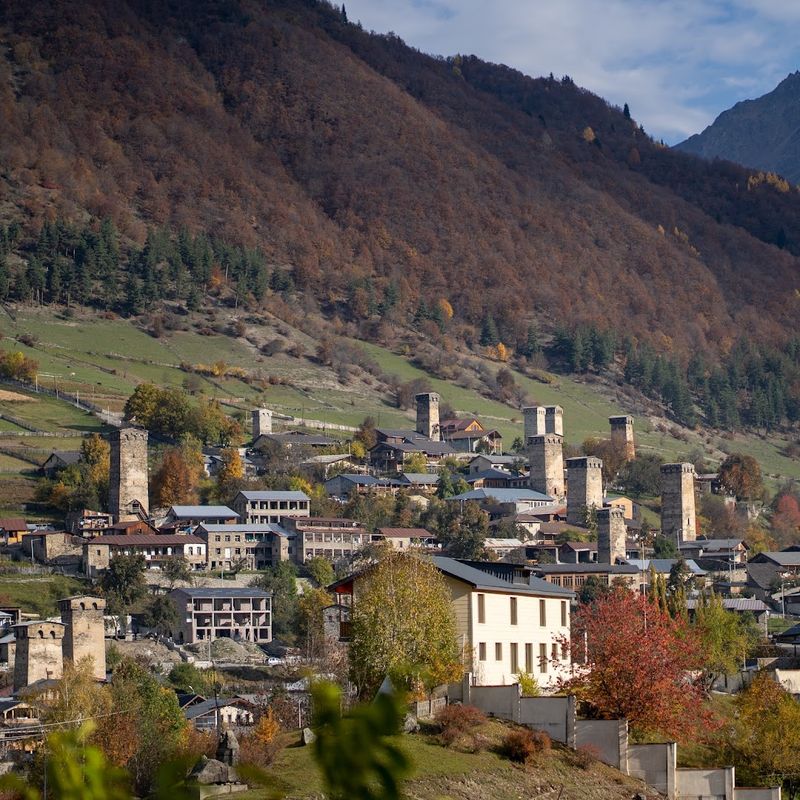
Mestia is the kind of mountain town where you can order coffee in a modern cafe and then look out the window at a 900-year-old stone tower rising from the neighboring yard.
As the administrative and cultural capital of Svaneti, this highland hub sits at 1,500 meters above sea level and features dozens of surviving medieval koshki towers woven into its residential neighborhoods.
Historic quarters like Lanchvali and Lekhtagi still contain traditional family homes built in the classic machubi style, where the ground floor historically sheltered both people and livestock under one roof.
The Svaneti Museum of History and Ethnography preserves ancient icons, manuscripts, and religious artifacts, while the Margiani House-Museum allows visitors to explore a fully intact fortified dwelling.
Hiking trails to the Chalaadi Glacier and Koruldi Lakes launch directly from town, and the Hatsvali cable cars provide elevated views of Mount Ushba. Mestia manages the rare trick of being genuinely convenient while still feeling authentically medieval.
7. Latali, Samegrelo-Zemo Svaneti, Georgia
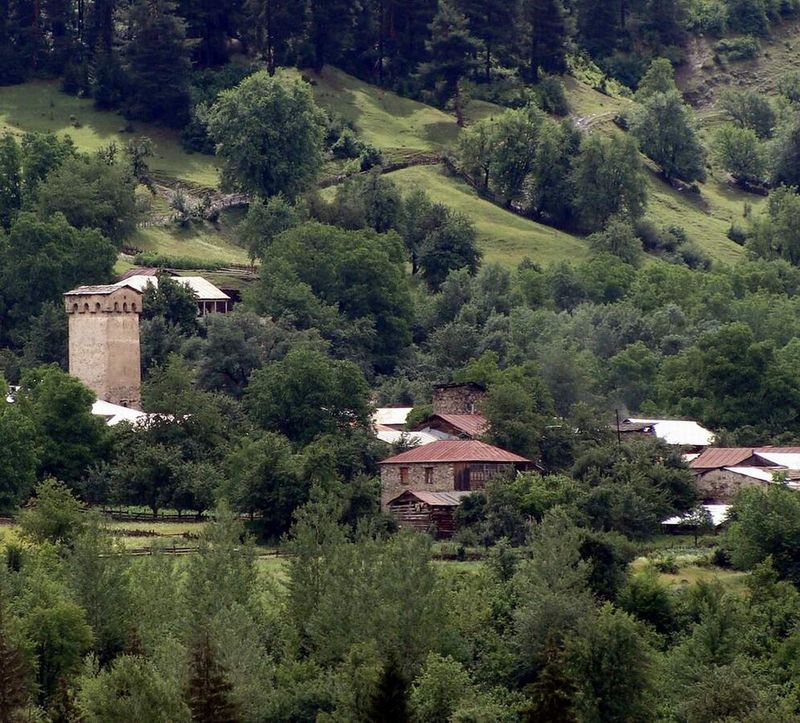
Latali claims more than 60 churches for a community of its size, a ratio that makes even the most devout European cathedral towns look understated by comparison.
Positioned at 1,800 meters in the Mestia Municipality, this collection of traditional Svan villages is historically regarded as the gateway to what was once called Free Svaneti, the stretch of the region that maintained the greatest independence from outside rulers.
Medieval towers punctuate the green valleys at regular intervals, and the 10th to 11th-century Matskhvarishi Church contains a 15th-century fresco uniquely depicting the coronation of King Demetrius I, alongside a 12th-century silver cross.
Higher up on Mount Mkheri, the Archangel Church holds the distinction of being Europe’s highest Orthodox church, offering sweeping panoramic views alongside its 14th-century frescoes.
The annual Lataloba festival, held on the last Monday of July, brings together church services, traditional Svan dishes, and local markets, confirming that this community’s cultural calendar is as full as its landscape is photogenic.
8. Kala, Samegrelo-Zemo Svaneti, Georgia
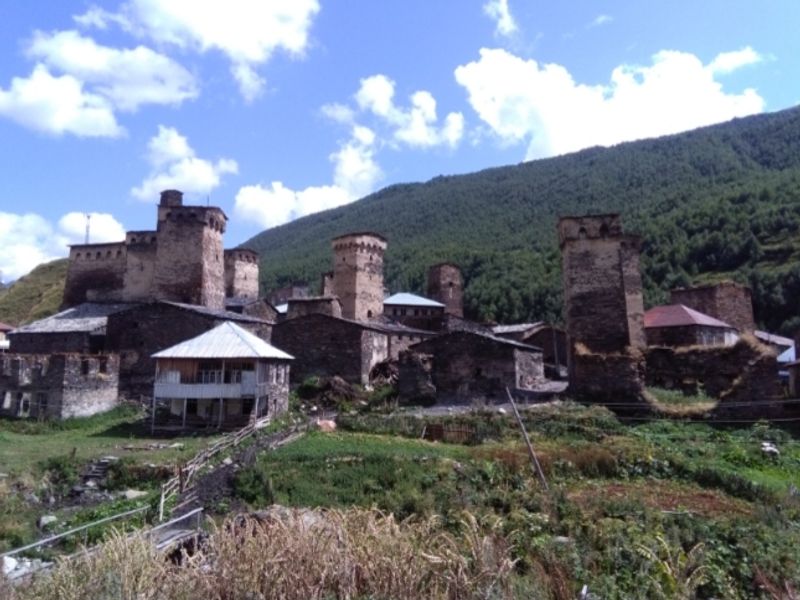
At roughly 2,200 meters above sea level, the villages of Kala sit high enough that the surrounding peaks feel less like scenery and more like next-door neighbors.
These Svan towers, built between the 8th and 18th centuries, were engineered to handle both human conflict and natural hazards, their thick stone walls designed to resist seismic activity and the crushing weight of heavy seasonal snowfalls.
The cultural centerpiece of the area is the Kvirike and Ivlita Church, known locally as Lagurka, a 10th-century hall church considered the principal Christian shrine of all Upper Svaneti. An oath sworn on its icons is still regarded by local communities as the most binding promise a person can make.
Inside Lagurka, frescoes painted by master artist Tevdore in 1111 and 1112 depict biblical scenes and the martyrdom of saints, widely recognized as a high point in medieval Georgian monumental art.
Every July 28th, the church becomes the focal point of the Kvirikoba festival, an all-Svan pilgrimage that draws visitors from across the entire region.
9. Iprari, Samegrelo-Zemo Svaneti, Georgia
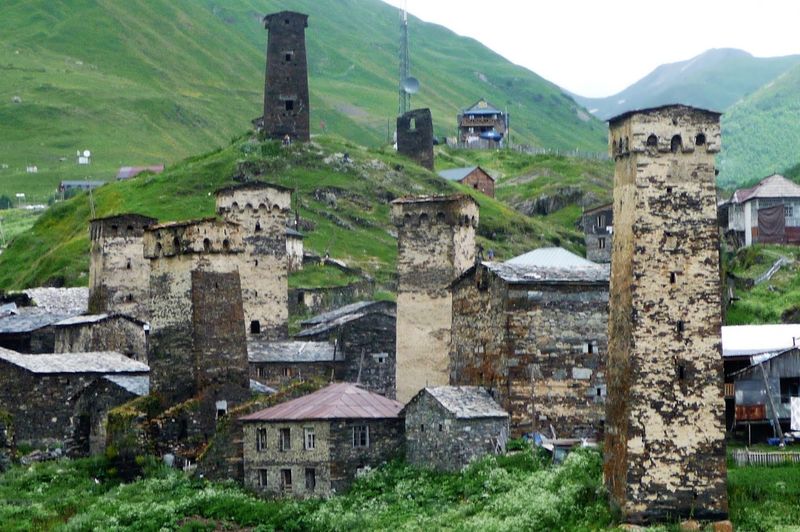
Most travelers speed past Iprari on the road between Mestia and Ushguli, which means this ancient village has quietly held onto an authenticity that busier destinations have long since traded away.
Traditional homes sit alongside clusters of medieval towers here, and the community has maintained a genuinely unhurried pace of life that contrasts sharply with the more developed corners of Upper Svaneti.
The architectural highlight is the Church of the Archangels, called Tarngzel locally, an 11th-century hall church that houses frescoes painted by the royal artist Tevdore in 1096. Art historians consider these murals a pinnacle of medieval Georgian monumental painting, with scenes including the Deesis, the Annunciation, and the Baptism of Jesus rendered in vivid, expressive detail.
The church also preserves a 12th to 13th-century icon of Archangel Michael, kept safe partly because of the village’s relative isolation.
Iprari sits on the popular Adishi to Iprari hiking trail, making it a natural and rewarding rest stop for trekkers passing through between June and September.
10. Adishi, Samegrelo-Zemo Svaneti, Georgia
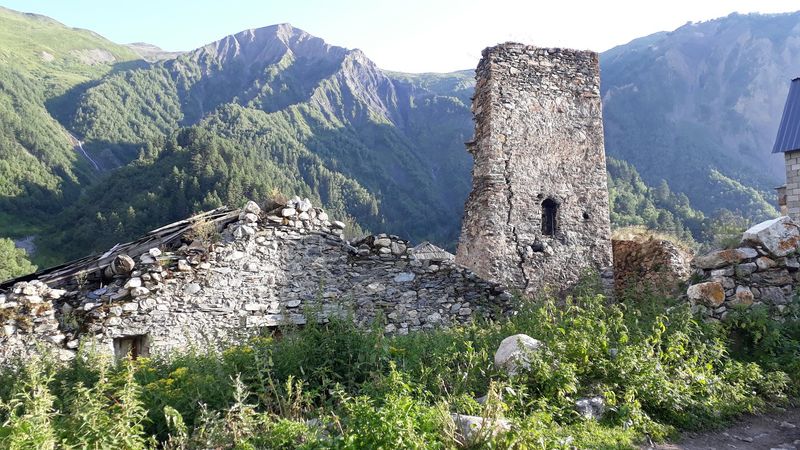
Getting to Adishi requires crossing a river on horseback, navigating a rough 4×4 track, or completing a multi-day trek through high alpine terrain, which is precisely why the village has remained so remarkably intact.
Sitting at 2,040 meters above sea level in Upper Svaneti, this remote community of around 44 residents preserves medieval stone towers alongside a way of life that has changed very little over the past several centuries.
Adishi holds a place in Georgian literary history as the longtime home of the Adishi Gospels, a manuscript dated to 897 AD and considered one of the country’s oldest and most significant written documents.
Several hall-type churches from the 10th through 12th centuries stand within the village, including two dedicated to St. George, each containing frescoes that document medieval religious art traditions.
The annual Lichaaniishi festival in August, held at the St. George basilica, draws the scattered community together for a celebration centered on spiritual devotion and collective hope for the generations ahead.
11. Becho, Samegrelo-Zemo Svaneti, Georgia
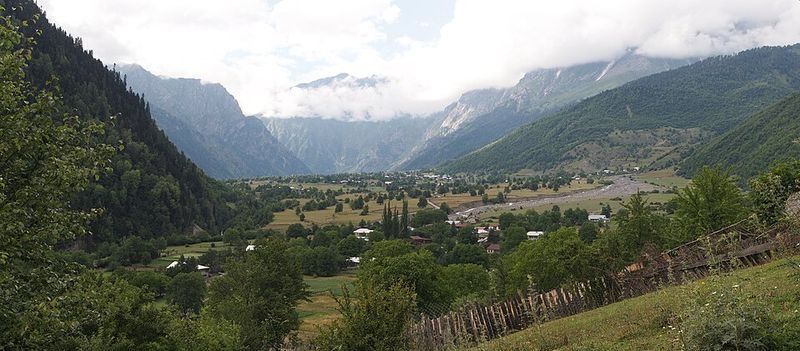
Mount Ushba’s twin peaks loom directly over Becho with such theatrical intensity that even veteran Caucasus travelers tend to stop mid-sentence to stare at the skyline.
This community in Upper Svaneti stretches across the Dolra Valley just west of Mestia, comprising thirteen small hamlets whose historic Svan towers were built as individual clan fortresses rather than a single unified defensive system.
The Goletiani family’s tower complex is among the most studied examples of how these structures functioned as vertical, self-contained strongholds, sheltering people and valuables during periods of intense raiding and blood feuds.
A 10-story tower once belonging to the Dadeshkeliani princes was demolished in 1921, but its ruins remain visible, and descendants of the family still live in the area, maintaining a living connection to that layered history.
The Magardeli Savior Church, an 11th-century hall-type church with well-preserved frescoes of the same period, rounds out Becho’s historical attractions. The village also serves as a classic base camp for mountaineers attempting Mount Ushba.
12. Mulakhi, Samegrelo-Zemo Svaneti, Georgia
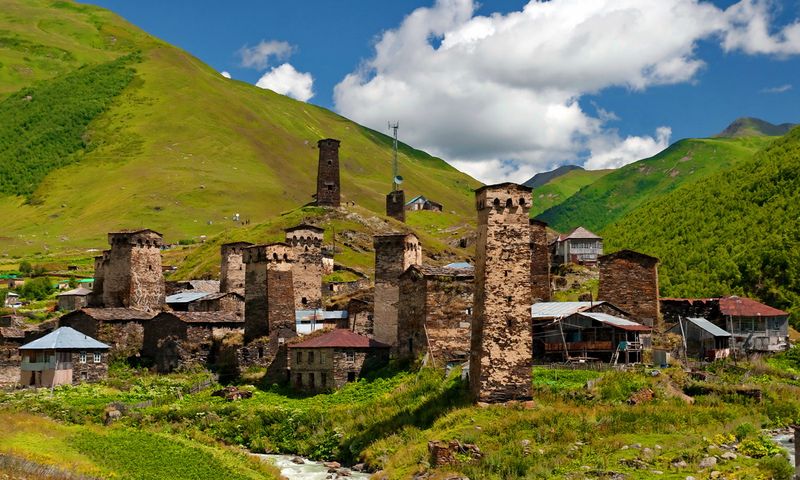
Just 15 kilometers from Mestia, the Mulakhi community manages to feel worlds apart, its villages strung along the Mulakhura River gorge with a quiet self-sufficiency that larger towns tend to lose over time.
The community includes several settlements such as Ldzhira and Zhabeshi, each contributing its own cluster of medieval towers to a collective architectural legacy built predominantly between the 9th and 13th centuries.
What sets Mulakhi’s towers apart architecturally is their clear reflection of a decentralized clan structure, where each family compound integrated a machubi ground floor for shared living with livestock directly beneath the defensive tower above.
Beyond the towers, Mulakhi preserves early Christian foundations including the 13th-century Church of Christ with ancient paintings and a 10th-century icon of Saint George.
Mount Tetnuldi and the Tsaneri Glacier dominate the horizon above the community, providing a backdrop that long-distance hikers heading toward Adishi, Zhabeshi, and Chvabiani consistently describe as among the finest mountain scenery anywhere in Georgia.
Share this story