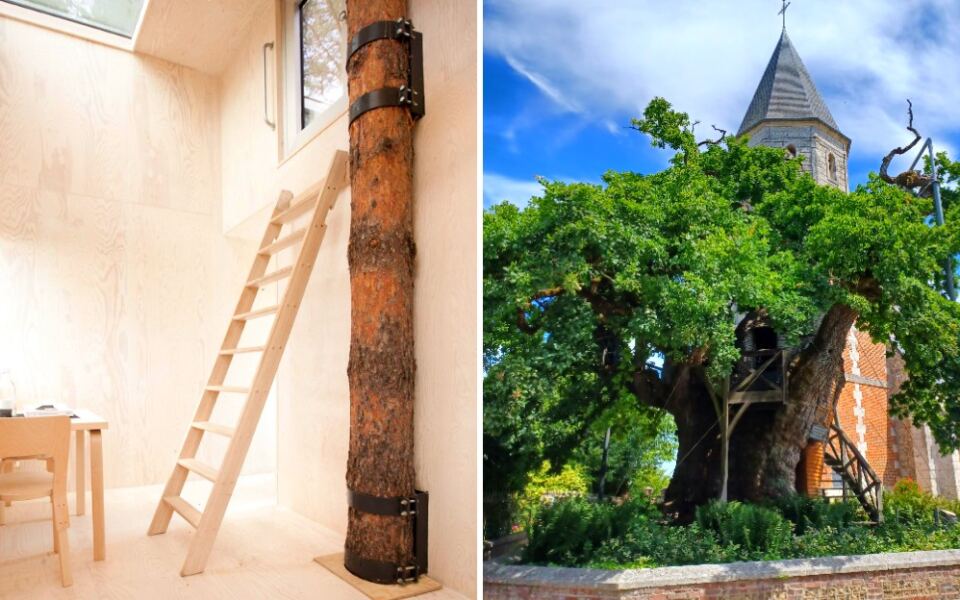
Some buildings have trees growing straight through their roofs. Others have giant roots wrapped around ancient walls, while one small chapel in Greece has 17 trees growing from its roof.
These unusual places can be found across the world, from Cambodia’s centuries-old temples to a modern coffee shop in Thailand designed around a baobab tree.
There’s even a mirrored hotel room in Sweden built around a living tree and a centuries-old oak in France with two chapels inside its trunk.
Here are 13 remarkable examples of what happens when trees become part of the architecture, sometimes by design and sometimes after centuries of growth.
1. Ta Prohm Temple, Siem Reap, Cambodia
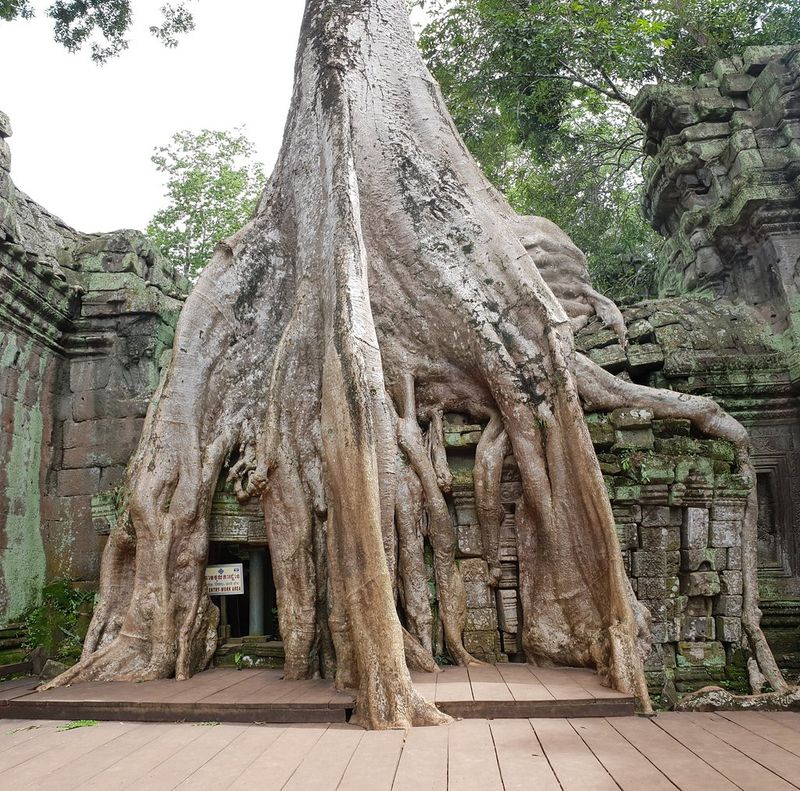
Movie fans may recognize this temple from the first Tomb Raider film. The real star, though, has always been the trees.
King Jayavarman VII built Ta Prohm in the late 12th century as a Buddhist monastery and honored his mother with it. Back then it was called Rajavihara, and it housed monks, teachers, and students.
Today, giant silk-cotton and strangler fig roots spill over the stone galleries. Some grip doorways so tightly that the roots and walls seem to be one piece.
Unlike many Angkor temples, large parts of Ta Prohm were left in their reclaimed state on purpose. The roots push stones apart, yet they also hold sections together.
Visitors follow marked paths and wooden platforms through winding corridors and courtyards. Arrive early in the morning to beat the biggest crowds.
A quick tip: the most famous root-covered doorway gets a line for photos. Have your camera ready before your turn comes.
2. Harudot by Nana Coffee Roasters, Chonburi, Thailand
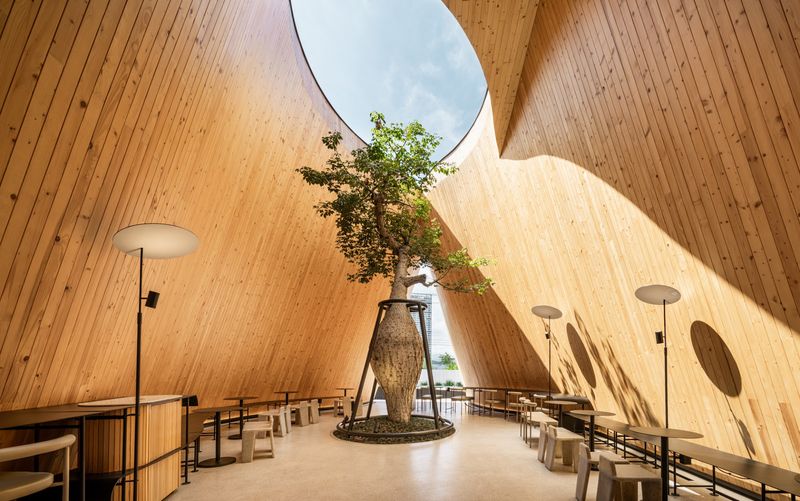
A baobab tree got the best seat in the house at this Thai café. It stands right in the middle, rising through a gap between the roofs.
IDIN Architects designed Harudot for Nana Coffee Roasters. The firm name stands for Integrating Design Into Nature, which suits this project very well.
The building has three gabled sections covered in blackened wood. Inside, warm pine walls and planted courtyards balance out the dark exterior.
The roof pieces separate on purpose so the baobab can keep growing upward. It almost looks like the tree arrived first and the café politely built around it.
Guests can pick from a coffee bar, lounges, and meeting areas. Some seats are even made from resin mixed with coffee grounds and rice.
Architecture fans should bring a good camera. The roof lines make great photos, and the menu gives you a tasty reason to stay longer.
3. Church of Agia Theodora, Vasta, Greece
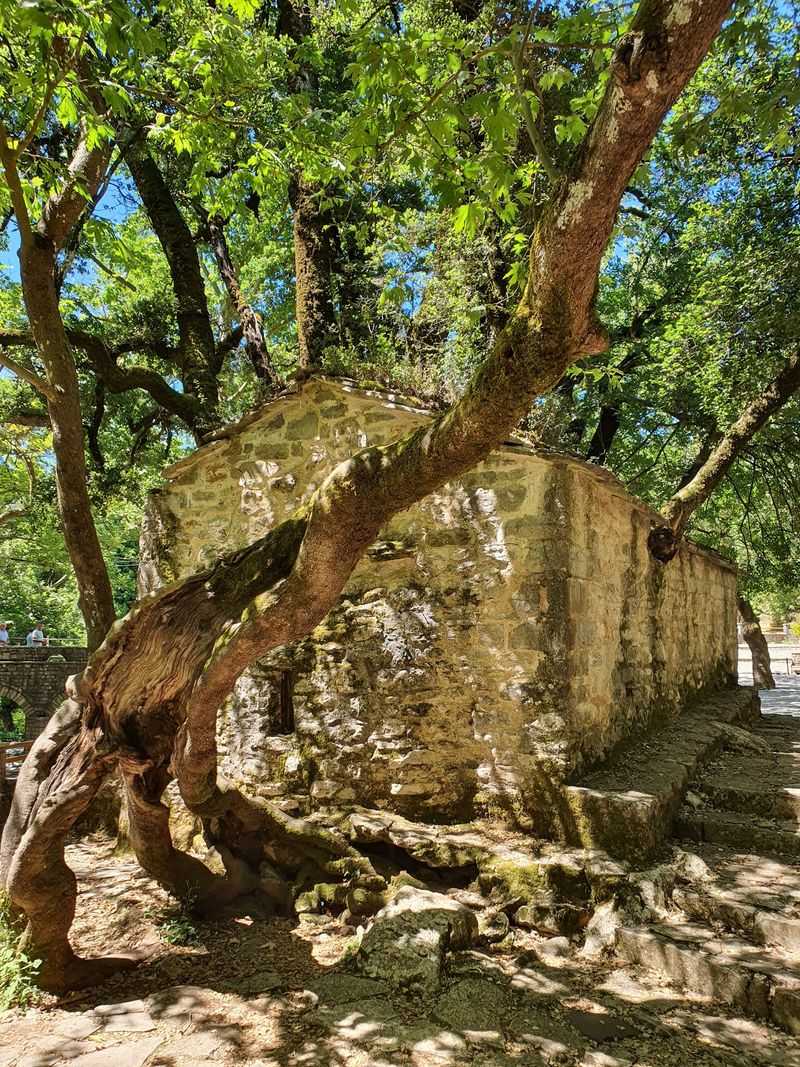
Seventeen trees on one tiny roof sounds like a math problem nobody can solve. The Church of Agia Theodora has been solving it for centuries.
The stone chapel measures about five meters long and four meters wide. Some of its trees reach around 30 meters tall, yet the thin roof still holds.
Local legend says Saint Theodora disguised herself as a soldier in the 11th century. She prayed that her hair would become trees, and many believe the 17 trees match her age.
Scientists have studied the site with ground radar. They found that roots slip through gaps in the stonework and reach an underground stream below the floor.
Those roots may also act like a support net for the walls. A spring flows right beside the chapel too.
Thousands of visitors arrive every year, many as pilgrims. Dress modestly and keep your voice low, since this is still an active place of worship.
4. Wat Bang Kung, Bang Khonthi, Thailand
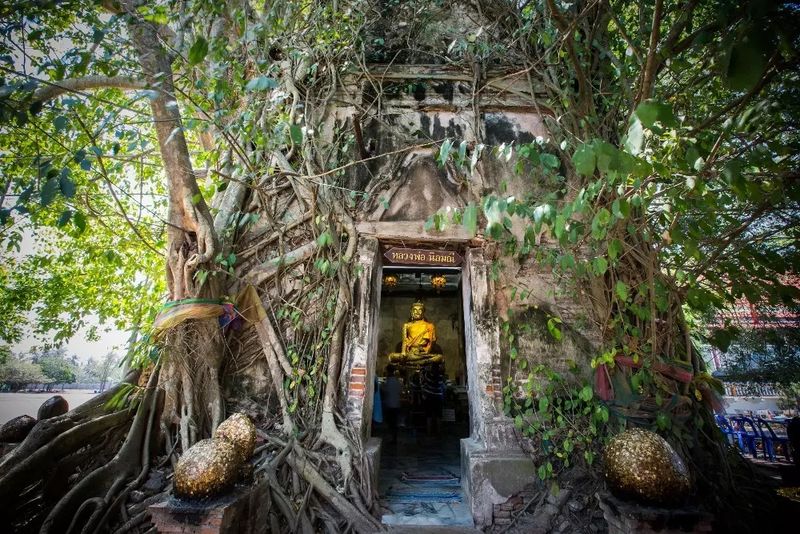
Is it a tree or a temple? At Wat Bang Kung, the honest answer is both.
The small ordination hall here is known as the Bot Prok Pho, or tree-covered chapel. Banyan, Bodhi, and other trees have wrapped it so completely that only the doorway and a few walls show.
The temple dates back over 300 years to the Ayutthaya period. Inside sits a golden Buddha image called Luang Pho Nilmani, along with faded wall murals.
History adds another layer. The area once held the Bang Kung military camp, where General Taksin led Siamese forces to victory against Burmese armies in 1768.
After that, the temple was left alone, and the trees took over. Thailand restored the grounds in 1967.
Today you can see statues of King Taksin and soldiers, some striking Muay Thai poses. Remember to remove your shoes before entering the chapel and leave a small offering if you wish.
5. Chêne Chapelle, Allouville-Bellefosse, France
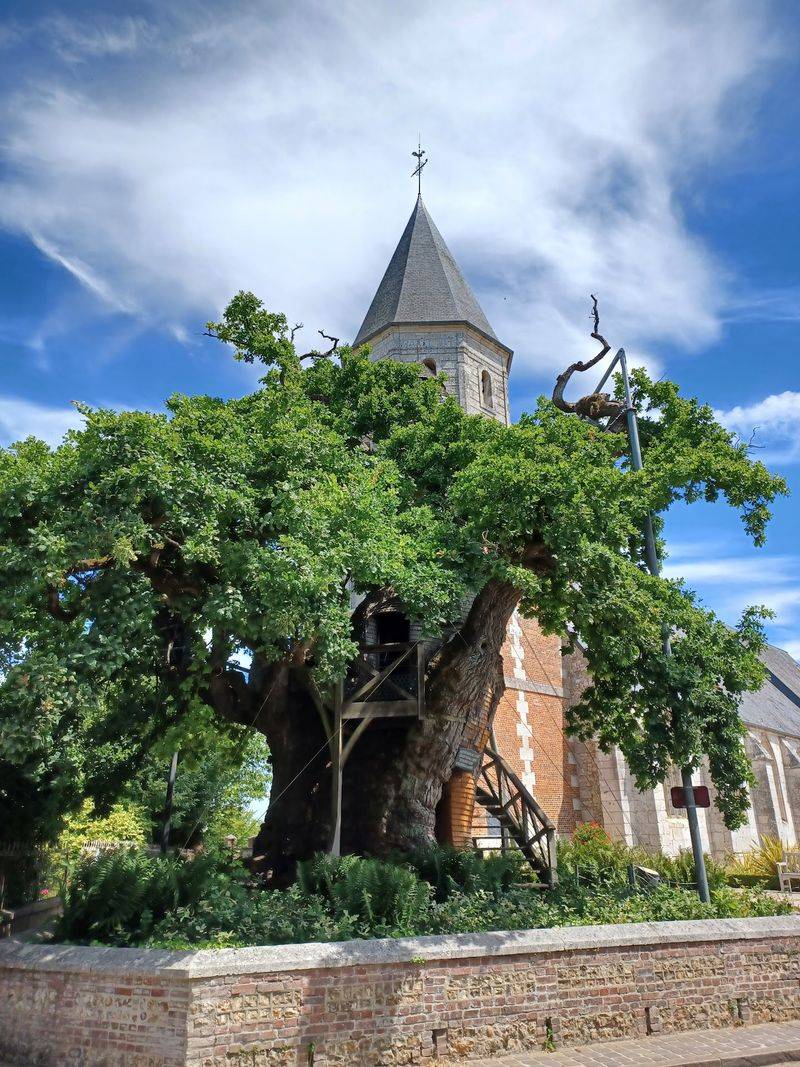
Lightning struck this oak in the 17th century and hollowed out its trunk. Instead of giving up, the tree kept growing leaves.
Local priests saw that as a sign. They built two tiny chapels inside the hollow, which turned the tree itself into the building.
The lower room is Notre-Dame-de-la-Paix, or Our Lady of Peace. The upper one is called the Hermit’s Room, and a spiral staircase wraps around the outside to reach it.
Experts believe the oak is between 800 and 1,200 years old. That may make it the oldest known tree in France.
During the French Revolution, an angry crowd wanted to burn it. A clever local renamed it the Temple of Reason, and the tree was spared.
Today wooden shingles and poles help support the aging trunk. Mass is still held twice a year, and a pilgrimage takes place every August 15, a fine date for a visit.
6. House of Music Hungary, Budapest, Hungary
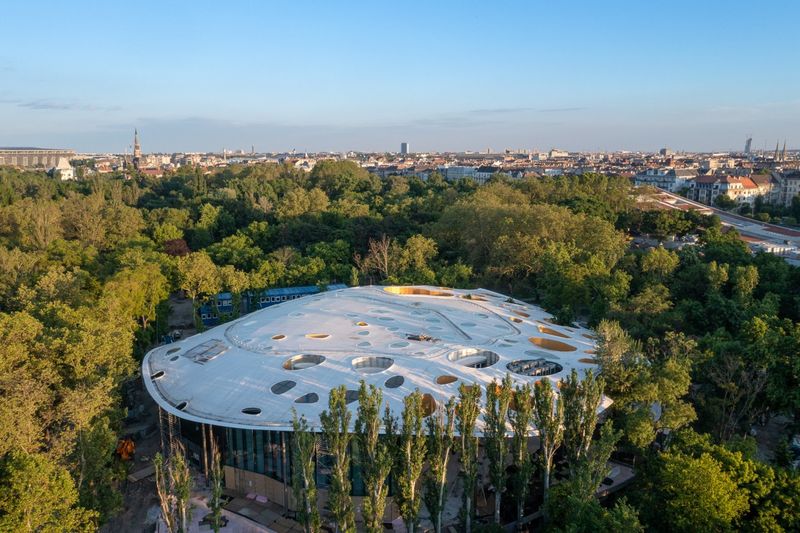
Plenty of buildings have skylights. Sou Fujimoto gave this one nearly 100 holes, and some of them belong to trees.
The Japanese architect designed House of Music Hungary, which opened in 2022 in Budapest’s City Park. Its wide, wavy roof includes openings that let existing trees keep reaching upward.
Other openings bring daylight down to the lower floors. Tall glass walls wrap the building, so the park stays in view from inside.
Look up once you enter. The ceiling holds about 30,000 decorative steel leaves, a playful nod to the real ones outside.
The building has exhibitions about European and Hungarian music history, plus two concert halls and learning spaces. A highlight is the Sound Dome, which fits up to 60 people for 360-degree audio shows.
Plan at least two hours here. Afterward, stroll around the outside to see how the roof weaves between the branches.
7. Du Mien Garden Coffee, Ho Chi Minh City, Vietnam
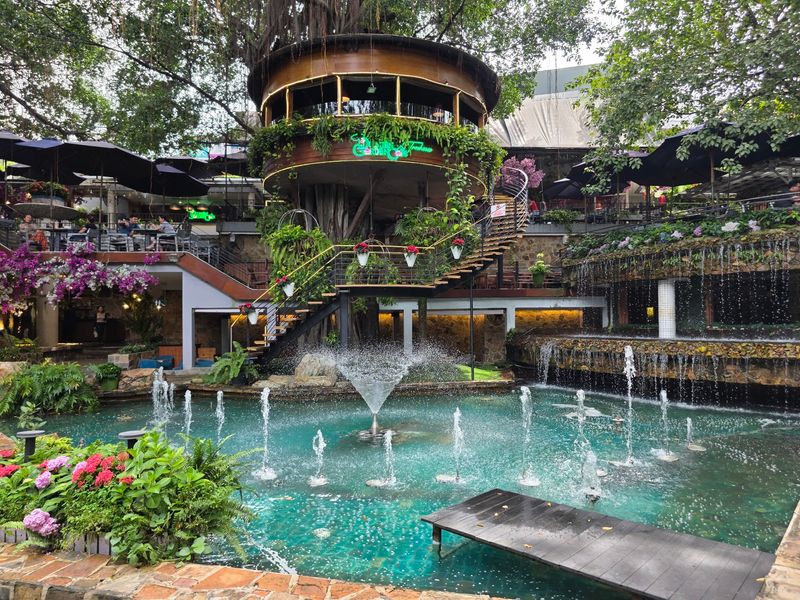
Ordering coffee here comes with a bonus question. Would you like your table on the ground or up in a tree?
Du Mien Garden Coffee sits in the Go Vap District of Ho Chi Minh City. It is famous for nest-shaped wooden seating pods built around mature ficus and banyan trees.
In some pods, the trunk passes straight through the floor and ceiling. You can sip your drink with a tree as your tablemate.
The builders were smart about safety. Iron posts and extra supports carry the weight, so the trees are not doing all the work.
Beyond the treehouses, the garden has lawns, small waterfalls, and misting systems that keep things cooler. Indoor rooms and rooftop seats are available too.
Treehouse pods fill up quickly on weekends. Go on a weekday afternoon if you want one, and stay until evening when the string lights come on.
8. Preah Khan Temple, Siem Reap, Cambodia
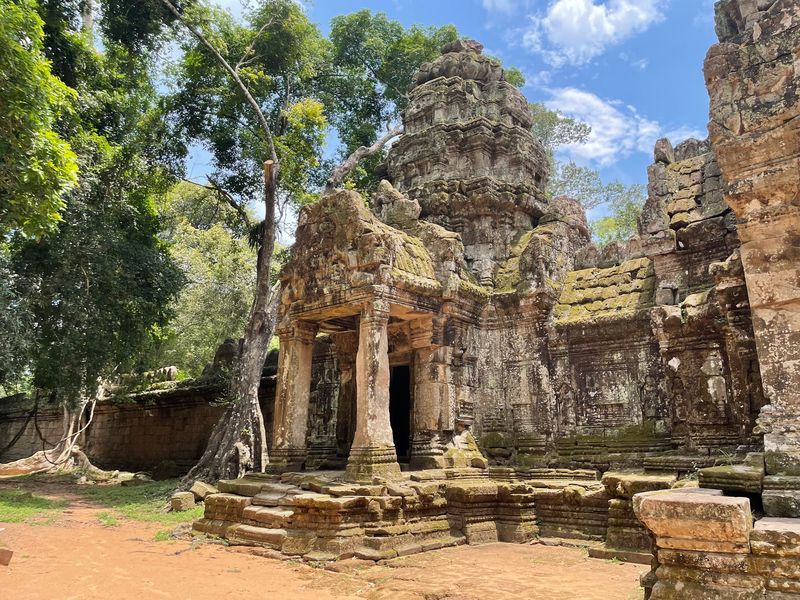
Preah Khan means Sacred Sword. The name marks the place where King Jayavarman VII won a major battle against invading Cham forces.
He built the temple in 1191 to honor his father. It once worked like a small city and Buddhist university, with thousands of people serving there.
Like Ta Prohm, much of the complex was left mostly unrestored. Huge roots spread over walls and squeeze through ruined galleries.
The site is big, covering around 140 acres. A moat surrounds it, lined with carved garudas, which are mythical bird figures.
Inside, long corridors stretch in straight lines through carved doorways. Watch for the Hall of Dancers, decorated with rows of carved dancing figures.
You will also find a rare two-story building with round columns. Preah Khan usually draws fewer visitors than nearby temples, so it is a good stop if you want room to explore at your own pace.
9. TiensTiens Café, Beijing, China
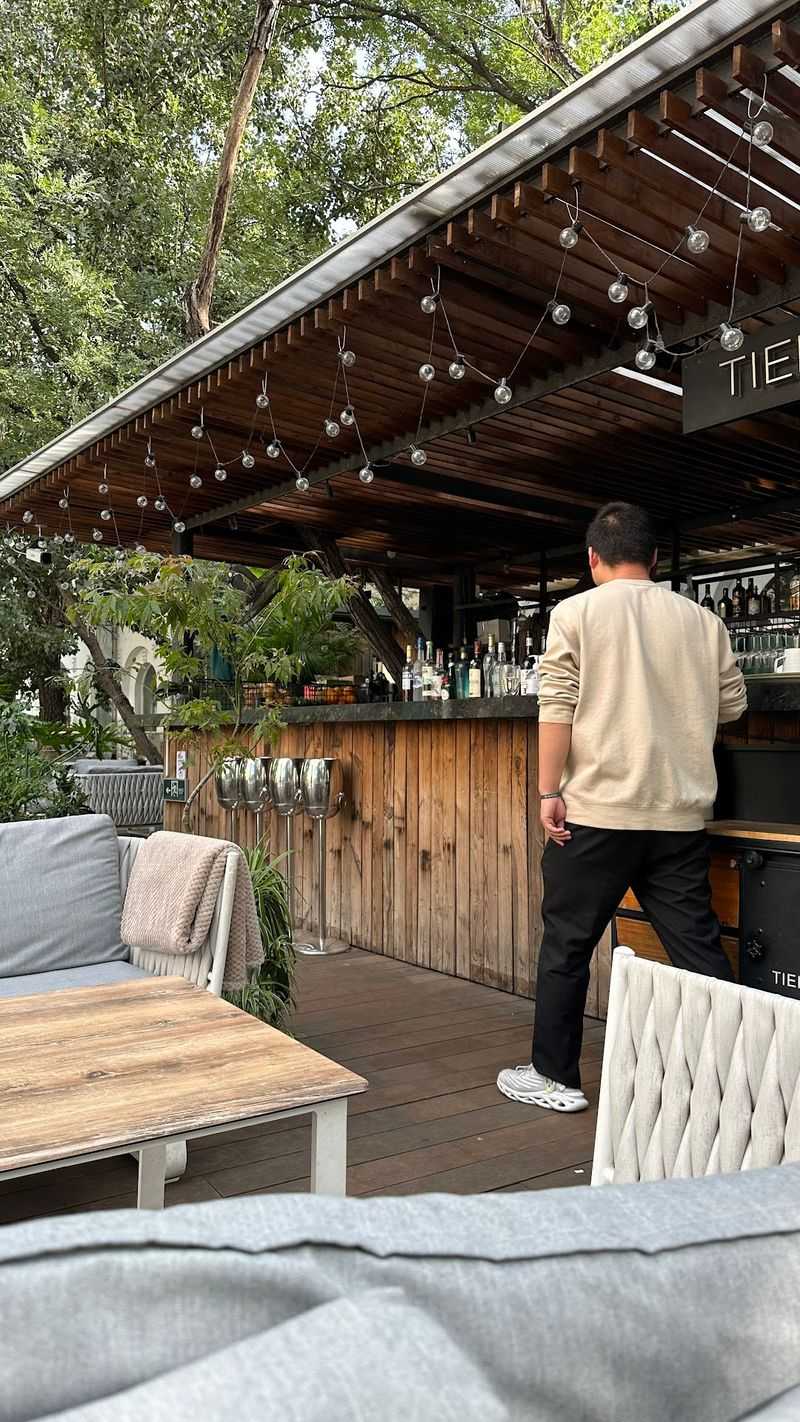
Sixty square meters is roughly the size of a small apartment. Squeezing a café and two big trees into that space took serious creativity.
Trace Architecture Office, led by architect Hua Li, took on the challenge in Beijing’s Sanlitun neighborhood. The plot was a narrow gap between two buildings, and two mature trees already stood there.
The architects kept both trees. They stacked platforms at different heights around the trunks and linked them with a spiral path.
Guests start at the street-level counter and climb upward. Each level shows the trees from a new angle.
The trip ends at a rooftop terrace right beneath the branches. Glass walls make it hard to tell where indoors stops and outdoors begins.
TiensTiens is known for French pastries, cakes, and specialty coffee. Grab a macaron, head to the top level, and enjoy a snack at canopy height.
10. Beng Mealea Temple, Siem Reap Province, Cambodia
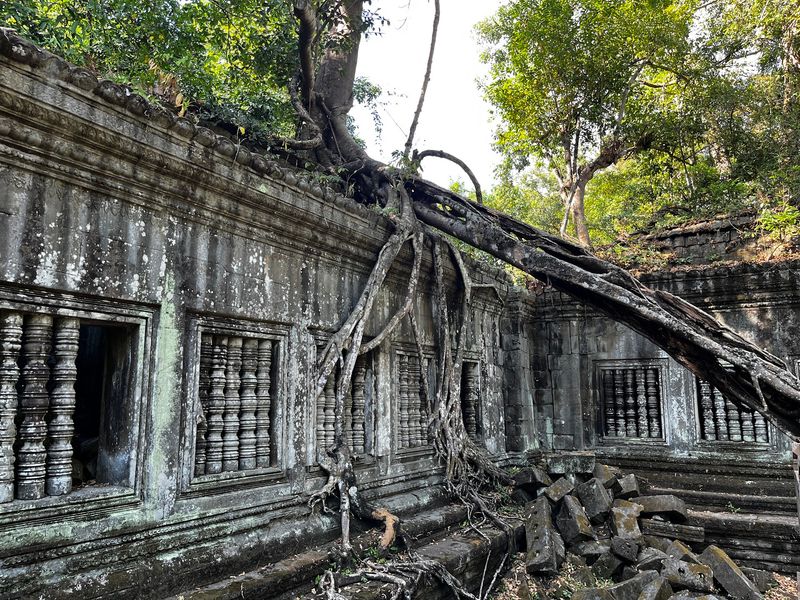
About an hour and a half by road from central Siem Reap, Beng Mealea rewards visitors willing to travel farther than usual.
King Suryavarman II, the ruler behind Angkor Wat, built this 12th-century temple. It was first dedicated to the Hindu god Vishnu.
Its layout looks a lot like Angkor Wat. Some scholars think it may have served as an early model for that famous site.
The big difference is what time has done. Beng Mealea remains largely unrestored, so trees grow from collapsed galleries and roots wind through piles of fallen stone.
Wooden walkways guide visitors over the trickiest areas. Recent work by the APSARA National Authority added new bridges and repaired the eastern causeway.
Wear sturdy shoes with good grip, since some paths cross uneven blocks. Bring water and snacks too, because services are limited compared to the main temple zone.
11. Treehotel Mirrorcube, Harads, Sweden
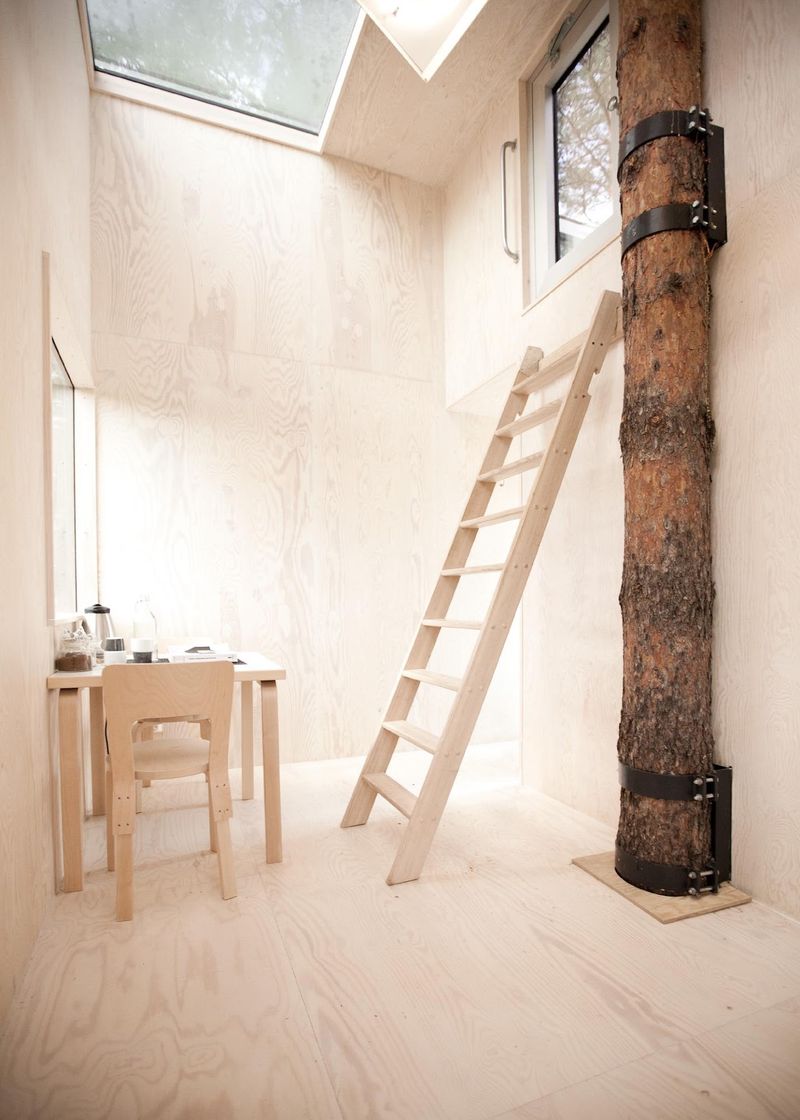
Finding your hotel room usually takes a key card. At the Mirrorcube, it might take a second look.
Swedish architects Bolle Tham and Martin Videgård designed this four-meter cube for Treehotel in Harads, northern Sweden. Mirrored glass covers every side, so it reflects the surrounding forest and seems to vanish.
A living tree trunk runs right through the center of the room. Guests reach the cube by a bridge about 12 meters long.
Inside, birch plywood lines the walls and heated floors help during cold winters. The room holds a double bed, a small sitting area, and windows on every side.
The cube has a compact eco toilet. Showers and a sauna are in a nearby guesthouse.
Fun fact: the glass has an infrared film that birds can see, which helps them avoid flying into it. Book months ahead, especially for northern lights season in winter.
12. The Laurel Tree, Utopia, Texas
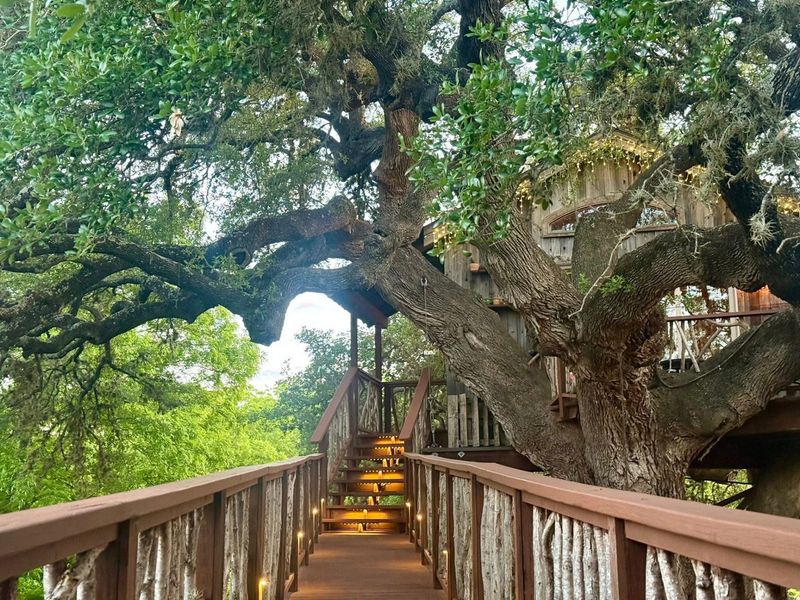
Meet Gerard, a 450-year-old oak with a trunk nearly six feet across. He also happens to hold up one of the most unusual dining rooms in Texas.
The Laurel Tree sits in the small town of Utopia, in Texas Hill Country. Owner and chef Laurel Waters trained in France and wanted a setting that blended French cooking with her Texas roots.
The treehouse fits up to six diners. Its siding is reclaimed wood from Waters’ family property.
A gentle ramp leads up, so guests and staff can travel easily between the kitchen and the table. The oak stays at the heart of the design.
Meals are reservation-only, and the menu changes weekly. Many ingredients come from the property’s own farm and gardens.
The build appeared on the TV show Treehouse Masters. Spots often sell out months ahead, so plan early and arrive with time to walk the pecan grove.
13. Yellow Treehouse Restaurant, Auckland Region, New Zealand
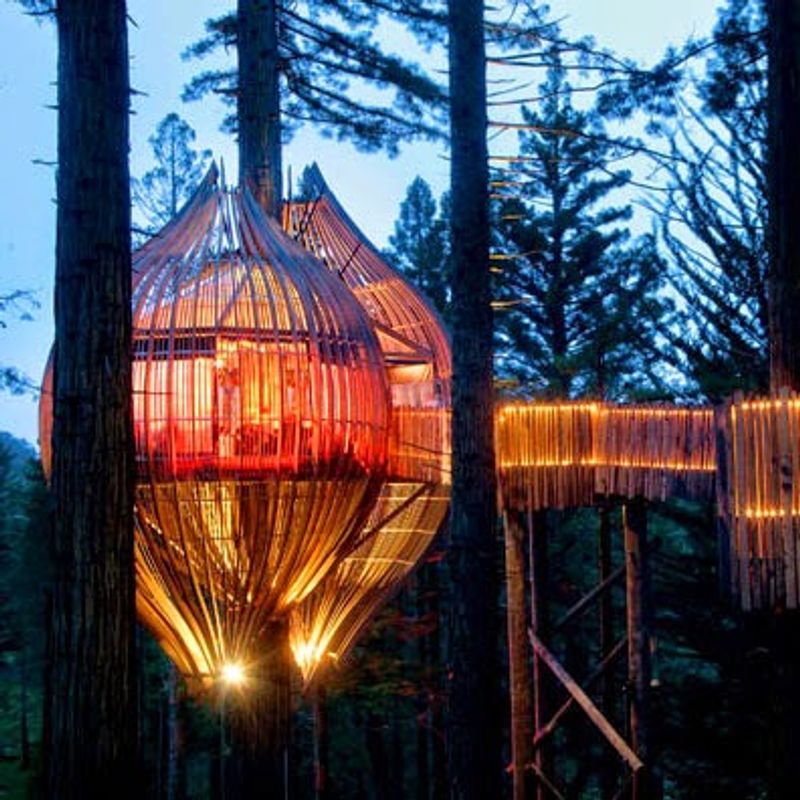
A phone directory company inspired one of the world’s most famous treehouses. The Yellow Treehouse began as a promotion for Yellow Pages.
Pacific Environments Architects designed it around a redwood more than 40 meters tall. The pod-shaped structure sits about 10 meters above the ground.
Its curved form wraps around the trunk, which rises through the middle. Builders used poplar slats and redwood railings milled on site.
Gaps between the slats let daylight inside. The room could seat about 30 guests.
Getting there was half the experience. Visitors crossed a treetop walkway roughly 60 meters long.
Engineers also thought about the tree’s future. Rods passed through metal cuffs so the trunk could keep growing without being squeezed.
Though it started as a temporary project, the design won several awards. It still shows how a single tree can become the center of a truly creative building, and it makes a fitting finale for this list.
Share this story