Architecture has always been about more than bricks and glass. Some of the world’s most famous buildings were carefully designed to broadcast political ideas, challenge authority, or shape how people think about power, identity, and history. A glass dome that puts citizens above their elected leaders, a courtroom window that lets judges see ordinary people walking by, a museum where empty space tells the story of loss, these are not accidents. They are deliberate choices made by architects who understood that buildings can argue, persuade, and even provoke.
Some messages were meant to be obvious, others were hidden in plain sight, and a few only reveal themselves once you know what to look for. This list covers 14 famous structures from around the world, each one carrying a political idea embedded in its very design. Get ready to look at famous buildings in a completely new way.
1. United States Capitol, Washington, D.C., United States

Before the first stone was laid, the founders of the United States had already decided what their new parliament should say about them. By choosing the neoclassical style, with its columns, domes, and symmetrical facades, they deliberately connected the young republic to ancient Greece and Rome, the birthplaces of democratic government.
Thomas Jefferson personally championed the classical aesthetic, believing that the building’s appearance should signal openness and equality. The separate wings for the House of Representatives and the Senate were not just practical; they reflected the constitutional separation of legislative responsibilities.
Throughout the interior, eagles, personifications of Liberty, and allegorical paintings transform decoration into a continuous civic lesson. The building’s enormous scale sent an additional message to the world: this republic was not a temporary experiment. It expected to last, and it built accordingly.
2. Palace of Westminster, London, England
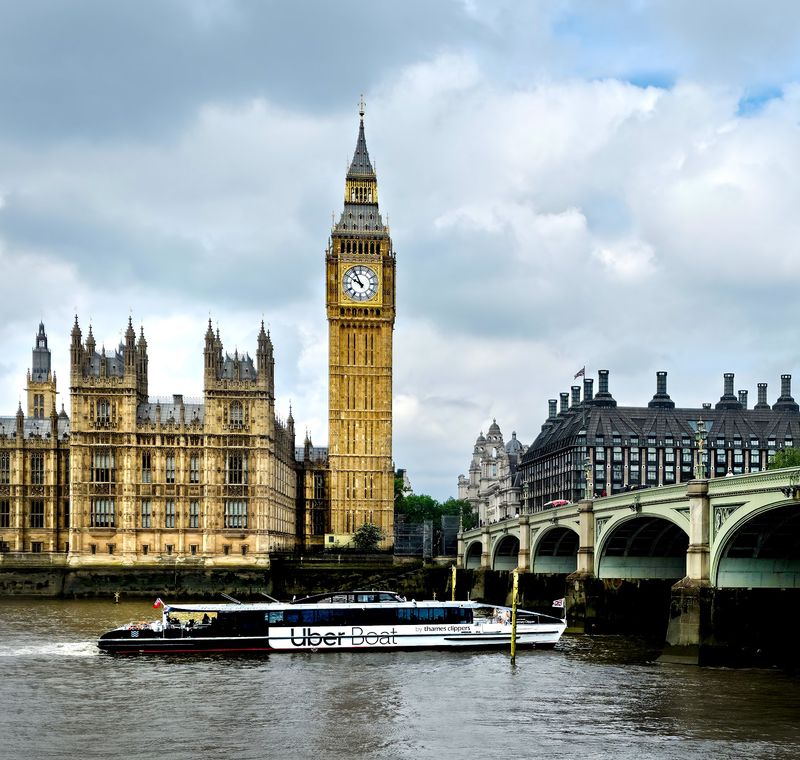
When fire tore through the old Palace of Westminster in 1834, the decision about what to build in its place became a political argument disguised as an architectural debate. France and the United States had both adopted classical styles for their government buildings, styles associated with revolution and sudden political transformation.
Britain chose something very different. The architects selected Gothic Revival, a style rooted in medieval English tradition, monarchy, and the Church. Every pointed arch and stone turret quietly insisted that British democracy had not been invented overnight; it had grown slowly across centuries.
That contrast was entirely intentional. The building’s appearance argued that Britain’s constitutional system was the product of patient, organic development rather than dramatic upheaval. Even the choice of style was a political statement, one that said Britain’s path to governance was unique, stable, and proudly its own.
3. Parliament House, Canberra, Australian Capital Territory, Australia
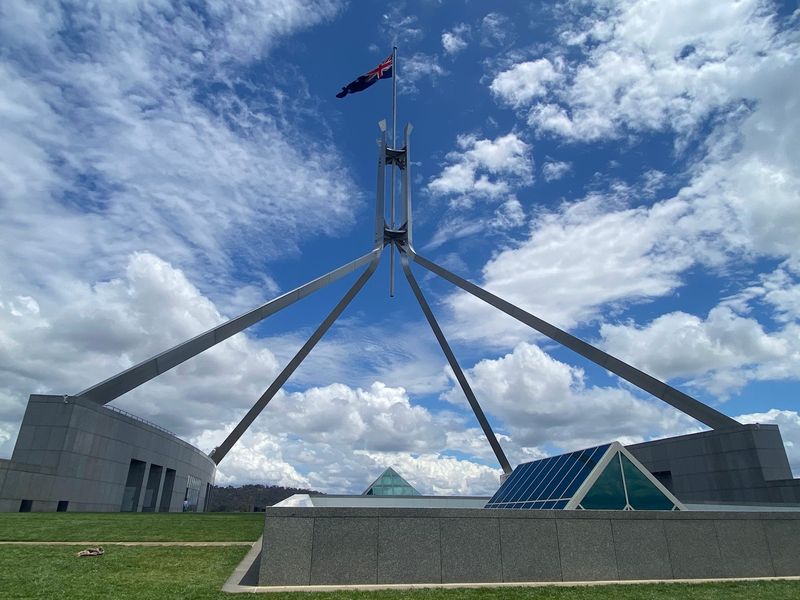
Most government buildings try to impress citizens by towering over them. Australia’s Parliament House took the opposite approach, and the result is one of the most quietly radical democratic statements in modern architecture. The building is buried into Capital Hill, and visitors are welcome to walk across the grass-covered roof directly above the chambers where laws are made.
The symbolism is hard to miss. Political authority sits beneath the people it serves, not above them. Architect Romaldo Giurgola designed the structure with this principle as its foundation.
The forecourt adds another layer of meaning through a large mosaic by Warlpiri artist Michael Nelson Jagamara, titled Possum and Wallaby Dreaming. Its presence connects the national government to Australia’s Indigenous heritage and the land itself. Native materials used throughout the building reinforce the same idea: this parliament belongs to the continent and all its people.
4. National Congress Palace, Brasilia, Federal District, Brazil
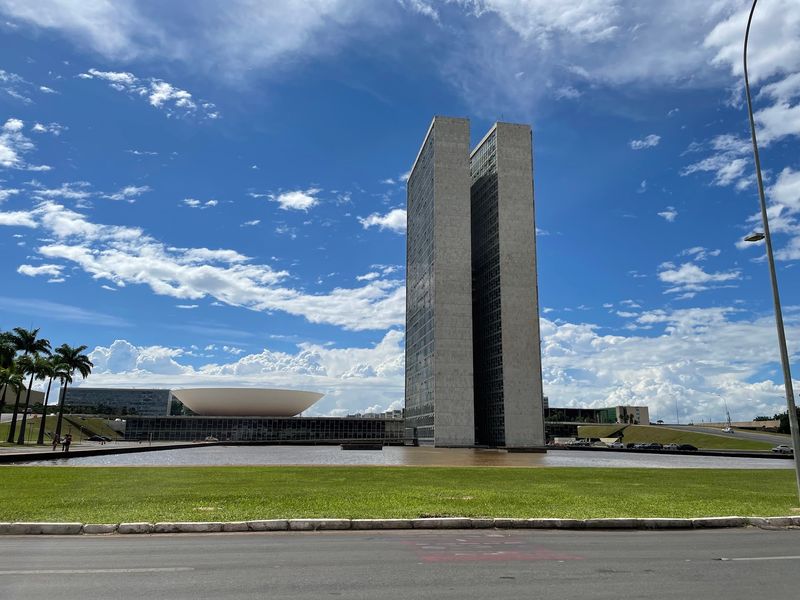
Oscar Niemeyer had a gift for turning abstract political ideas into concrete shapes, and nowhere is that talent clearer than in the National Congress Palace in Brasilia. The building features two dramatically different bowl-shaped structures sitting side by side. One faces upward to house the Chamber of Deputies, while the other curves downward to cover the Senate.
That visual contrast represents the balance of power between the two branches of the legislature. Neither dominates the other; they exist in deliberate equilibrium, a physical argument for checks and balances built right into the skyline.
The building sits at the far end of Brasilia’s grand Monumental Axis, making it the visual destination of the entire city plan. Niemeyer and urban planner Lucio Costa designed Brasilia from scratch in the late 1950s to present Brazil as a bold, modern nation, and the Congress Palace was its most confident architectural declaration.
5. Reichstag Building, Berlin, Germany
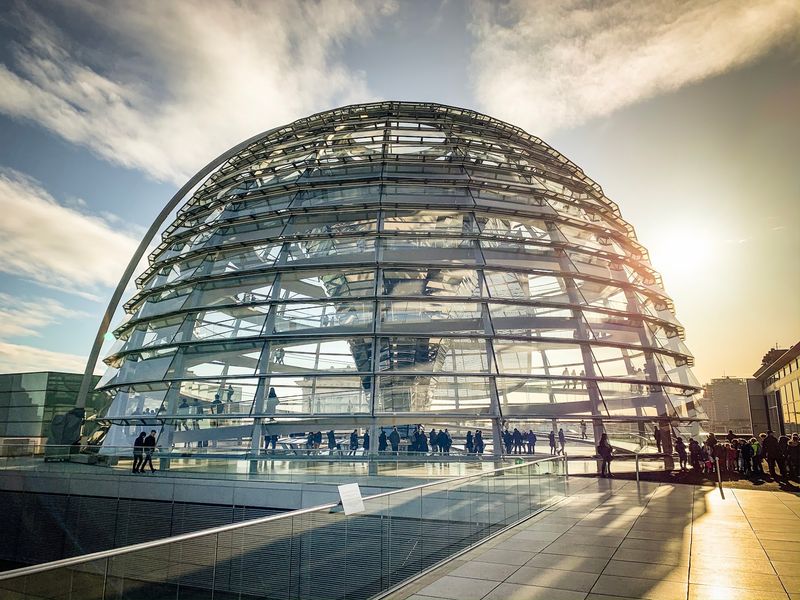
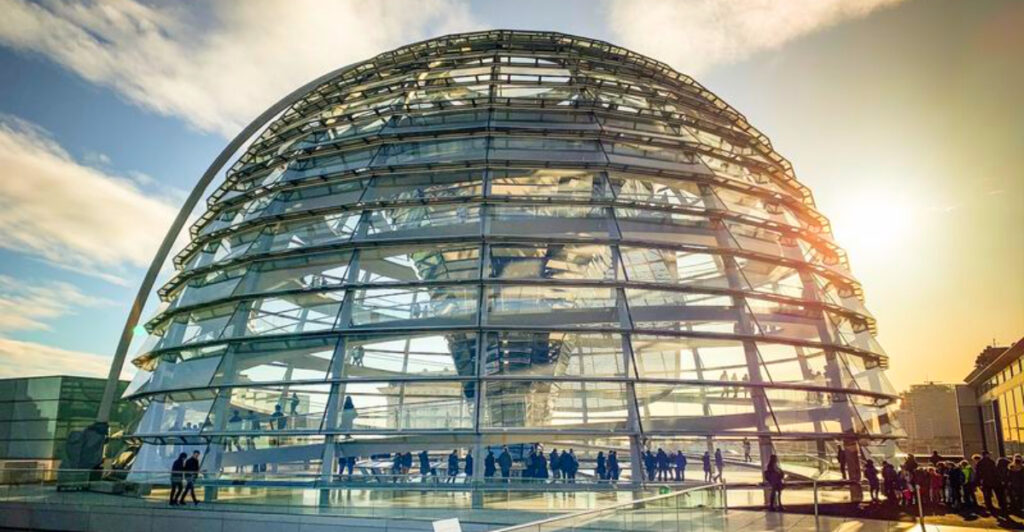
Norman Foster turned a battered piece of German history into a bold statement about democracy when he restored the Reichstag in the late 1990s. The transparent glass dome he added on top of the parliamentary chamber was not simply a stylish architectural choice. Visitors can walk up a spiral ramp inside it and look directly down onto the politicians debating below, placing ordinary citizens physically above their elected representatives.
That single design decision communicates something that no speech or inscription could match as efficiently. The message is simple: the people are in charge, not the other way around.
What makes the building even more powerful is what Foster chose to keep. Soviet soldiers scrawled Cyrillic graffiti on the walls during the Battle of Berlin in 1945, and much of it remains visible today. Those marks, alongside preserved bullet holes, ensure that modern German democracy cannot pretend its darker history never happened.
6. Jatiya Sangsad Bhaban, Dhaka, Bangladesh
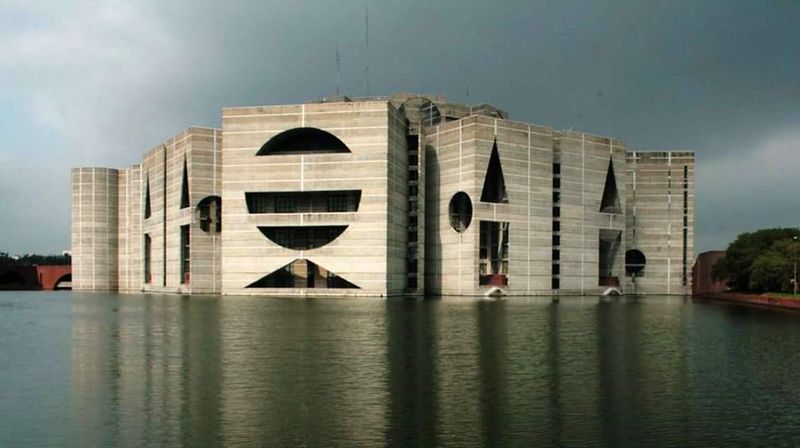
Louis Kahn’s National Assembly Building in Dhaka is one of the most extraordinary government structures ever built, and its political story is inseparable from its architecture. Commissioned in the early 1960s when Bangladesh was still East Pakistan, the project was interrupted by the Liberation War of 1971 and completed in 1982 as the parliament of a fully independent nation.
That shift in purpose gave the building a weight that no design brief could have anticipated. What began as a commission from one country became the civic heart of another, and it carries that transformation in every wall.
Kahn cut massive geometric openings into the concrete, circles, triangles, and rectangles, to fill the interior with natural light. A calm body of water surrounds the complex, reinforcing ideas of unity and reflection. The building became a symbol of Bangladesh’s hard-won independence and its emerging democratic identity.
7. Palace of Assembly, Chandigarh, India
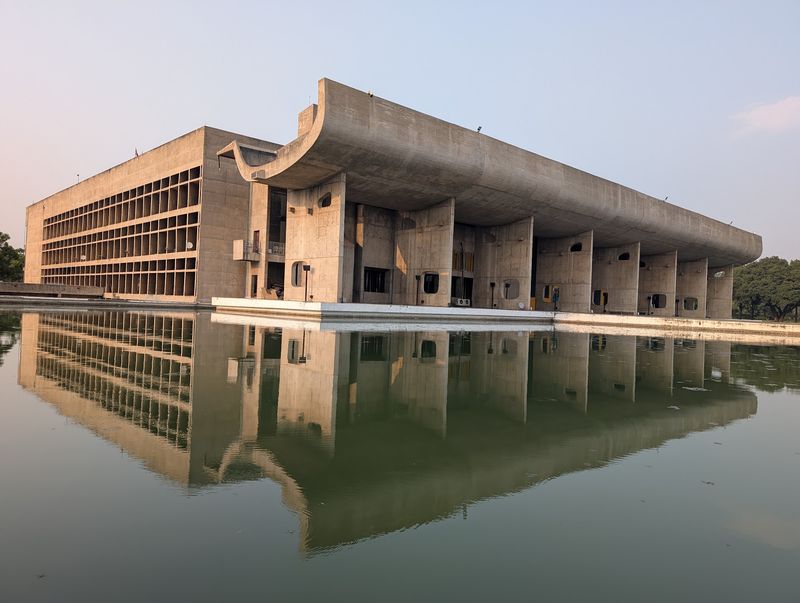
Le Corbusier did not design buildings quietly, and the Palace of Assembly in Chandigarh was no exception. Built as part of the new city created after the partition of India in 1947, the entire Capitol Complex was intended to represent a modern nation that had broken free from colonial rule and was confidently facing the future.
The monumental concrete forms of the Palace were designed to express legislative dignity without borrowing from European classical traditions. India would have its own architectural language, one suited to its climate, its scale, and its ambitions.
Nearby, the Open Hand Monument adds another dimension to the political message. The rotating sculpture depicts a hand open both to give and to receive, representing the democratic exchange of ideas at the heart of the new republic. Together, the buildings of Chandigarh’s Capitol Complex form a carefully assembled argument for what independent India could become.
8. Scottish Parliament Building, Edinburgh, Scotland
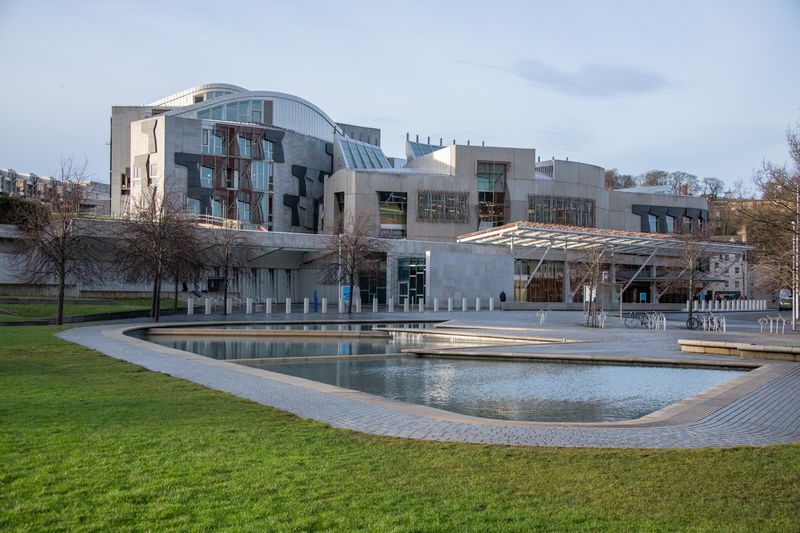
Architect Enric Miralles described his vision for the Scottish Parliament as a building that grew from the land of Scotland itself, and the finished structure makes that ambition visible in every detail. Rather than creating a single grand palace that echoed Westminster, Miralles designed a cluster of interconnected forms with branch-like layouts, boat-shaped roofs, and extensive use of Scottish stone.
Motifs drawn from Charles Rennie Mackintosh’s flower paintings appear throughout the building, and references to the Scottish landscape are woven into the facades. The effect is a parliament that feels rooted in its country rather than imported from somewhere else.
The debating chamber sits above a public gathering area, a subtle but deliberate arrangement that places parliamentary authority above the people while remaining visibly connected to them. Completed in 2004 after Miralles’ passing, the building communicates Scottish identity, democratic values, and a confident sense of cultural independence from a single, complex site.
9. Constitutional Court of South Africa, Johannesburg, Gauteng, South Africa
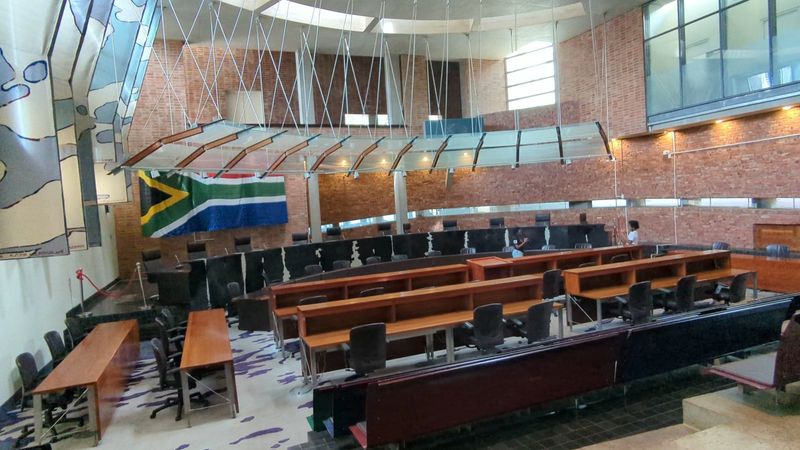
The location of South Africa’s Constitutional Court is itself a political statement. The building stands on the grounds of the Old Fort prison complex in Johannesburg, a place where political prisoners were held and human rights were systematically violated during the apartheid era. Building the nation’s highest court for rights and justice on that exact spot was a deliberate act of historical reckoning.
The design rejects the intimidating heaviness of traditional court architecture. Glass walls, warm materials, and columns resembling trees create a space that feels accessible rather than forbidding. Original bricks salvaged from the demolished prison cells were incorporated into the courtroom walls, keeping the past physically present.
One detail stands out above all others. A low window in the main courtroom gives judges a direct view of the feet of people passing outside. That small opening is a constant, quiet reminder that the law exists to serve ordinary citizens, not to stand apart from them.
10. Jewish Museum Berlin, Berlin, Germany
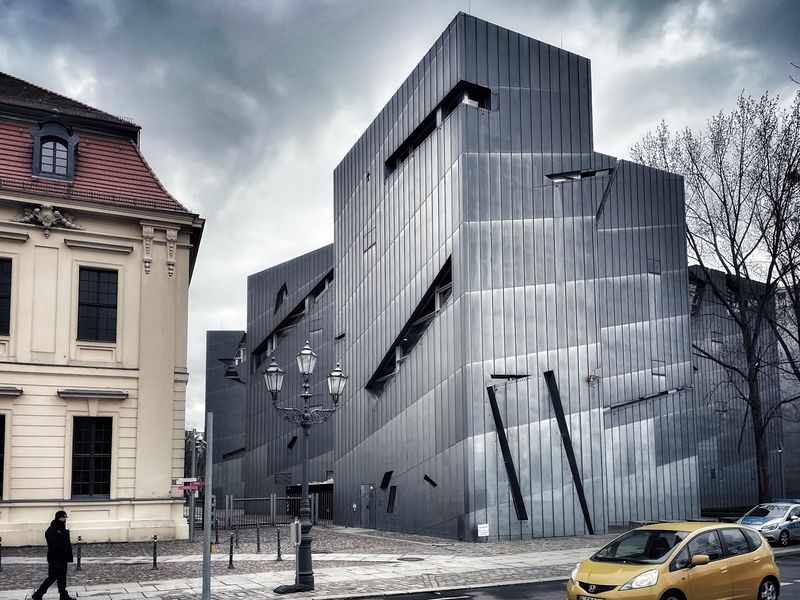
Daniel Libeskind designed the Jewish Museum Berlin so that the building itself would tell a story before visitors read a single word of the exhibits. The zigzagging footprint, the deliberately sloping floors, the narrow windows that slash across the walls at disorienting angles, and the dead-end corridors are all intentional. They are meant to make visitors feel, physically, a sense of disruption and loss.
The most powerful element is what Libeskind called the voids: tall, empty concrete shafts that cut through the full height of the building. Visitors can peer into them through small openings, but they cannot enter. The voids represent the absence left by the Holocaust, making emptiness a form of memorial.
One separate space, the Holocaust Tower, is a bare concrete silo with only a thin sliver of light at the top. The building does not just display history. It makes visitors experience a fraction of its weight.
11. Palace of Parliament, Bucharest, Romania
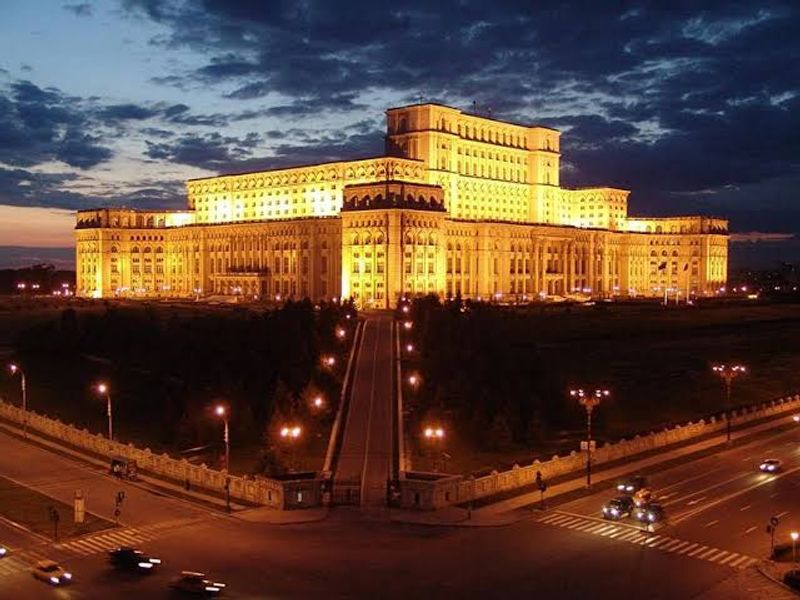
Few buildings in the world communicate political ego as bluntly as the Palace of Parliament in Bucharest. Nicolae Ceausescu ordered its construction in the 1980s as the centerpiece of a rebuilt government district, and to make room for it, large sections of historic Bucharest, including churches, neighborhoods, and monuments, were demolished. The scale of destruction was staggering.
The palace itself was designed to project absolute authority. Its endless corridors, heavy ornamentation, and overwhelming dimensions were calculated to make visitors feel small and the state feel permanent. Ceausescu reportedly drew inspiration from visits to authoritarian governments in Asia, and the building reflects that influence clearly.
The political irony of what happened next is difficult to overstate. After the fall of communism in 1989, Romania’s new democratic parliament moved into the very building constructed to glorify the regime it replaced. The former symbol of dictatorship now houses the country’s elected representatives.
12. Palazzo della Civilta Italiana, Rome, Lazio, Italy
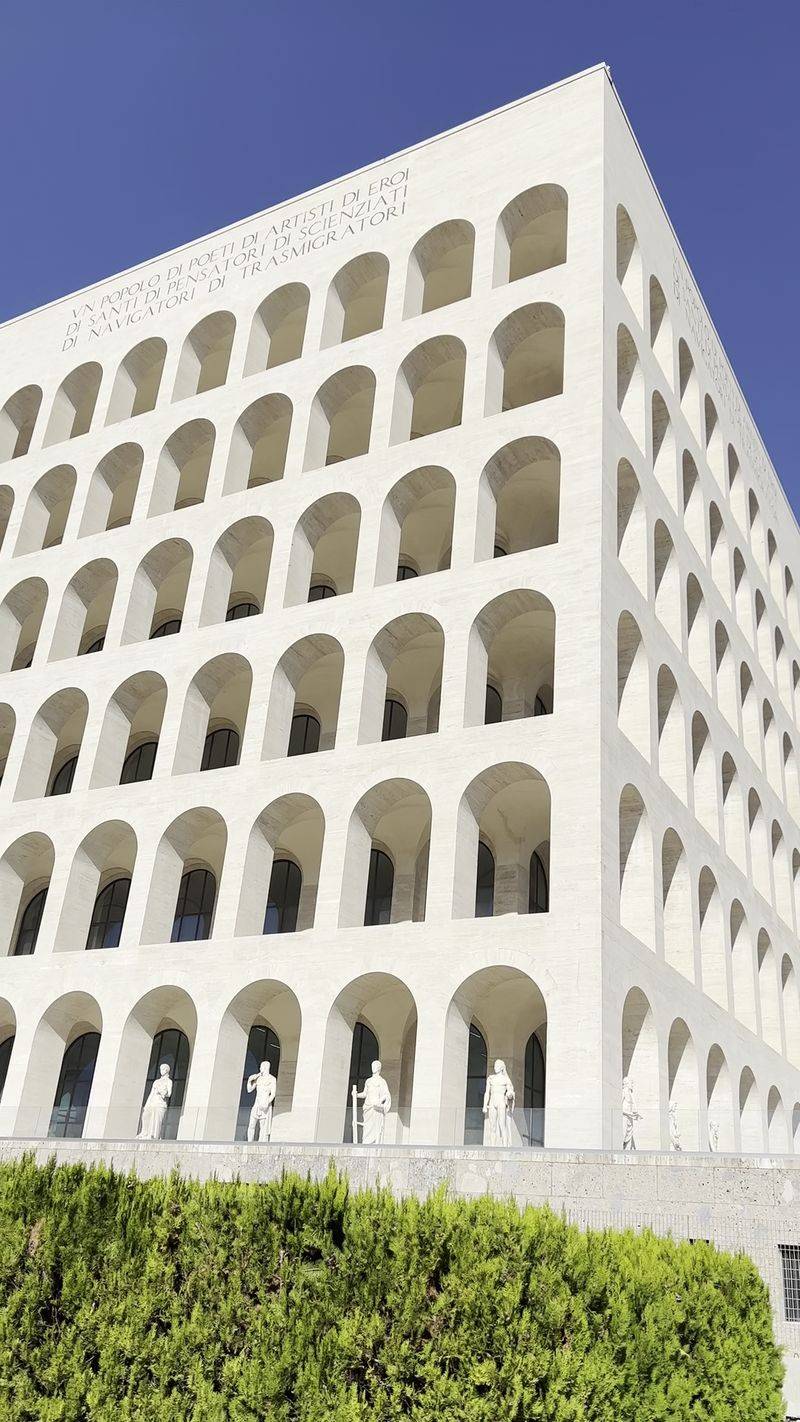
The nickname Square Colosseum captures the building’s most obvious trick: it borrowed the visual grammar of ancient Rome’s most iconic structure and stripped away everything organic, replacing curves with rigid geometry. The Palazzo della Civilta Italiana was built for a world exposition planned by Benito Mussolini’s government in 1942, an event that never took place because World War II intervened.
The stacked arches were not meant as a tribute to Roman heritage. They were meant to claim it. Mussolini’s government promoted a philosophy called romanita, the idea that Fascism was the direct and legitimate heir to the Roman Empire. The building’s severe symmetry and monumental scale were designed to reinforce that claim.
An inscription running across all four sides quotes Mussolini, describing Italy as a nation of poets, artists, and heroes. The exposition was canceled, but the building remains one of the most unambiguous pieces of political architecture the 20th century produced.
13. Olympiastadion Berlin, Berlin, Germany
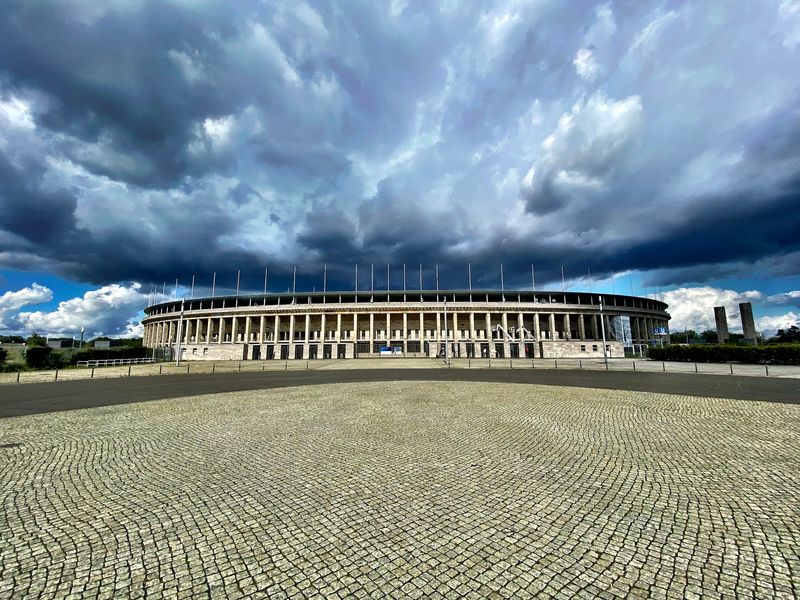
Adolf Hitler ordered the demolition of an existing stadium and the construction of a far grander replacement specifically because he saw the 1936 Olympic Games as an international stage for Nazi propaganda. Architect Werner March delivered a design that matched the ambition: massive stone forms, rigid symmetry, broad ceremonial approaches, and 136 limestone-clad pillars evoking ancient Greek architecture.
Every element was a calculated political statement. The scale projected power. The classical references suggested civilization and order. The surrounding Reichssportfeld complex was used for mass demonstrations designed to celebrate the regime and its ideology.
What makes the stadium particularly interesting today is the decision made during later renovations to preserve much of the original exterior. Modern democratic Germany did not tear the building down or disguise what it was. Visitors are left to confront its origins directly, making the stadium a permanent, uncomfortable, and honest reminder of where nationalist architecture can lead.
14. Guggenheim Museum Bilbao, Bilbao, Basque Country, Spain
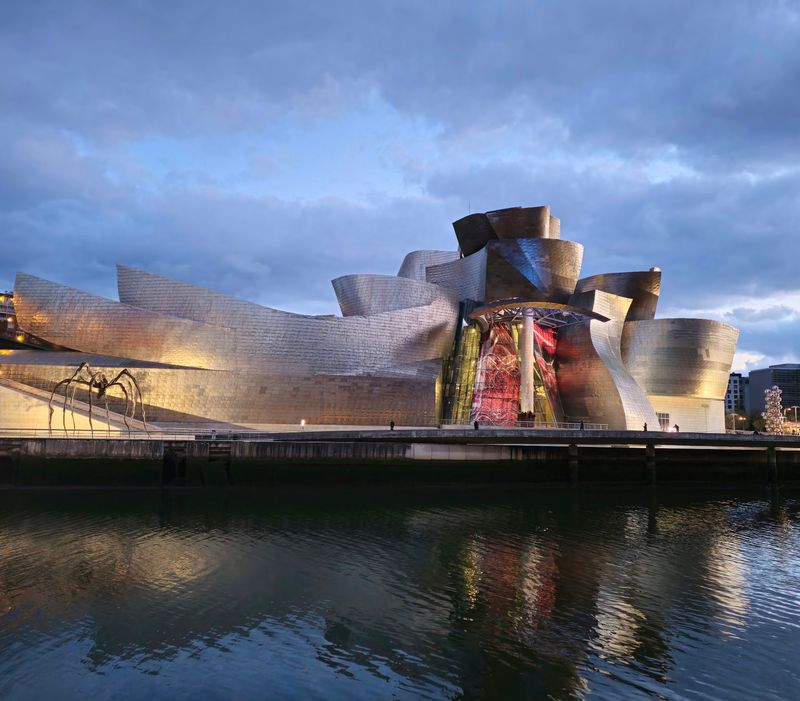
Frank Gehry’s museum in Bilbao is famous for its sculptural titanium curves, but the building’s political significance runs well beneath the surface of its striking exterior. The Guggenheim was the centerpiece of a deliberate regeneration strategy for a Basque city that had been hit hard by the decline of its industrial economy. Cultural investment was the tool chosen to reposition Bilbao on the world map.
The plan worked so effectively that urban planners around the world began studying it as a model, coining the term the Bilbao Effect to describe the transformation a single landmark building can trigger in a struggling city. But the museum carries a second, quieter political message.
The large Basque-language word Museoa displayed on the building is a small but pointed assertion of regional identity. In a country with strong regional linguistic tensions, choosing the Basque word over Spanish signals cultural pride and a determination to define the region on its own terms.
Share this story