Some bridges exist to get you from one side to the other. Others exist to make your palms sweat.
Europe is home to dozens of crossings that combine jaw-dropping height, exposed walkways, and scenery so dramatic it almost feels unfair. Whether you are a thrill-seeker or just a curious traveler, these 15 bridges will make you look twice before taking that first step.
516 Arouca – Portugal
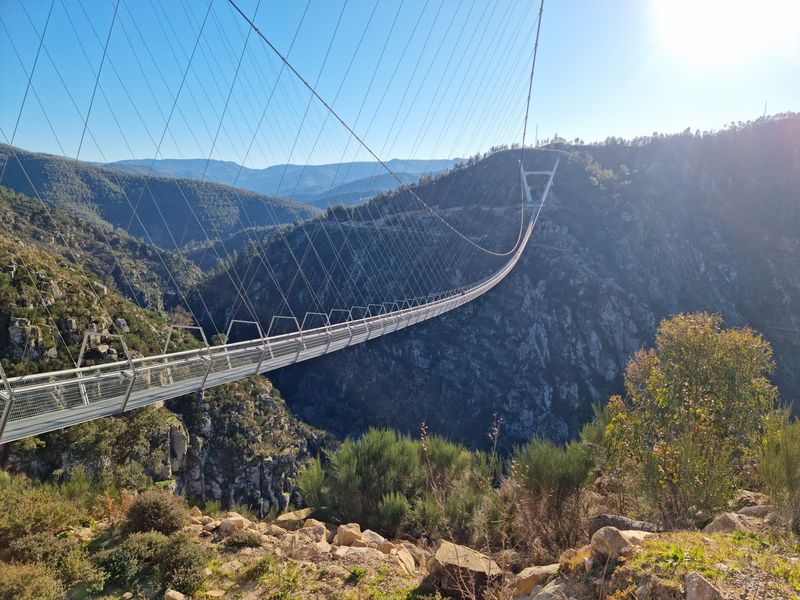
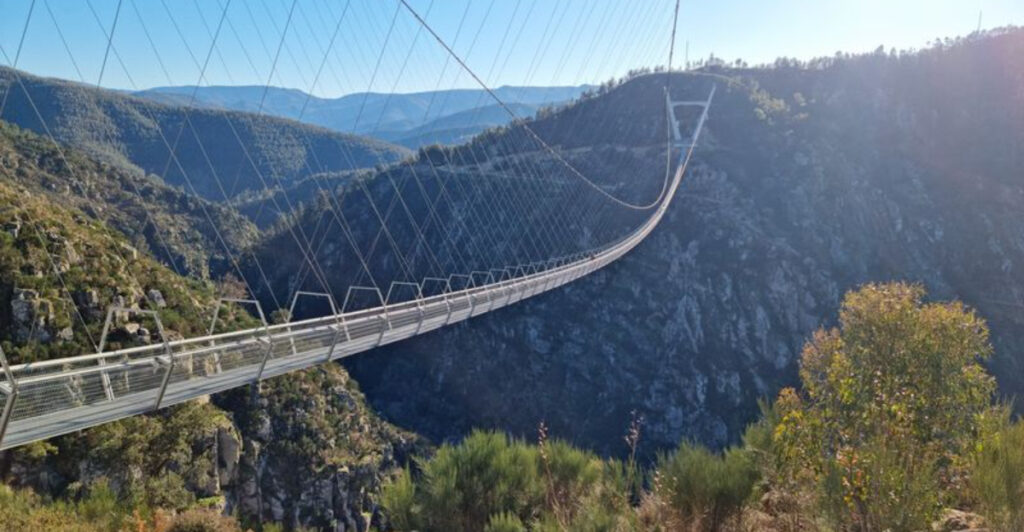
Portugal decided that a regular wooden walkway along the Paiva River just was not enough excitement. The 516 Arouca bridge stretches 516 meters across the Paiva Gorge, hanging 175 meters above the river below.
It sits inside the Arouca UNESCO Global Geopark, right beside the beloved Paiva Walkways trail.
The walkway is only about 1.2 meters wide. That alone would make most people nervous.
But the real kicker is the metal grating underfoot, which lets you see the gorge, the waterfall, and the rushing river directly beneath your shoes at all times.
When it opened in 2021, it was promoted as the world’s longest pedestrian suspension bridge. That title has since been taken away.
The 175-meter drop has not moved an inch, though. Visitors who cross it describe the experience as equal parts terrifying and unforgettable, and the surrounding scenery of forested slopes and cascading water makes every shaky step worth it.
Tibetan Bridge of Canillo – Andorra
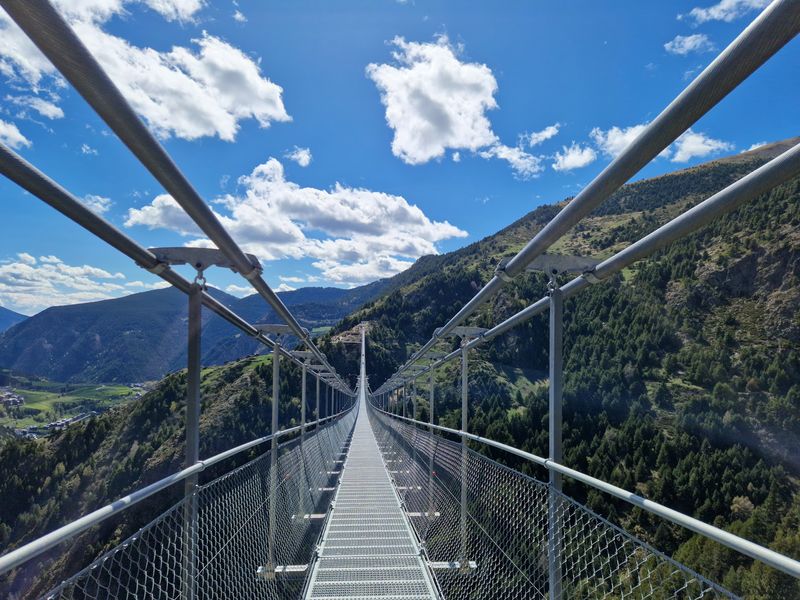
Andorra is a tiny country, but its most daring pedestrian bridge makes a very large impression. The Tibetan Bridge of Canillo stretches 603 meters across the Vall del Riu, reaching a maximum height of 158 meters above the valley floor.
The whole thing sits at roughly 1,875 meters above sea level.
Here is the detail that really gets people: it is only one meter wide. Standing on it feels less like crossing a bridge and more like walking a tightrope strung between two mountain ridges.
The structure seems to simply vanish into the Pyrenean sky on both sides.
Getting there requires a shuttle ride followed by a 900-meter walk through mountain terrain. For anyone who finds the crossing itself insufficient, the site now offers a bridge-jumping experience from the structure.
The surrounding Pyrenean peaks provide genuinely spectacular views. The only catch is that the middle of the bridge, swaying gently in the mountain air, may not be the most comfortable place to stop and appreciate them.
Sky Bridge 721 – Czechia
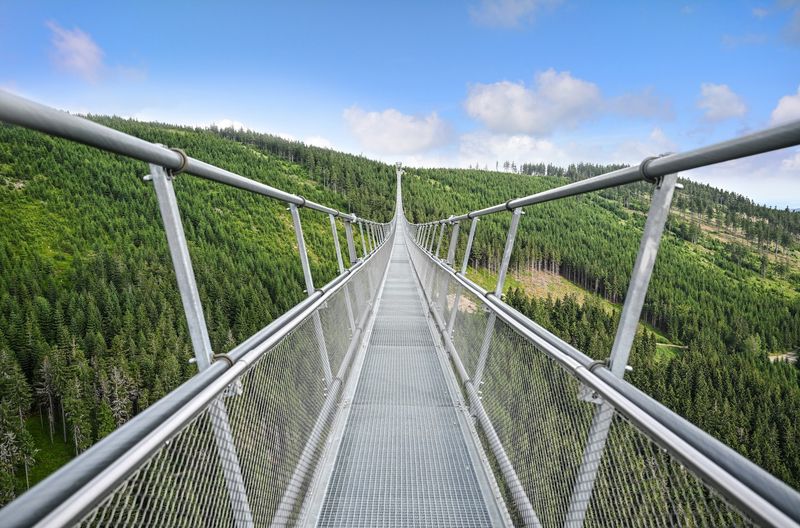
When Dolni Morava mountain resort opened Sky Bridge 721, it set a new world record for the longest pedestrian suspension bridge. At 721 meters, it crosses the Mlynsky Stream valley in the Kralicky Sneznik region, connecting two mountain ridges at elevations of around 1,125 and 1,135 meters above sea level.
The highest point sits 95 meters above the ground. That sounds manageable until you realize the bridge gives you a very long time to think about it.
A short rope bridge can be sprinted across. Seven hundred twenty-one meters is a different psychological situation entirely, with the valley floor visible below you for nearly every step of the crossing.
The surrounding forests and mountain ridges provide a genuinely beautiful backdrop. On clear days, the views stretch across rolling forested hills and open sky.
Dolni Morava has built the bridge into a broader mountain experience, so visitors often combine the crossing with other activities at the resort. Still, the bridge itself remains the headline attraction, and the length is the reason why.
Millau Viaduct – France
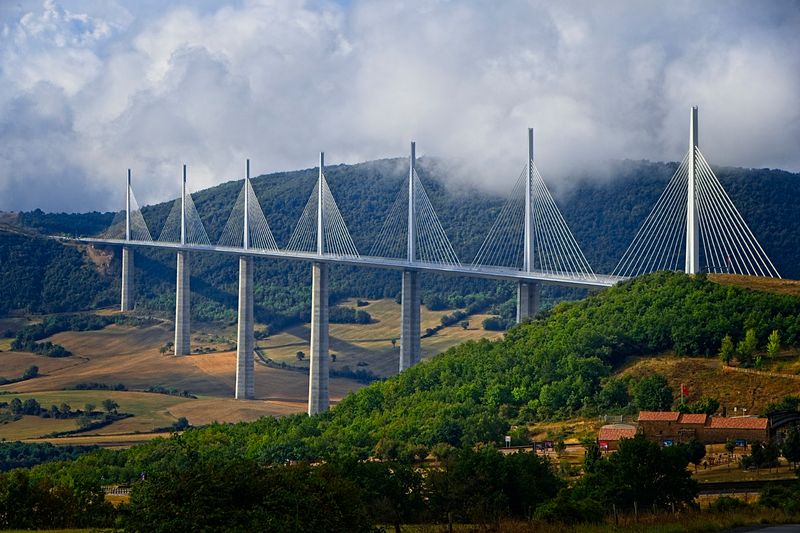
Driving across the Millau Viaduct feels suspiciously similar to flying. The enormous cable-stayed structure carries the A75 motorway across the Tarn Valley in southern France, with the road deck sitting roughly 270 meters above the river.
The highest point of the structure reaches 343 meters, which puts it above the Eiffel Tower.
Unlike most entries on this list, no hiking boots or special tickets are required. You simply drive across on a regular motorway.
The strange part is how the bridge manages to look almost weightless despite its colossal scale. Seven slender piers support a gently curving deck that appears to float above the valley, particularly when morning fog gathers below and the road seems to hover in midair.
From the driver’s seat, the landscape simply drops away on both sides. From distant viewpoints along the valley, passing cars look like tiny moving dots.
Millau is one of Europe’s finest examples of engineering that enhances the scenery rather than interrupting it. The French government opened it in 2004, and it remains one of the most photographed structures on the continent.
Highline179 – Austria
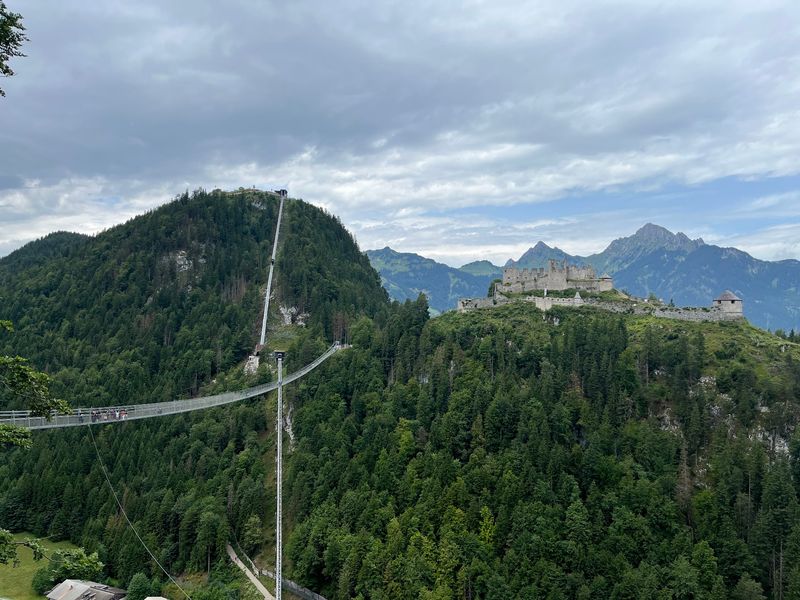
Connecting two medieval ruins with a modern suspension bridge is either a brilliant idea or a very strange one, depending on your fear of heights. Highline179 links the Ehrenberg Castle ruins with Fort Claudia near Reutte in Tyrol, stretching 406 meters and hanging 114.6 meters above the valley floor.
The walkway is about 1.2 meters wide and deliberately open to create maximum exposure to the surrounding Alpine air.
The setting is what separates this bridge from many purpose-built thrill attractions. Visitors move from exploring centuries-old castle ruins to crossing more than 100 meters above a busy highway and the open Alpine valley below.
The contrast between old stone fortifications and modern steel cables is genuinely striking.
The operators market the panorama as a view with a thrill, which is unusually honest advertising. Mountain ranges stretch in multiple directions, the valley floor spreads out below, and the historic fortress complex frames both ends of the crossing.
On clear days, the views extend across the Tyrolean landscape in every direction. For anyone who enjoys combining history with a healthy shot of adrenaline, Highline179 delivers both at once.
Charles Kuonen Suspension Bridge – Switzerland
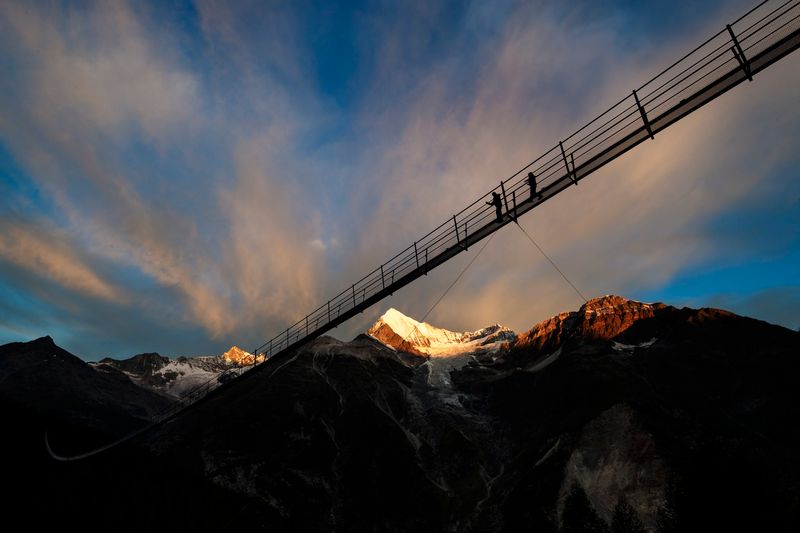
Sixty-five centimeters. That is the width of the Charles Kuonen Suspension Bridge walkway near Randa in Switzerland’s Mattertal valley.
For context, that is barely wider than most people’s shoulders. Stretching 494 meters across the Grabengufer ravine with a maximum height of 85 meters, the bridge forms part of the famous Europaweg hiking route near Zermatt.
The narrow width does most of the psychological work here. Wider suspension bridges allow you to stay comfortably in the center and maintain some distance from the edge.
On the Charles Kuonen bridge, there is no center to retreat to. You are essentially walking a thin steel ribbon across an Alpine ravine with open air on both sides.
On clear days, the scenery is extraordinary. Glaciers, steep mountain slopes, and some of Switzerland’s most celebrated high peaks fill the background.
The bridge replaced an older crossing that was destroyed by a rockslide in 2010, and the current structure opened in 2017. Hikers on the Europaweg route treat it as a highlight of the trail rather than a detour.
That enthusiasm is easier to understand once you see the view from the middle.
Trift Bridge – Switzerland
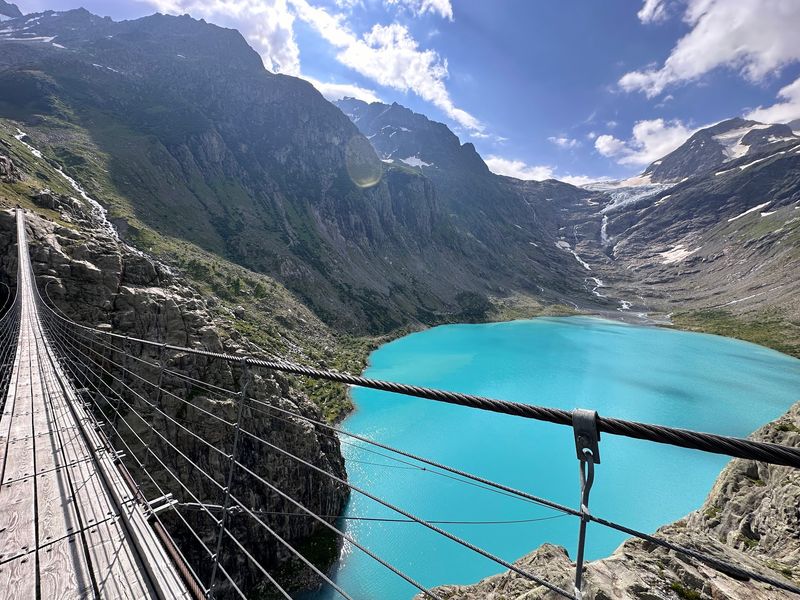
The Trift Bridge exists because of climate change. As the Trift Glacier retreated over recent decades, the old hiking route to the Trift Hut became impassable.
A suspension bridge was built to restore access, eventually leading to the current structure that opened in 2009. It spans 170 meters and hangs approximately 100 meters above the glacial lake formed by the retreating ice.
That backstory gives the crossing an unusual emotional weight. Standing on the bridge, you are looking directly at a landscape in the process of changing.
The turquoise glacial lake below exists because the glacier above it has been shrinking. The Trift Glacier itself is still visible, but noticeably smaller than in historical photographs taken from the same spot.
Getting there is not simple. Visitors combine a cable-car journey with a substantial mountain hike, so the bridge feels like a genuine reward for the effort rather than a tourist shortcut.
The Alpine scenery is breathtaking from every angle. The bridge is narrow, exposed, and moves in the wind.
For anyone who makes the journey, the combination of height, scenery, and the glacial story unfolding below makes Trift one of Switzerland’s most affecting mountain experiences.
Geierlay Suspension Bridge – Germany
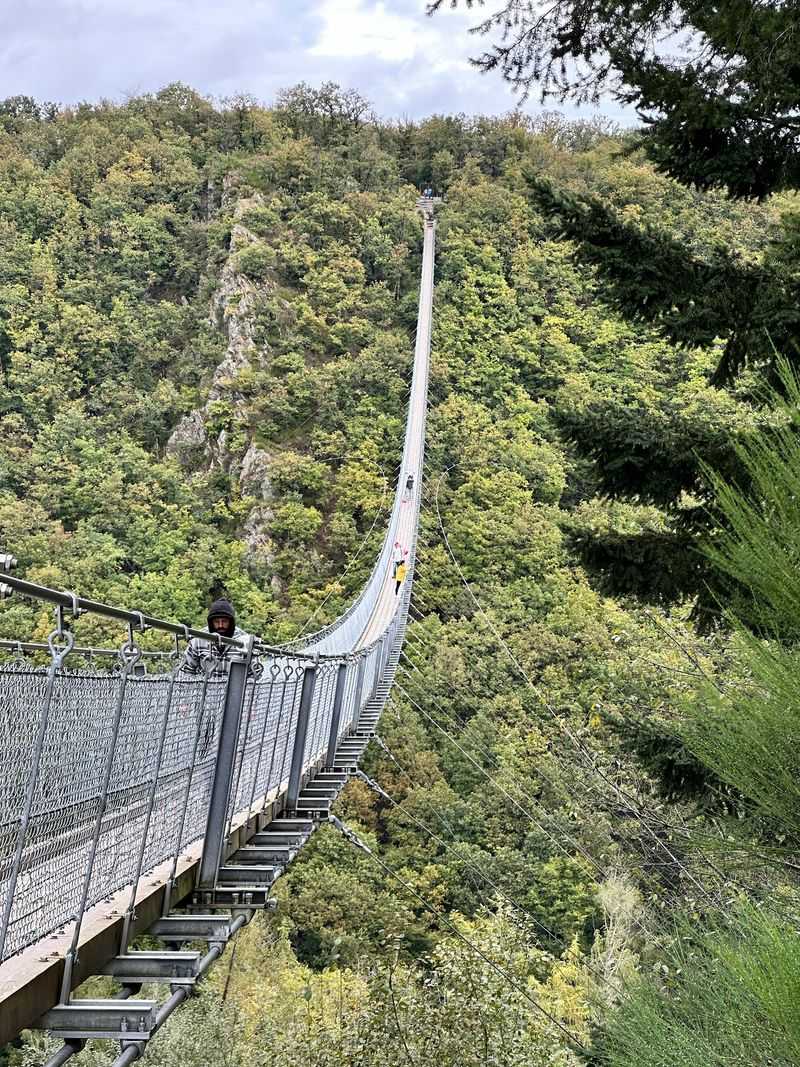
Germany’s answer to vertigo-inducing bridges skips the snow-capped mountains entirely and uses dense forest instead. The Geierlay bridge stretches 360 meters between the villages of Morsdorf and Sosberg in the Hunsruck region, hanging roughly 100 meters above the valley floor.
Near the middle, the walkway narrows to about 85 centimeters.
It also sways. Germany’s official tourism organization describes it as a slightly moving Douglas-fir walkway supported by steel cables, which is a very calm way to describe something that makes grown adults grip the handrails.
The bridge opened in 2015 and quickly became one of Germany’s most-visited pedestrian crossings.
One of its best qualities is accessibility. Crossing is free and the bridge is generally open year-round, though severe weather causes temporary closures.
Autumn may be the single best time to visit, when the Hunsruck forest transforms into a spread of red, orange, and gold directly beneath your feet. The surrounding landscape is quiet and deeply green most of the year, which makes the height feel more surprising than it might in an obviously dramatic mountain setting.
Sometimes the forest below is the view that gets you.
Durdevica Tara Bridge – Montenegro
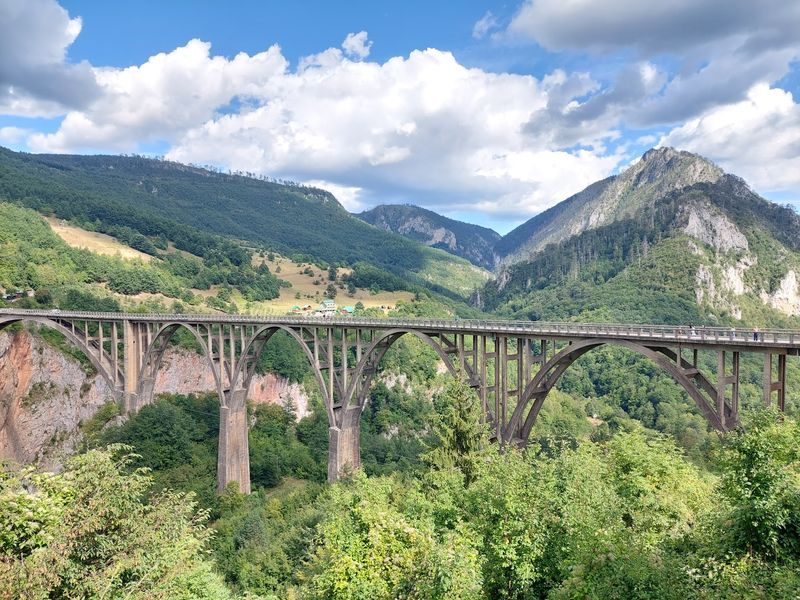
The Tara Canyon in Montenegro is already one of Europe’s most dramatic natural landscapes. Then someone decided to build a bridge across it 172 meters above the river.
The Durdevica Tara Bridge opened in 1940 and was considered a remarkable engineering achievement for its time. Its largest arch spans 116 meters across the gorge.
Its wartime history is equally dramatic. During World War II, one section of the bridge was deliberately destroyed by local resistance fighters to prevent enemy forces from using it to advance through the canyon.
The bridge was rebuilt after the war, and that history adds a layer of significance to standing on it today.
The Tara River below is UNESCO-protected and famous for its extraordinary clarity and color. From the bridge deck, the river appears as a vivid turquoise thread winding through the canyon floor far below.
Visitors stop here for the views into the Durmitor region and the canyon walls rising on both sides. For anyone wanting more adrenaline, zip lines operate nearby across the canyon.
But simply walking to the railing and looking straight down toward the Tara River is usually enough of an experience on its own.
Puente Nuevo – Ronda, Spain
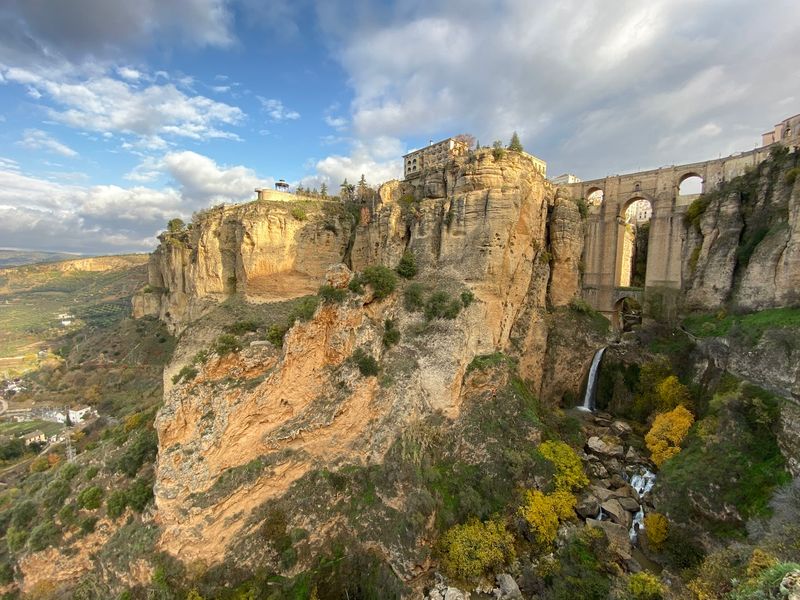
Very few bridges look like they were carved directly from the cliffs they cross. Puente Nuevo in Ronda, Spain, manages exactly that impression.
The monumental stone structure crosses El Tajo Gorge, connecting the two historic sections of a town that is dramatically split by the Guadalevin River 98 meters below.
Construction took more than four decades, completing in 1793. That timeline makes sense when you see the scale of the stonework.
Enormous stone supports rise from the gorge walls, and the bridge integrates so naturally into the cliffs that from certain angles it is genuinely difficult to tell where the rock ends and the masonry begins.
Standing on top gives visitors views toward houses perched almost on the cliff edge and the valley stretching beyond. Walking to lower viewpoints changes the experience entirely.
From below, the bridge appears as much a geological feature as an architectural one, with its massive arch framing the gorge in a way that photographs struggle to fully capture. Ronda is a popular day trip from Malaga and Seville, and Puente Nuevo is consistently the reason most visitors make the journey.
The drop makes sure nobody forgets they came.
Pont de la Caille – France
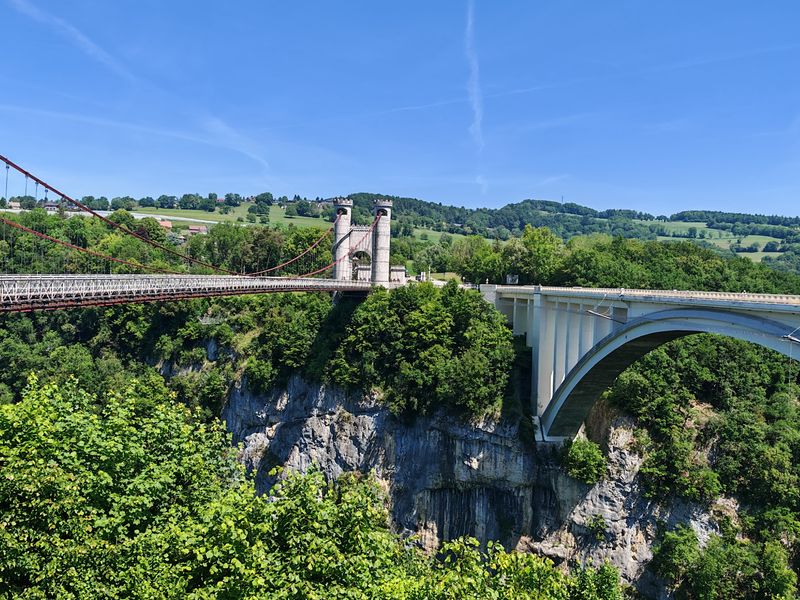
Most people assume that terrifyingly high pedestrian bridges are a modern invention. The Pont de la Caille in Haute-Savoie would like to correct that assumption.
Built in the 19th century and opened in 1839, this historic suspension bridge crosses the Usses gorge between Annecy and Geneva at a height of 147 meters. It is now protected as a French historic monument.
The bridge measures approximately 180 meters long and carries only pedestrians, since vehicle traffic was redirected to the neighboring modern bridge built alongside it. That separation is actually a gift to visitors.
Without cars rushing past, there is no reason to hurry. You can stand at the center, look down into the gorge, and take your time deciding how you feel about it.
Local tourism authorities describe views from the crossing toward both the Usses gorge and sections of the Aravis mountain range. The combination of 19th-century engineering, protected gorge scenery, and mountain backdrop makes this one of France’s most underrated bridge experiences.
Most tourists driving between Annecy and Geneva pass very close without stopping. The ones who do stop tend to spend considerably longer than they originally planned.
Carrick-a-Rede Rope Bridge – Northern Ireland
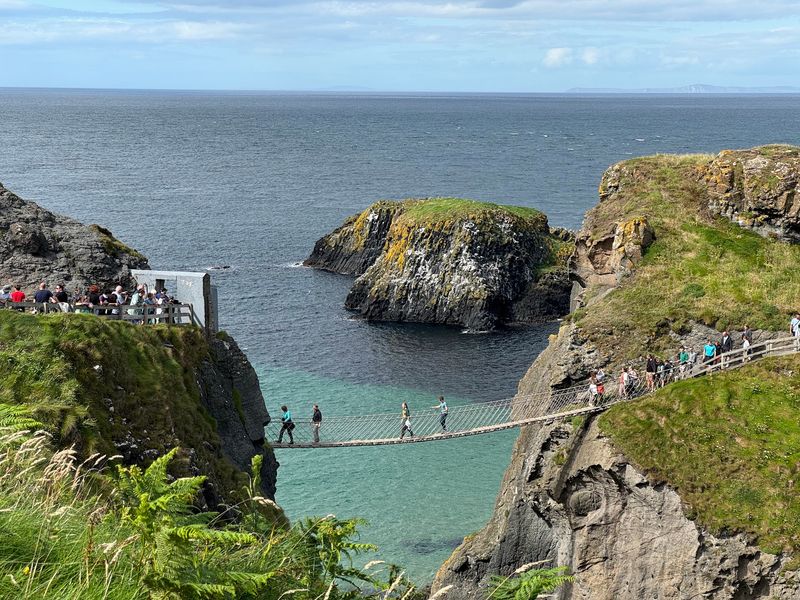
Raw height is not the only thing that makes a bridge frightening. Carrick-a-Rede on Northern Ireland’s Causeway Coast proves that 30 meters above crashing Atlantic waves can feel far more alarming than 100 meters above a calm forest.
The narrow rope bridge spans a 20-meter gap between the mainland and tiny Carrick-a-Rede Island, with rocks and open ocean directly below.
Salmon fishermen first used rope crossings at this location more than 250 years ago. Today’s bridge is substantially safer and maintained by the National Trust, but the exposure has not changed.
Coastal wind pushes at you from the side. The bridge moves.
The water below is not calm or distant. It is close, loud, and constantly moving against the rocks.
The surrounding Causeway Coast provides views toward dramatic sea cliffs, scattered islands, and open Atlantic horizon. Tickets are required and should be booked in advance, especially during summer.
The crossing itself takes only a minute or two, but most visitors stand on the island for a while afterward, partly to enjoy the view and partly to prepare for the walk back. The return trip feels just as exposed as the first crossing, somehow.
Clifton Suspension Bridge – Bristol, England
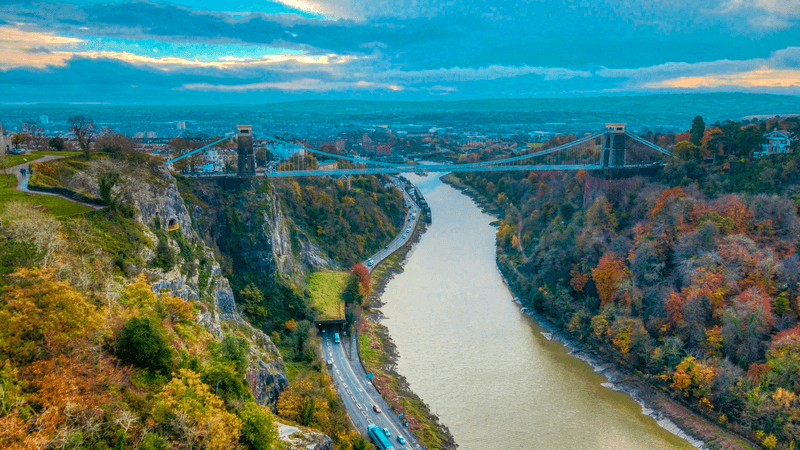
Brunel’s Clifton Suspension Bridge has been crossing the Avon Gorge since 1864, and it has spent every decade since making a strong impression on pedestrians who walk across it. The deck sits 75.5 meters above high-water level, with the gorge dropping steeply to the River Avon below and Bristol spreading out on one side while wooded cliffs take over on the other.
Pedestrians can walk across on both sides of the roadway. From the middle of the span, the view down into the gorge is genuinely striking, especially when the tide is low and the river appears as a narrow strip far below.
The bridge’s official visitor information notes something that many people feel before they read about it: the bridge moves. Standing in the center, visitors can sometimes detect subtle vertical movement in the deck as traffic passes overhead.
The bridge is free to cross on foot and open most days. Clifton itself is one of Bristol’s most attractive neighborhoods, making the crossing a natural part of exploring the area.
The combination of Victorian engineering, gorge scenery, and that faint but unmistakable sense of movement underfoot makes Clifton one of Britain’s most memorable bridge walks.
Tamina Bridge – Switzerland
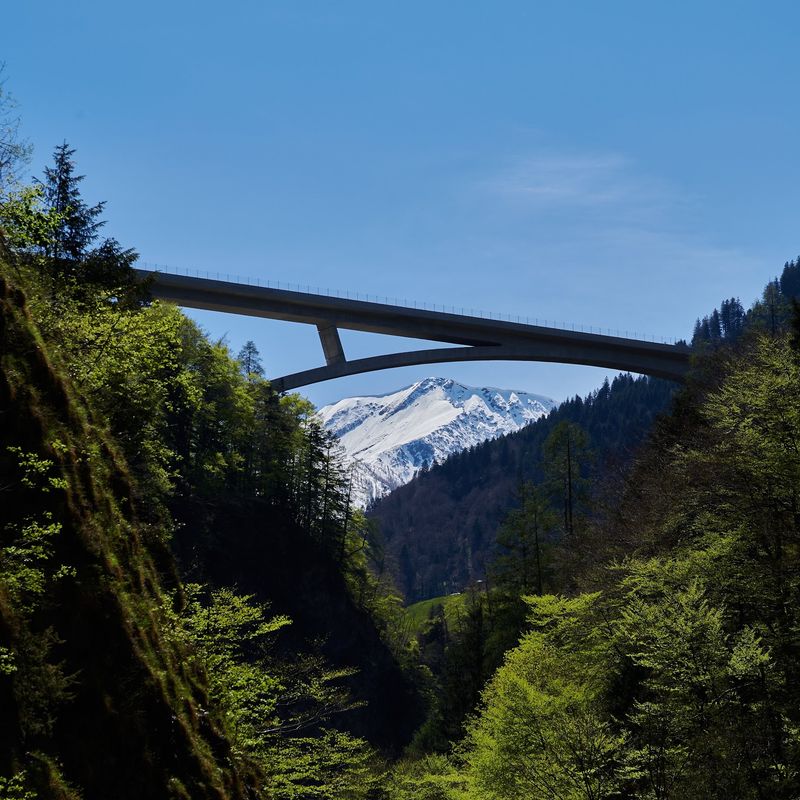
Switzerland builds bridges that make people stop their cars and stare into gorges. The Tamina Bridge crosses the Tamina Gorge between Pfafers and Valens in the canton of St. Gallen, carrying ordinary road traffic on a deck that sits approximately 200 meters above the gorge floor.
The overall structure stretches about 475 meters in length.
What makes Tamina particularly unsettling is how effortless it looks. The elegant concrete arch curves across the gap with a lightness that seems to contradict the enormous space below it.
From distant viewpoints, the bridge appears as a thin curved line suspended above forested cliffs, almost too slender to be carrying vehicles at all.
Drivers crossing it may barely register the engineering. Anyone who stops at a viewpoint and actually looks at the gorge will have a very different reaction.
The Tamina Gorge is deep, narrow, and heavily forested, making the height feel especially dramatic because there is so little open space between the bridge and the canyon walls. The bridge opened in 2017 and replaced an older structure on the same route.
It has already become one of the most photographed bridges in eastern Switzerland, and the gorge below is the reason.
Europabrucke – Austria
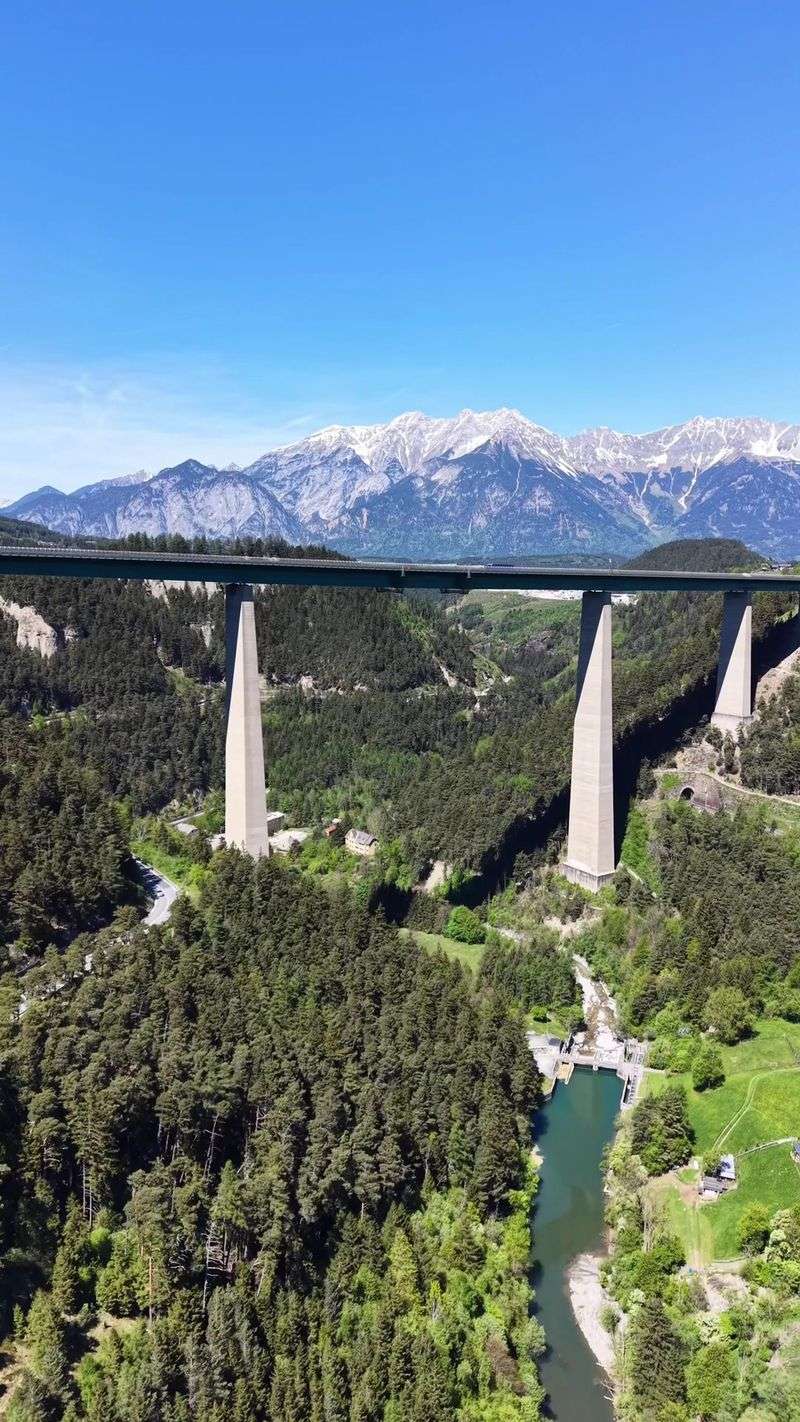
For decades, the Europabrucke was the bridge that defined what an Alpine motorway crossing could look like. Opened in 1963, it carries the A13 Brenner Autobahn across the Wipp Valley south of Innsbruck, standing approximately 190 meters above the Sill River below.
At the time of its opening, it ranked among Europe’s highest bridges and became a critical link between Austria and northern Italy.
Driving across it at motorway speed is a particular kind of experience. The valley drops away on both sides, the Alpine peaks rise around you, and the whole thing happens fast enough that many drivers barely process the height before they are already on the other side.
Passengers tend to have a more extended reaction.
The bridge has since become a major bungee-jumping location, with operators advertising jumps from roughly 192 meters. That detail says something about how the structure is perceived.
You do not turn a bridge into a bungee site unless the height genuinely impresses people. Driving across is one experience.
Voluntarily stepping off the edge is a completely different commitment. Either way, the Europabrucke remains one of the most dramatic mountain motorway crossings on the continent, and the Wipp Valley views have not aged a day.
Share this story