Morocco has a way of making history feel completely alive. Ancient squares fill with performers, palace courtyards display centuries of tile and carved wood craftsmanship, and fortified hilltop villages look as though they were built just last season rather than hundreds of years ago. Across cities like Marrakech, Fes, Meknes, Rabat, and Essaouira, a remarkable collection of historic sites has survived intact, each one telling a different chapter of the country’s long story. Some of these places are famous worldwide, while others reward the curious traveler who ventures a little deeper into the medina lanes or beyond the city gates.
What they all share is a concrete, visible connection to Moroccan tradition that goes far beyond postcards and surface-level tourism. This guide covers thirteen destinations that deliver exactly that kind of authentic experience, ranging from grand imperial monuments to quiet garden retreats tucked behind centuries-old walls.
1. Jemaa el-Fnaa, Marrakech, Morocco
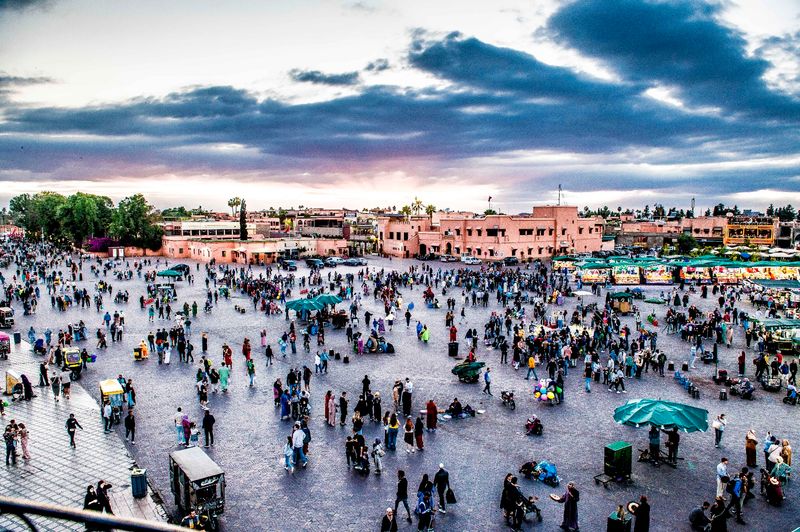
No public square in Morocco changes its personality quite as dramatically throughout the day as this one. Jemaa el-Fnaa has anchored the heart of Marrakech’s medina since the Almoravid dynasty established it around 1070, and its role as a social crossroads has never really faded.
By morning, vendors arrange stalls selling fresh orange juice, dried fruits, and spices, while a handful of traditional performers set up their spots. The crowd is manageable, the pace slower, and it is genuinely easy to find a seat and watch the square organize itself for the day ahead.
By evening, the character shifts completely. Food stalls multiply across the plaza, and storytellers, musicians, acrobats, and Gnaoua performers draw tight audience circles known as halqa. UNESCO recognized this tradition in 2001, designating the square a Masterpiece of Oral and Intangible Heritage. A rooftop terrace nearby is the classic spot to observe the full transformation from above.
2. Bahia Palace, Marrakech, Morocco
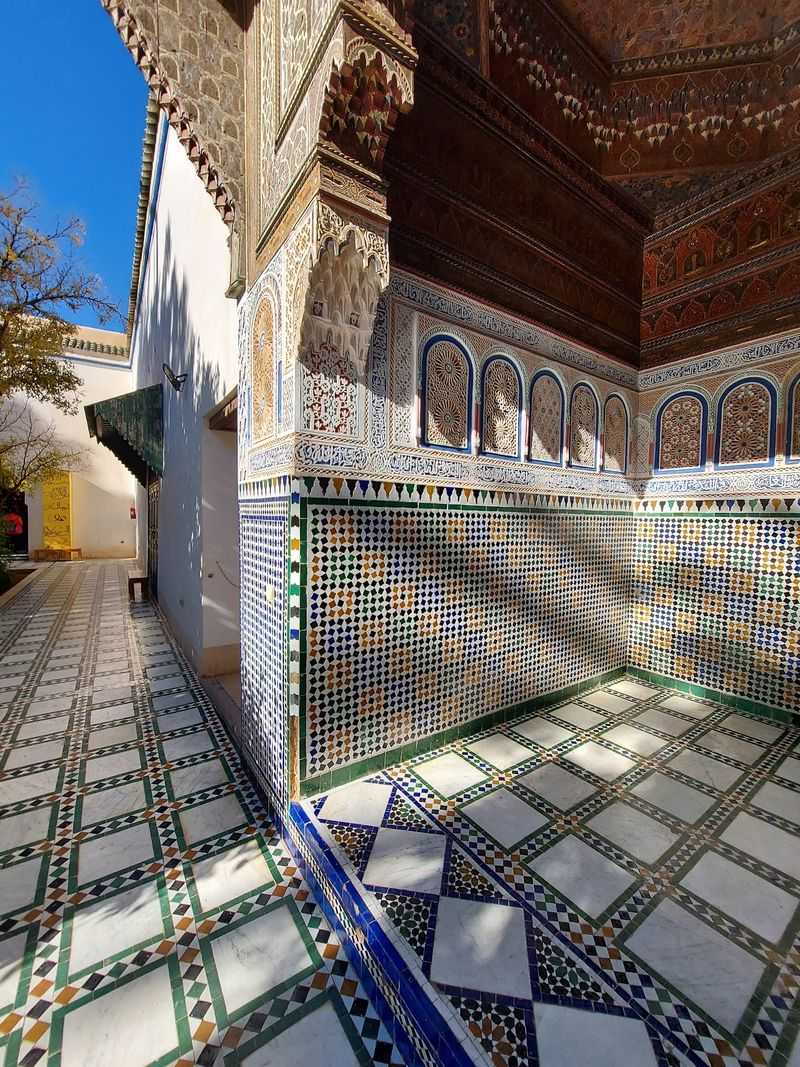
Built to impress and designed to last, Bahia Palace is one of the most elaborately decorated buildings in all of Marrakech. Construction began in 1866 under Si Musa, grand vizier to Sultan Muhammad IV, and his son Abu Boubaker expanded it significantly between 1894 and 1900.
The result is a sprawling complex covering eight hectares, with 150 rooms, multiple courtyards, and gardens. Rather than following one unified grand plan, the palace unfolds as a series of smaller riads and intimate courtyards, each decorated with its own distinct combination of materials.
Carved cedarwood from the Atlas Mountains covers ceilings and door frames, while zellige tiles in geometric patterns line the floors and lower walls. Stucco panels display calligraphic inscriptions and floral motifs throughout. After Abu Boubaker’s passing in 1900, the state took control of the property. Today, sections remain open to the public as a historical monument and occasional venue for cultural events.
3. Le Jardin Secret, Marrakech, Morocco
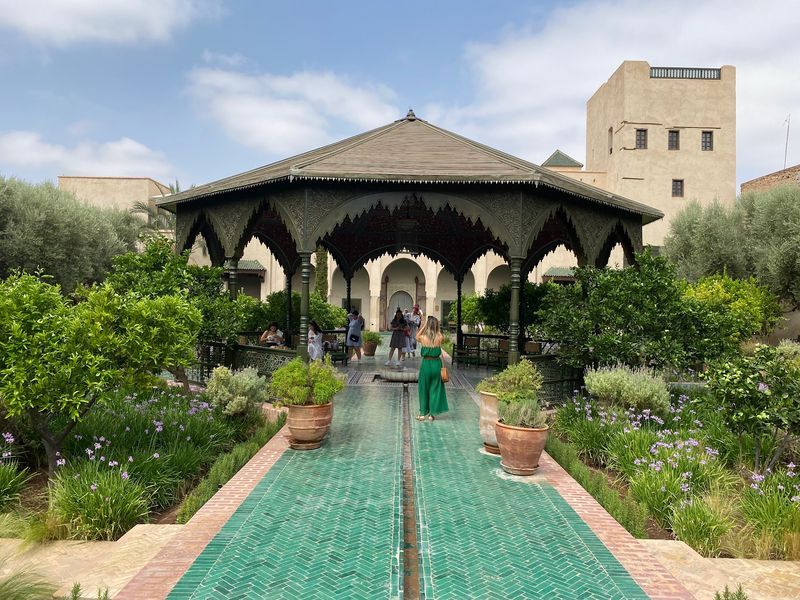
Tucked behind an unmarked door in the medina, Le Jardin Secret has been surprising visitors since it reopened to the public in 2016 after a careful eight-year restoration. The site’s origins trace back to the Saadian Dynasty in the late 16th century, when it served as the palace of a prominent qadi, or chief magistrate, of Marrakech.
The garden is divided into two distinct sections. The Islamic Garden follows the classic charbagh layout, with four quadrants separated by water channels and pathways, planted with date palms and citrus trees arranged in geometric beds. The Exotic Garden presents plants adapted from various global climates.
One of the most historically significant features is the restored ancient hydraulic system that once channeled water from the Atlas Mountains to irrigate the entire complex. Visitors can observe water moving through traditional seguia channels, which are a key part of Moroccan garden engineering. Two pavilions and a tower also provide elevated views over the surrounding medina rooftops.
4. Ben Youssef Madrasa, Marrakech, Morocco
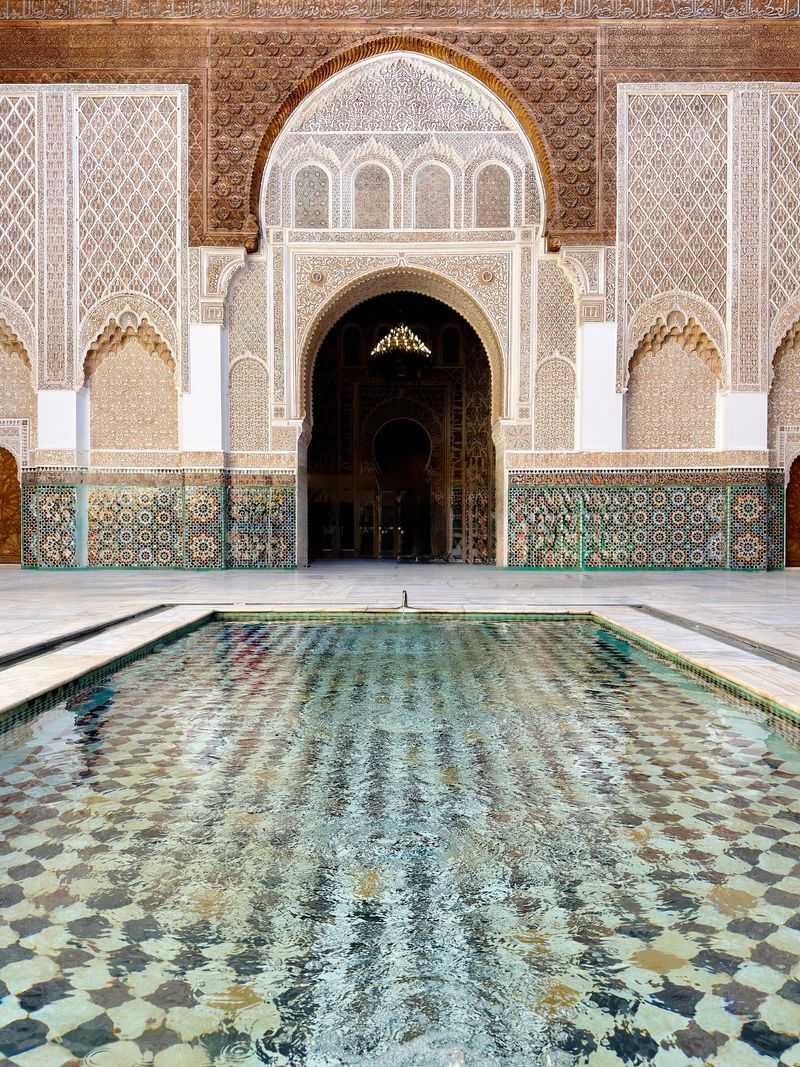
Once the largest religious school in Morocco, Ben Youssef Madrasa educated thousands of students in theology and law over five centuries. The version visitors see today was rebuilt by Saadian Sultan Abdallah al-Ghalib around 1565, replacing an earlier structure connected to the Almoravid period.
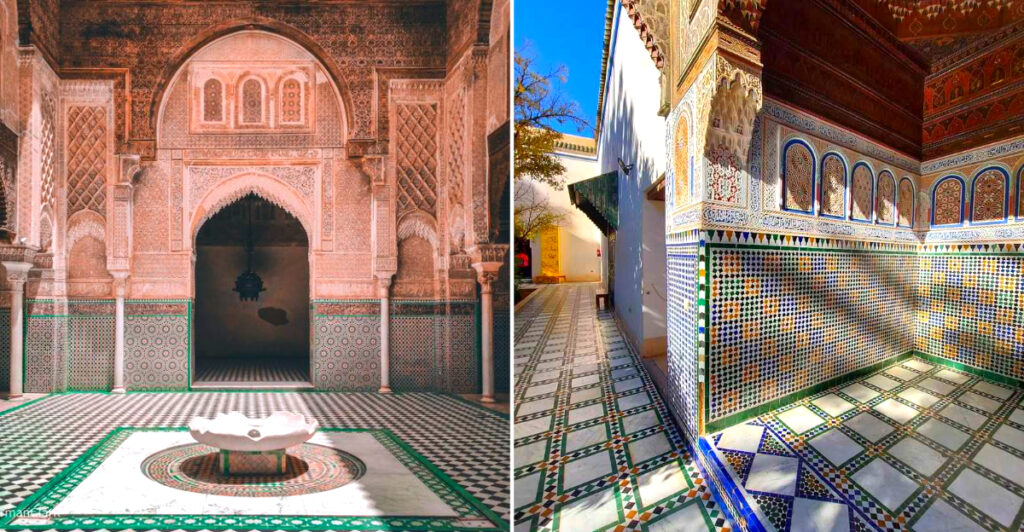
The central courtyard is the architectural centerpiece, combining three distinct decorative traditions in one compact space. Geometric zellige tilework covers the lower walls, carved stucco with Quranic calligraphy and arabesque patterns fills the middle sections, and detailed cedarwood work frames the upper eaves and window openings.
A large reflective pool sits at the courtyard’s center, historically used as a gathering and prayer space for students. Two floors of modest student cells surround the courtyard, reportedly housing up to 900 students at the madrasa’s peak. A restoration completed in the early 21st century preserved the original features with care. The madrasa sits in the heart of Marrakech and remains one of the city’s most visited historic monuments.
5. Al Attarine Madrasa, Fes, Morocco
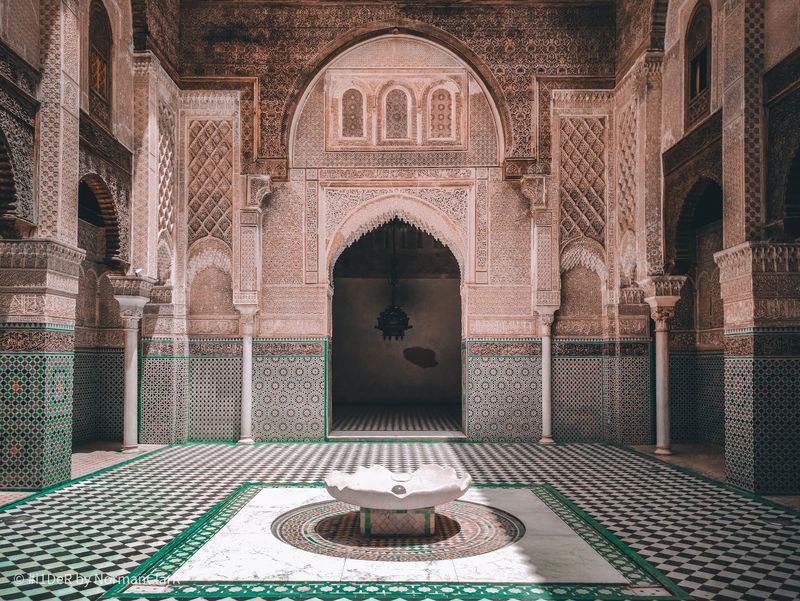
Getting to Al Attarine Madrasa is half the experience. The route passes through the narrow lanes of Fes el-Bali, where artisan workshops, spice vendors, and the souk al-Attarine, the perfume and spice market that gave the madrasa its name, line the path leading to the entrance.
Marinid Sultan Abu Said Uthman founded the madrasa in 1325, positioning it adjacent to the Al-Qarawiyyin University, one of the oldest universities in the world. It served as student accommodation and a place of study for those enrolled at the university next door.
The courtyard is compact but richly detailed. Zellige tilework in complex geometric patterns covers the lower walls, carved stucco with calligraphic passages fills the mid-sections, and cedarwood frames the eaves and gallery ceilings above. A central marble fountain anchors the composition. Around thirty small student cells occupy the surrounding galleries, offering a clear picture of daily academic life during the Marinid era.
6. Nejjarine Museum, Fes, Morocco
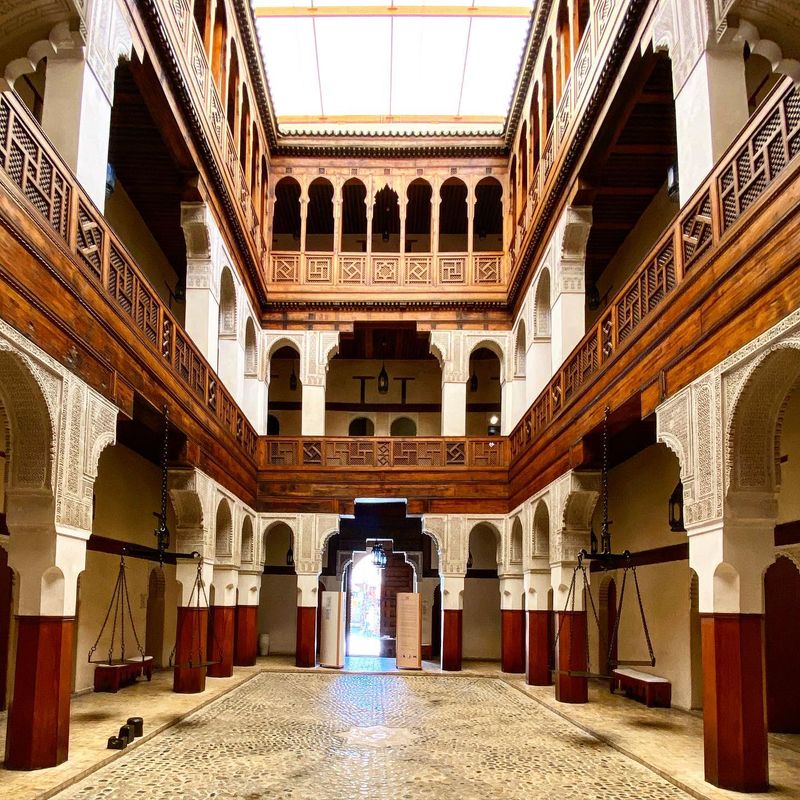
Morocco’s woodworking tradition has a dedicated home in Fes, and it occupies one of the old city’s finest buildings. The Nejjarine Museum of Wooden Arts and Crafts is housed in a restored 18th-century funduq, a type of caravanserai originally built to accommodate traveling merchants, their goods, and their animals.
The museum’s collection covers the full range of Moroccan woodworking history. Carved chests, antique doors, musical instruments, ceremonial objects, and architectural fragments like decorative mihrabs are all on display, illustrating both the practical and artistic dimensions of the craft across different periods.
The building itself competes with the exhibits for attention. Carved cedarwood balconies overlook the central courtyard on multiple levels, and stucco work and zellige tile patterns decorate the surrounding walls. The restoration preserved these original features throughout. Nejjarine Square just outside the museum still hosts active woodworking workshops, connecting the historical collection inside to living craft traditions on the street.
Morocco’s national tourism office highlights this museum among Fes’s key cultural attractions.
7. Kasbah Chefchaouen, Chefchaouen, Morocco
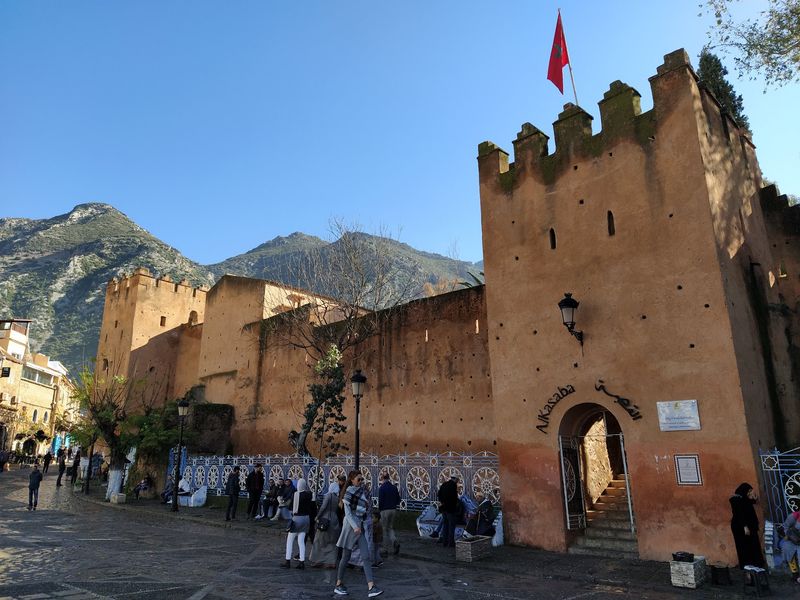
Chefchaouen is globally recognized for its blue-painted lanes, but the kasbah at the center of the medina tells a different visual story entirely. Its walls are warm shades of red and ochre, a stark contrast to the surrounding streetscape that many visitors find unexpectedly striking.
Moulay Ali ibn Rashid al-Alami, the founder of Chefchaouen, built the original fortress in the 15th century to defend the city against Portuguese incursions. Its elevated position provided clear sightlines over the surrounding Rif Mountain valleys, making it a strategically important structure from the beginning.
Inside the kasbah walls, an Andalusian-style garden provides a calm central space with symmetrical plantings, traditional fountains, and shaded paths. An ethnographic museum within the complex displays regional clothing, pottery, musical instruments, and historical photographs that document local customs. Climbing one of the defensive towers rewards visitors with panoramic views of the blue medina and mountain backdrop. Morocco’s national tourism office highlights both the gardens and museum collection as key parts of the city’s heritage.
8. Mausoleum of Moulay Ismail, Meknes, Morocco
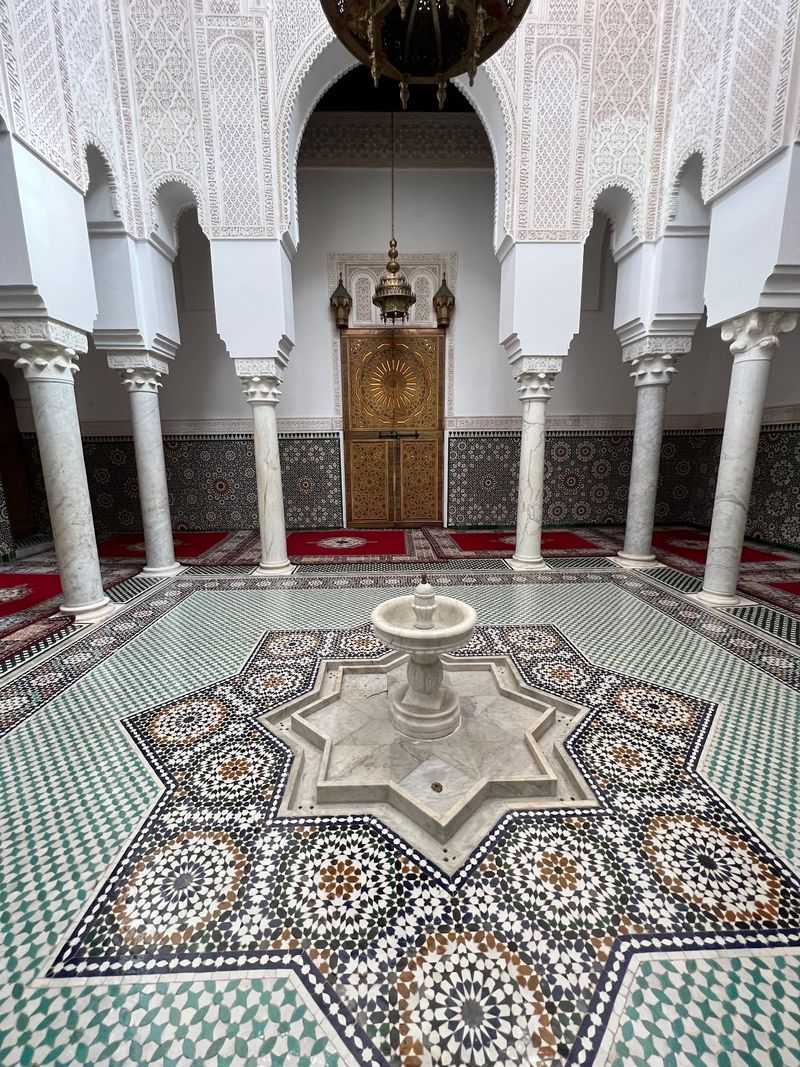
Sultan Moulay Ismail ruled Morocco from 1672 to 1727 and left Meknes transformed into an imperial capital defined by massive walls, monumental gates, and grand public spaces. His mausoleum, built during the late 17th or early 18th century and renovated several times since, reflects the same ambition for architectural grandeur that marked his entire reign.
Visitors enter through a series of ornate gateways into a sequence of courtyards, each one progressively more decorated than the last. The main courtyard leading to the tomb chamber features marble paving and arcaded galleries on all sides.
Inside, zellige tilework covers the lower walls in vibrant geometric patterns, while carved plasterwork above displays floral motifs and Quranic calligraphy. Cedarwood ceilings painted in traditional patterns complete the decorative scheme. Non-Muslim visitors cannot enter the inner tomb chamber but can observe its interior from an adjoining doorway. Morocco’s national tourism office lists the mausoleum among Meknes’s primary historic attractions, recognizing its significance as a monument to imperial-era craftsmanship.
9. Dar Jamai Museum, Meknes, Morocco
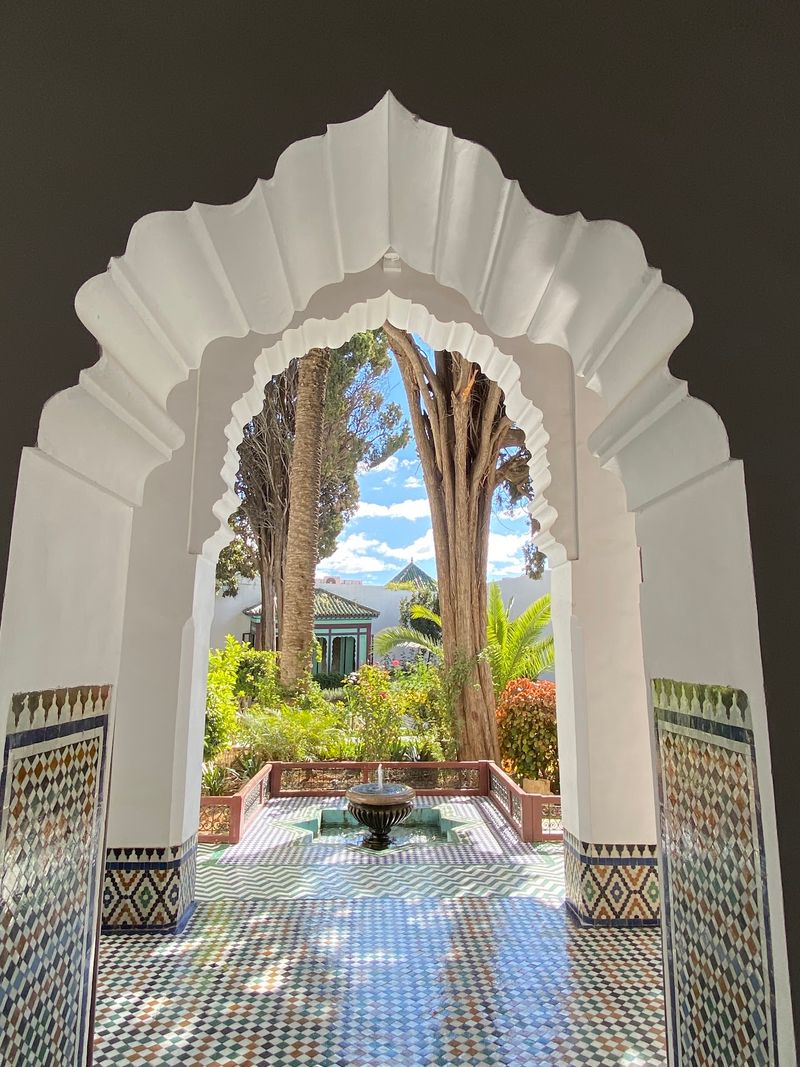
Right across from the broad expanse of Place el-Hedime, a 19th-century palace quietly houses one of Morocco’s oldest public museums. Dar Jamai was built in 1882 as a private residence for the Jamai family, who served as grand viziers and ranked among the most powerful figures in Meknes at the time.
The palace became a museum in 1920, a conversion that preserved both the building’s architecture and much of its original decorative character. Painted cedarwood ceilings, carved stucco panels, and zellige tile work remain in the rooms that now display the museum’s collection of regional decorative arts.
Exhibits cover traditional ceramics, textiles, jewelry, elaborate caftans, carved wooden objects, and archaeological artifacts from the Meknes area. The central courtyard follows a charbagh garden layout with a fountain, symmetrical planting beds, and tiled pathways. Upper-floor terraces offer direct views of Place el-Hedime and the famous Bab el-Mansour gate, giving the museum visit a broader urban context alongside its interior cultural offerings.
10. Kasbah of the Udayas, Rabat, Morocco
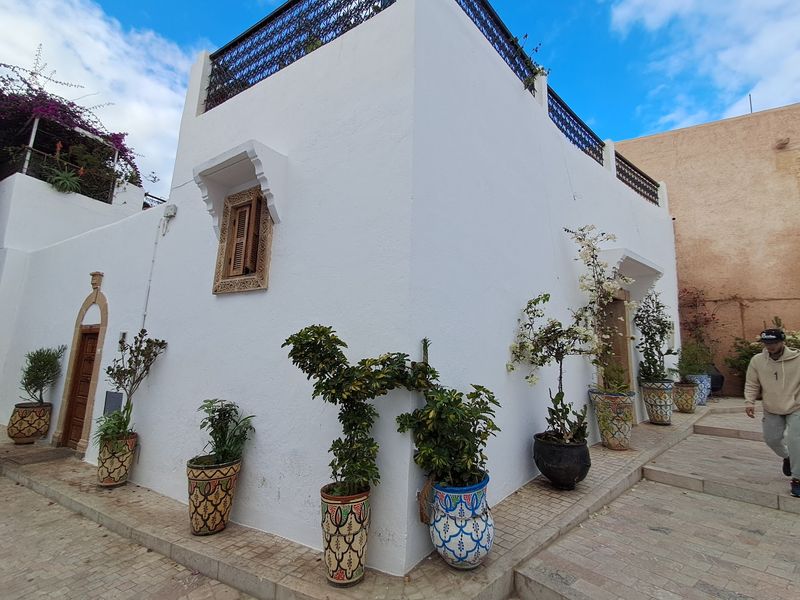
Rabat is Morocco’s capital, but the Kasbah of the Udayas operates on an entirely different scale, more like a compact village than an urban landmark. Its narrow lanes, whitewashed walls with blue-painted doors and window frames, and quiet residential character set it apart from the city surrounding it.
The Almohad dynasty established the site in the 12th century as a ribat, a fortified monastery, and it evolved over subsequent centuries into a residential and defensive complex. Andalusian immigrants and the Udaya tribe shaped much of its current appearance in later periods. The monumental Bab Oudaia gate, with its elaborate 12th-century stone carving, marks the main entrance.
Inside, the Andalusian Garden features symmetrical pathways, traditional plantings, and a central fountain, offering a calm contrast to the stone lanes nearby. The Udayas Museum, housed in a former royal residence within the complex, displays Moroccan folk art and traditional artifacts. The kasbah’s elevated position also provides Atlantic Ocean and Bou Regreg River views. Morocco’s national tourism office ranks it among Rabat’s defining historic sights.
11. Chellah Castle, Rabat, Morocco
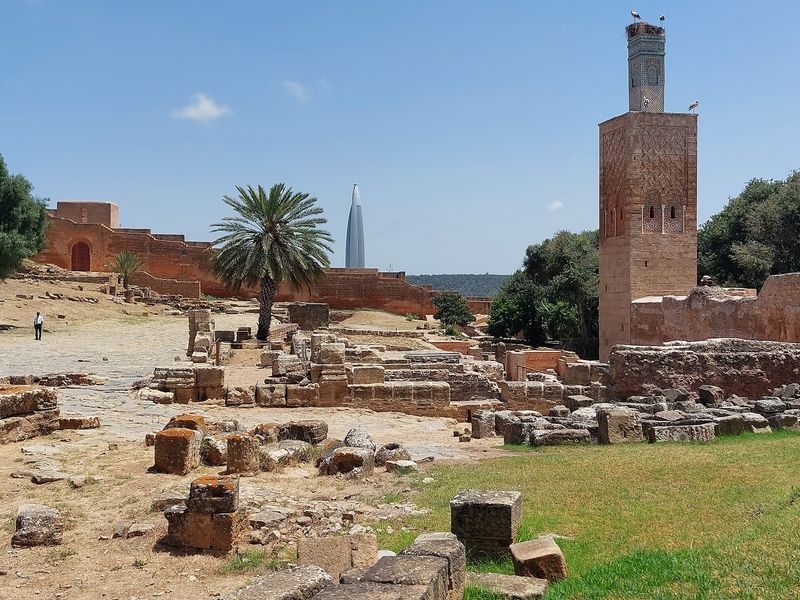
Two entirely different civilizations left their marks on the same walled site just outside Rabat’s city walls, and Chellah preserves both without trying to tidy up the overlap. The site began as Sala Colonia, a functioning Roman port city, before it was abandoned around 1154 CE.
In the 13th and 14th centuries, Marinid sultans chose the location for a royal necropolis, building a mosque, a zawiya, and tombs directly on top of the Roman foundations. The result is a layered archaeological landscape where a Roman Decumanus Maximus, forum, triumphal arch, and bath remnants coexist with a partially preserved Marinid minaret and carved stucco tomb structures.
The tombs of Marinid Sultan Abu al-Hasan Ali and his wife are among the most visited features of the necropolis section. Storks nest atop the ancient minaret and ruined walls each season, adding an unexpected natural element to the historical setting. Morocco’s national tourism office identifies Chellah as a Marinid-era historic necropolis and one of Rabat’s major heritage attractions.
12. Skala de la Ville, Essaouira, Morocco
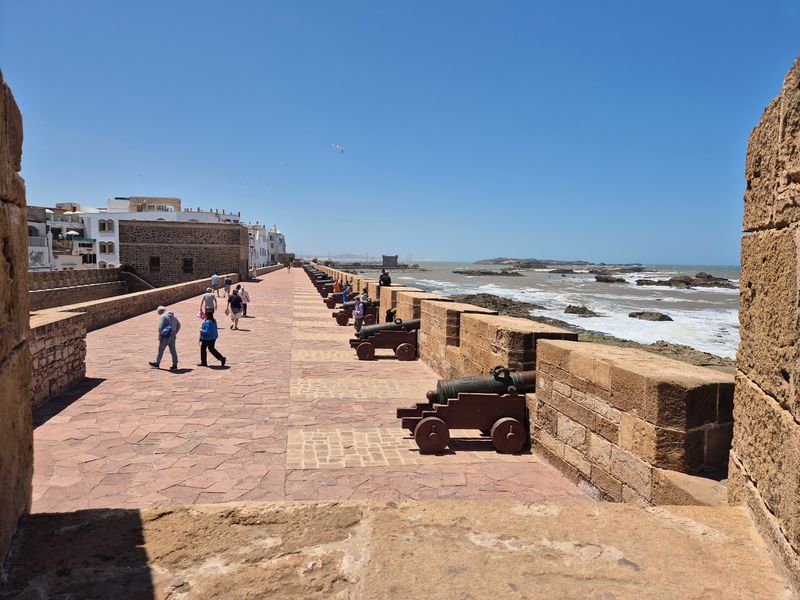
Essaouira has one of the most distinctive coastal identities in Morocco, and the Skala de la Ville is a large part of why. This 18th-century sea bastion stretches along the city’s western edge, built under the direction of French architect Theodore Cornut, who blended European military design with Moroccan defensive requirements.
Along the top of the ramparts, rows of historic brass cannons remain positioned as they were during the city’s active defensive years. Many bear Portuguese or Spanish coats of arms, marking their origins as captured or traded military equipment. The stone used throughout the fortifications has weathered centuries of Atlantic conditions without losing its structural integrity.
From the rampart walkway, the view stretches across the ocean toward the Ile de Mogador, a small island that served as a sanctuary and historical trading point. The whitewashed medina buildings with their characteristic blue accents are visible on the landward side. Essaouira’s entire medina, including these fortifications, holds UNESCO World Heritage status. The ramparts connect directly to the fishing port at one end, making the transition from historic site to working harbor entirely seamless.
13. Ait Ben Haddou, Aït Benhaddou, Ouarzazate Province, Morocco
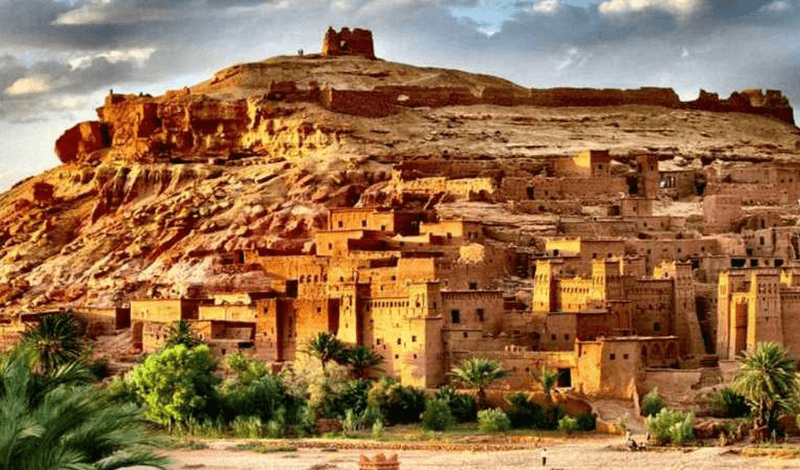
A cluster of earthen towers rising from a desert valley floor is not something most travelers forget quickly, and Ait Ben Haddou has been producing that reaction for centuries. UNESCO granted the ksar World Heritage status in 1987, describing it as a traditional pre-Saharan settlement enclosed by defensive walls with tightly packed houses and reinforced corner towers.
The construction material throughout is local clay and straw, shaped into adobe bricks and rammed earth walls that blend naturally into the surrounding landscape. The reddish-brown tones of the buildings shift noticeably depending on the time of day and the angle of light, though the overall silhouette remains consistently dramatic from any direction.
The ksar sits along the ancient trans-Saharan trade route connecting Marrakech to the Sahara, a position that explains both its historical importance and its layered architecture. Some residential structures within the walls are still inhabited, while others have been converted into small shops or guesthouses. Climbing toward the highest point of the settlement reveals panoramic views of the Ounila River valley and surrounding palm groves. The site has also served as a filming location for numerous international productions.
Share this story